


A Soldier’s Journey Home: How an Old Photograph Solved a 70-Year Mystery
The story of U.S. Army Sergeant Roger Duquesne is one that spans decades, continents, and the evolution of forensic science itself. At just 25 years old, this World War II veteran found himself fighting in another brutal conflict on the Korean Peninsula in 1950. On September 3rd of that year, while engaged in combat with North Korean forces near Masan—a city in what is now South Korea—Duquesne vanished while on a seemingly routine mission to locate a spare-parts kit for his unit, A Company of the 89th Medium Tank Battalion, 25th Infantry Division. His family would wait more than seven decades for answers about what happened to their loved one, and remarkably, it would be a simple photograph that would finally bring him home.
When Traditional Methods Failed
For years, the Defense POW/MIA Accounting Agency (DPAA) has employed cutting-edge forensic technology and meticulous historical research to identify the remains of fallen American soldiers. These modern techniques have successfully reunited hundreds of families with their lost loved ones, providing closure to families who have waited generations for answers. However, Sergeant Duquesne’s case proved to be exceptionally challenging, defying conventional identification methods at every turn. His remains, recovered near South Korea’s Naktong River in September 1950—the same month he went missing—had been buried as an unknown soldier at the National Memorial Cemetery of the Pacific in Honolulu, Hawaii, in 1956. The remains lay there for fifty-five years before being exhumed in October 2011 for reexamination, as advances in forensic science offered new hope for identification.
The investigation that followed was frustrating for DPAA scientists. Multiple examinations were conducted, but each avenue seemed to lead to a dead end. Attempts to extract DNA and match it to living relatives failed completely. Dental records, often a reliable source of identification, provided little help because there were few distinguishing features that could be compared with confidence. Many Korean War identification cases rely heavily on chest radiographs—X-rays that can reveal unique skeletal features—but no such records existed for these particular remains. The case seemed destined to remain unsolved, another name on the long list of unknowns from America’s forgotten war. That is, until forensic specialists decided to reach back into the history of their field and employ a technique that many considered somewhat outdated.
An Old Technique Gets New Life
When modern methods failed, DPAA investigators turned to a forensic approach known as craniofacial superimposition. This technique, which compares photographs of a missing person with images of an unidentified skull, has been around for decades but had fallen out of favor in some circles due to scientific limitations. The method has historically struggled with issues like photographic distortion, variations in camera angles, and the difficulty of precisely matching two-dimensional photographs with three-dimensional skulls. However, recent advances in video technology and digital imaging have breathed new life into this old technique, making it far more accurate than it once was. For Sergeant Duquesne’s case, it would prove to be exactly what was needed.
The DPAA enlisted the help of Carl Stephan, an associate professor at the University of Queensland who specializes in craniofacial identification methods. Stephan acknowledged that this technique “has always had some scientific hurdles,” but he also understood that when applied with careful scientific rigor and modern technology, it could provide answers that newer methods might miss. The key to success lay in finding the right photograph—one that provided enough detail and reference points to allow for accurate comparison. Fortunately, investigators had access to a photograph of Duquesne wearing his military dress hat. This seemingly minor detail would prove crucial, as the hat could serve as a reference object to determine the precise distance the camera would need to be from the skull to recreate the original photograph’s perspective.
The Painstaking Process of Matching
The work that followed was meticulous and demanding. Stephan explained that finding the correct camera distance required testing multiple positions: “You’ll find no match, no match, no match, then a sweet spot, and then no match again. That tells you how far the camera needs to be away from the reference object.” To assist in this process, investigators created replica hats to help determine the correct angle and distance. One replica proved to be an incorrect match and was discarded, while another helped them zero in on the precise positioning needed. This attention to detail, while time-consuming, was absolutely essential to ensuring the accuracy of the identification.
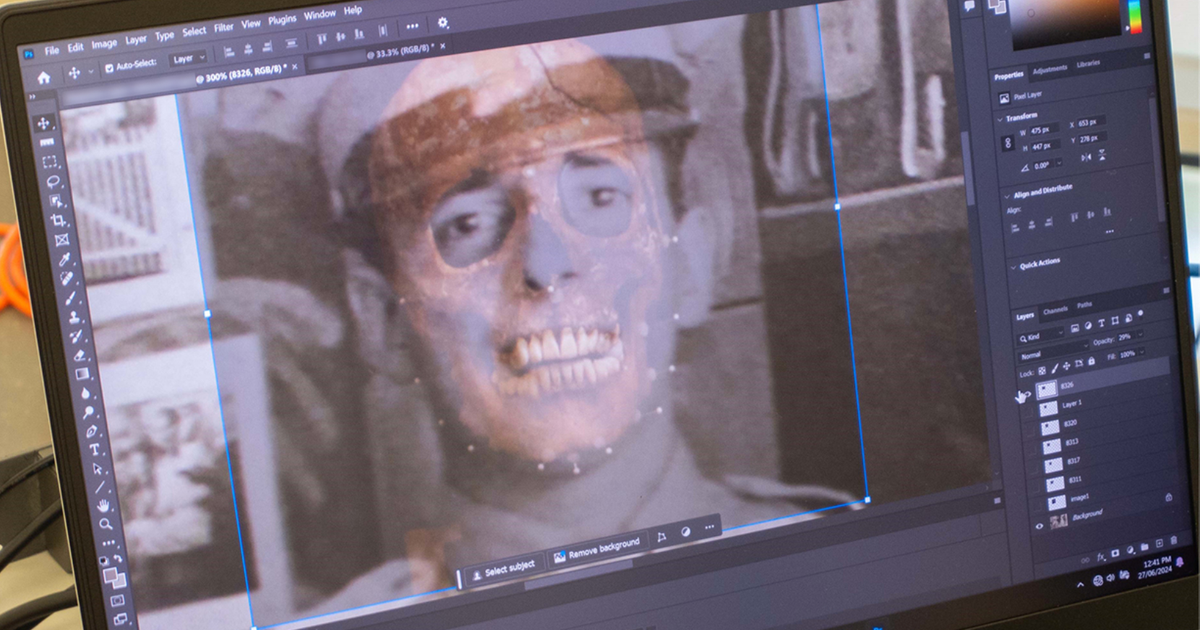
Once the camera’s distance had been confirmed with precision, DPAA investigators faced the delicate task of positioning the skull to match the exact pose of Duquesne’s face in the photograph. Every angle, every tilt, every slight adjustment mattered. When they finally achieved the correct positioning, they captured a photograph of Duquesne’s face overlaid on the skull and studied it carefully for what forensic scientists call “anatomical consistency”—essentially, whether the bones of the skull aligned properly with the features visible in the photograph. The results were encouraging, but the most compelling evidence came from an unexpected source: Duquesne’s smile.
In the photograph, Sergeant Duquesne is smiling broadly, displaying his upper teeth. One detail stood out to investigators—a prominent upper canine tooth that cast a distinctive shadow across the neighboring teeth. When the skull was positioned correctly to match the photograph, that same shadow appeared in exactly the same place. “That’s one of the decisive things that indicates this is a match,” Stephan explained. This seemingly small detail—the shadow cast by a single tooth—became the key piece of evidence that convinced investigators they had finally identified Sergeant Duquesne. However, responsible forensic science required more than just a visual match. DPAA investigators also combed through historical records and systematically excluded all other possible candidates who might have matched the remains, ensuring beyond reasonable doubt that these were indeed the remains of Roger Duquesne.
A Testament to Scientific Persistence
The successful identification of Sergeant Duquesne represents more than just the resolution of a single case—it demonstrates an important principle in forensic science: that older techniques should not necessarily be discarded simply because newer methods have been developed. As the DPAA noted, this case is “a clear example of how older forensic techniques can be refined rather than discarded, and how careful science, applied thoughtfully, can still bring clarity and answers to even the most difficult identifications decades after the fact.” This philosophy could have profound implications for the thousands of other unidentified remains from past conflicts.
The DPAA officially accounted for Duquesne’s remains in September of the previous year, but only revealed the detailed process that led to the identification this week, allowing the public to understand the remarkable scientific detective work involved. Prior to his identification, Sergeant Duquesne had been memorialized on the Courts of the Missing at the National Memorial Cemetery of the Pacific and on the Korean War Veterans Memorial Wall in Washington, D.C.—honored, but unknown. Now, his name can be spoken with the certainty that he has been found, and his sacrifice properly recognized.
The Ongoing Mission
Sergeant Duquesne’s story, while remarkable, is just one among thousands. The Korean War, sometimes called America’s “Forgotten War,” left deep scars and many unanswered questions. According to the DPAA, the remains of more than 450 Americans killed in the Korean War have been identified and returned to their families since 1982—a significant achievement that has brought comfort to countless families. However, this number also highlights the enormity of the task that remains: approximately 7,000 Americans are still unaccounted for from the conflict. Each one represents a family that has lived with uncertainty, a community that lost one of its own, and a nation’s obligation to leave no soldier behind.
The techniques used to identify Sergeant Duquesne—combining traditional methods with modern refinements—offer hope that more of these cases can be solved. As technology continues to advance and forensic scientists think creatively about how to apply both old and new techniques, more families may receive the closure that Duquesne’s family now has. The work is slow, painstaking, and often frustrating, but for the families who have waited decades for answers, each identification is precious beyond measure. Sergeant Roger Duquesne went missing in 1950 while looking for spare parts to help his unit. He was declared dead on December 31, 1953. But it took until 2024—more than 70 years later—for him to truly come home. His journey reminds us that for those who serve, the nation’s commitment to remember and recover them should know no expiration date.