


The Hinckley Hilton: How Layers of Security Stopped a Potential Mass Casualty Event
A Building Defined By Its History
For anyone who has ever worked in the Secret Service, the Washington Hilton isn’t just another hotel venue. Timothy Reboulet, a former Secret Service agent, explains that within the agency, it’s always referred to as the “Hinckley Hilton”—a name that carries the weight of one of America’s most infamous assassination attempts. On March 30, 1981, just outside the hotel’s entrance, John Hinckley Jr. fired shots at President Ronald Reagan, wounding not only the commander in chief but also Secret Service agent Tim McCarthy, D.C. police officer Thomas Delahanty, and White House press secretary James Brady. That day forever changed how the Secret Service views this particular building. It’s no longer seen as just a ballroom or event space—it’s a complex security challenge, a system of doors, choke points, stairwells, loading docks, and motorcade routes that agents must know inside and out.
Reboulet knows the Washington Hilton the way all agents who’ve worked there know it: intimately and strategically. He can rattle off details about its 46 breakout rooms, the million-square-foot sprawl, 1,107 guest rooms, and every specification of “the bunker”—a hidden, hardened garage that was added after the Reagan assassination attempt. This secure arrival point allows presidential motorcades to pull directly into the building without any outdoor exposure. The hotel is divided into what agents call “clean” spaces—completely secure areas where everyone has passed through metal detectors—and “dirty” spaces, where people and their possessions haven’t been screened. This bright red line between secure and unsecured areas is defined by federal statute, specifically 18 USC 1752. Reboulet has walked these hallways hundreds of times, having covered security at the White House Correspondents’ Association Dinner under both George W. Bush and Barack Obama, back when attending the annual event was a regular fixture on the presidential calendar.
What Really Happened on Saturday Night
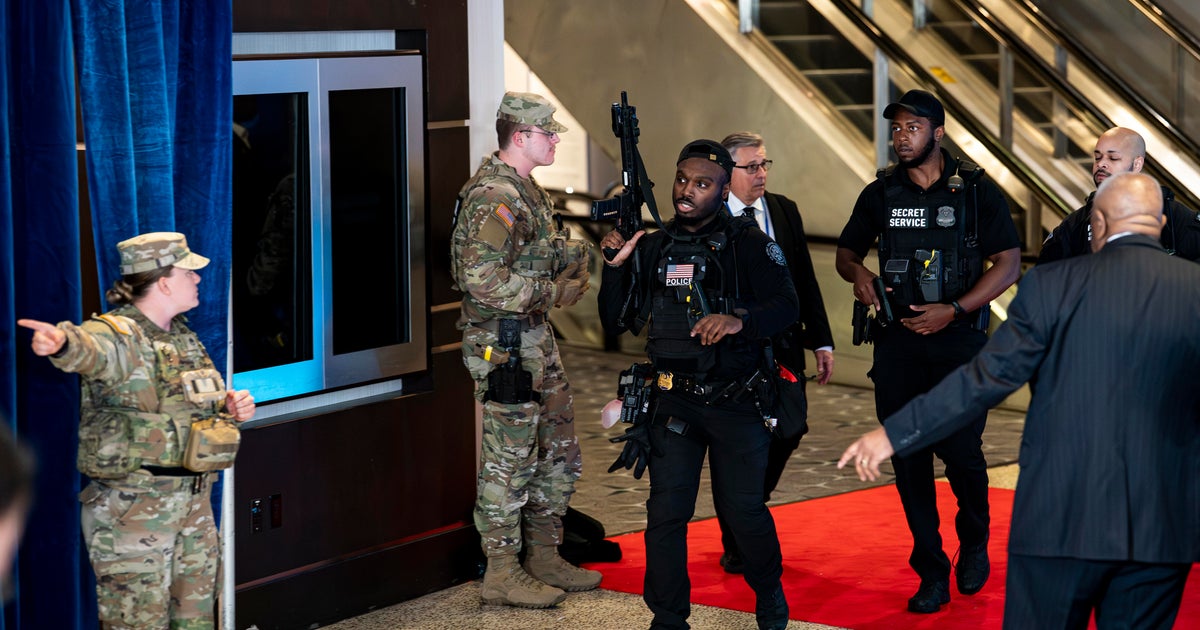
After the events of Saturday night, Reboulet and other former Secret Service agents are clear about what happened: the security system worked exactly as designed. “Everybody did their job,” Reboulet states matter-of-factly. “This was textbook. The layered approach worked.” According to senior law enforcement officials who reviewed surveillance footage, the suspect didn’t slip unnoticed through the crowded lobby or pre-dinner parties. Instead, cameras captured him leaving a 10th-floor hotel room dressed in black, carrying a shotgun, handgun, and knives concealed in a black bag. Rather than attempting to move through heavily monitored public areas, he entered an interior stairwell and ran down approximately 10 floors. The alleged gunman then sprinted about 45 yards before Secret Service Uniformed Division officers tackled him one story above the ballroom where the dinner was taking place.
The timing of this interception is crucial to understanding why security experts consider this a success. Just after 8:30 p.m., the event had already begun. The color guard had exited the ballroom, and the salad course was underway. Metal detectors that had been screening incoming guests were already being dismantled and packed away since no new attendees were being allowed into the ballroom. The security perimeter around the event itself remained completely intact, but officers were in the process of breaking down equipment when they spotted the blur of a man sprinting through the concourse. They immediately confronted and tackled him, stripped away his outer clothing to check for additional weapons or a suicide vest, and secured his bag. The critical point that former agents emphasize is this: the suspect never made it to the ballroom. He was carried out in handcuffs, neutralized before he could reach his apparent target. For Reboulet, this sequence represents the security system functioning precisely as intended. “You create these layers,” he explains. “Outside, middle and inner. And they worked.”
Why The Washington Hilton Is One of America’s Hardest Venues to Secure
The Washington Hilton has always presented unique challenges for the Secret Service, ranking alongside venues like the Kennedy Center Honors as one of the most difficult places in America to protect a president. The challenge isn’t unfamiliarity—agents know this building exceptionally well—but rather the constant activity and complexity of a functioning hotel. “It literally almost takes up a full city square block,” Reboulet notes. “There’s a whole ecosystem with a hotel.” That ecosystem creates inherent security obstacles: hotel guests checking in and out, constant deliveries arriving, workers moving throughout the building at all hours. Waitstaff must be individually vetted, background checked, and given special access pins. Hundreds of people with absolutely no connection to the presidential event mill around the lobby bar, restaurants, and upper floors at any given time. This is why the Secret Service must draw clear lines defining where the secure site begins and ends. “Otherwise, it’s infinity,” Reboulet explains.
Inside those defined lines, space is tightly controlled. Outside them, it remains public, and that distinction is mandated by law. This legal reality explains why one part of the Hilton can feel chaotic and open while another section is completely locked down. It’s why the lobby remains “dirty” (unsecured) while the ballroom is “clean” (secured), and it’s precisely why the president never walks through the front door or even the side entrance of the hotel. Instead, presidents use the bunker—that hardened, fully enclosed arrival garage added after the 1981 shooting that allows motorcades to pull directly inside the building without any outdoor exposure whatsoever. “As a site agent, I wish every site had a bunker,” Reboulet admits, recognizing how this single architectural feature dramatically reduces risk. The challenge is multiplied by the fact that the White House Correspondents’ Dinner brings together an unprecedented concentration of high-value targets in one place: the president, vice president, the entire Cabinet, members of Congress, senators, and hundreds of other officials, all attended by more than a dozen different security agencies.
How Multiple Agencies Coordinated Under Pressure
While the Secret Service serves as the security lead for events involving the president, the Correspondents’ Dinner creates a complex puzzle of overlapping protective details. Agencies represented on Saturday night included U.S. Customs and Border Protection, D.C. Metropolitan Police, U.S. Marshals, FBI, U.S. Capitol Police, Health and Human Services Office of the Inspector General, ATF, Diplomatic Security Service, Army Criminal Investigation Division, Homeland Security Investigations, U.S. Park Police, and private security contractors. “You’ve got the president, the vice president, the entire Cabinet, members of Congress, senators,” Reboulet notes. “It becomes quite the nightmare” to coordinate. Each dignitary often brings their own security detail, identifiable only by different pins on their lapels, creating a potential recipe for confusion and miscommunication in high-stress situations.
Yet on Saturday night, this patchwork of agents, officers, and security personnel from more than a dozen agencies moved in remarkable coordination to evacuate guests and neutralize the suspect. What particularly impressed Reboulet was the restraint shown by armed personnel in a chaotic situation. In law enforcement, there’s a specific term for this kind of discipline: “muzzle discipline”—meaning not pointing weapons at each other even in the confusion of a rapidly evolving threat. One uniformed officer took buckshot to his bulletproof vest and still managed to draw his weapon and respond appropriately. “Fight, flight or freeze,” Reboulet reflects. “None of them froze. None of them ran. Everybody fought.” This level of coordination and professional response across multiple agencies, each with different training protocols and command structures, represents precisely the kind of outcome that countless hours of joint exercises and planning are designed to achieve.
Questioning the Narrative of Failure
Despite the successful interception of the suspect before he reached his target, questions have emerged about whether he should have been detected and stopped even sooner, particularly regarding access to the interior stairwell. Former Secret Service Deputy Director A.T. Smith points to a fundamental tension inherent in protecting leaders in democratic societies: the venue was a hotel open to the public. Completely locking down every floor and stairwell is technically possible, Smith acknowledges, “but we don’t normally do that in the United States.” Instead, the Secret Service secures what’s called the event footprint, creating a protective corral around the ballroom and its immediate approaches while the rest of the hotel continues operating as a public accommodation.
For Paul Eckloff, a former senior leader on the presidential protective detail, the critical reaction to Saturday night fundamentally misses the point and ignores the history of this very location. “I mean, everybody is always on alert at the Hinckley Hilton anyway,” he notes, “if you consider that in 1981 the president and the White House spokesman were shot—James Brady never fully recovered from that shot to the head—Officer Delahanty was shot, Agent McCarthy was shot, and the president was shot.” Four people were struck by bullets from a gunman who got within feet of the president. “And that was considered a success,” Eckloff says with notable irony. “Twenty feet from the President, four people were shot—and the Secret Service was praised as heroes.” He pauses to let that sink in. “Nobody got hurt at this,” he says of Saturday night’s incident. “And they’re calling it a failure.” Eckloff sees the situation entirely differently: “This is a mass casualty event that was prevented. Dozens of people should be shot—but everybody walked away.”
The Broader Questions About Presidential Security and Public Access
Mike Matranga, another former Secret Service agent who served on the presidential protective division’s counter-assault team under President Obama, shares this assessment of Saturday’s events as a success. “I truly believe that the concentric rings of the Secret Service methodology worked,” he says. The suspect attempted to outrun those protective circles and failed. “You’ve got an individual running at full speed toward a checkpoint,” Matranga explains. “They had seconds” to assess and respond, which they did effectively. However, Matranga also recognizes the inherent limitations of the current approach: “You cannot secure the entire hotel. When you’ve got a quasi-public event in a public place, these are the risks.” This raises a larger question that security professionals are now debating: if the Correspondents’ Dinner continues as an annual tradition, should it remain at the Washington Hilton at all? “I would not have this at a hotel,” Matranga admits, before adding the sobering reality: “But we can’t put the president in a bubble.”
Eckloff frames this dilemma even more fundamentally: “If the president can’t go to a public event, what are we defending anymore?” The suspect used the building itself—its massive size, its network of stairwells, its inherent complexity—to get closer than anyone would like. But critically, not close enough. He never reached the ballroom or came within sight of the president. “This cannot be compared to Butler,” Eckloff emphasizes, referring to the first assassination attempt against President Trump during a 2024 campaign rally in Butler, Pennsylvania. In that incident, a gunman climbed to an elevated firing position with a clear line of sight to the then-former president and managed to fire eight shots before being neutralized. One round grazed Trump’s ear, one attendee named Corey Comperatore was killed, and two others were injured. On Saturday night at the Washington Hilton, former agents argue, there was something operating that proved harder to see and easier to misunderstand: a decent, workable security system not designed to eliminate every conceivable threat in advance, but rather to stop any threat from reaching the president of the United States and his constitutional line of succession. By that fundamental measure—the one that actually matters—the system worked exactly as designed.