


NASA’s Space Launch System Rocket Passes Critical Fueling Test Ahead of Historic Moon Mission
Successful Wet Dress Rehearsal Marks Major Milestone
NASA achieved a significant breakthrough Thursday as engineers successfully loaded more than 750,000 gallons of supercold rocket propellants into the massive Space Launch System (SLS) rocket without encountering the troublesome hydrogen leaks that had plagued earlier attempts. This critical test brings the space agency one step closer to launching four astronauts on humanity’s first crewed mission to the moon in over half a century, potentially as early as March 6. The practice countdown, which began Tuesday night, represented a meticulously planned sequence of operations designed to simulate an actual launch scenario and verify that the world’s most powerful operational rocket is ready for its historic journey.
The fueling process commenced at 9:35 a.m. Thursday when Launch Director Charlie Blackwell-Thompson gave the green light to begin pumping enormous quantities of cryogenic propellants into the rocket. The SLS first stage received 196,000 gallons of liquid oxygen and 537,000 gallons of liquid hydrogen, while the second stage was loaded with an additional 22,500 gallons of these supercold fuels. What made this test particularly encouraging was the absence of significant hydrogen leaks—a stark contrast to the rocket’s first fueling attempt earlier in the month, which had to be abandoned due to dangerous gas buildups. As propellants were continuously topped off to compensate for normal boil-off throughout the rehearsal, the team worked toward a final milestone: pressurizing the propellant tanks in the countdown’s final ten minutes, exactly as they would during an actual launch sequence.
The Artemis II Crew Prepares for Launch
The positive results from this wet dress rehearsal have put NASA on track to potentially clear the Artemis II mission for launch, carrying commander Reid Wiseman, pilot Victor Glover, mission specialist Christina Koch, and Canadian Space Agency astronaut Jeremy Hansen on an unprecedented voyage around the moon. So confident is NASA in the progress that the crew planned to enter their mandatory pre-flight medical quarantine on Friday, isolating themselves from potential illness in the critical weeks before launch. This will be the first time humans have traveled to the moon since the final Apollo mission touched down in 1972, and these four astronauts will venture farther from Earth than any human beings in history.
For Wiseman and his crewmates, this mission represents multiple historic firsts. They will be the first people to ride into space atop the towering 322-foot Space Launch System rocket, which will be making only its second flight after a successful uncrewed test flight in 2022. They will also be the first astronauts to fly aboard the Orion deep space crew capsule, a state-of-the-art spacecraft designed specifically for missions beyond low Earth orbit. Beyond the individual accomplishments, the Artemis II mission serves as a crucial stepping stone toward the even more ambitious Artemis III mission, currently scheduled for 2028, which aims to land astronauts near the moon’s south pole—a region that has never been explored by humans and may contain valuable water ice in permanently shadowed craters.
Overcoming Technical Challenges
The road to this successful test has been anything but smooth. NASA had originally planned to launch Artemis II early this month, but those plans were derailed when engineers encountered serious problems during an initial dress rehearsal countdown. The issues centered on hydrogen leaks detected near the base of the massive rocket, specifically in a cavity between umbilical plates where fuel lines connect to the SLS first stage. Sensors in this critical area began registering dangerous buildups of hydrogen gas when engineers increased flow rates following an initial “slow fill” period designed to gradually cool the rocket’s internal systems.
Hydrogen is an extremely volatile fuel, and even small leaks can pose catastrophic fire and explosion risks, making these detections a serious safety concern. Through careful troubleshooting, engineers managed to continue that first test by carefully varying flow rates and temperatures, keeping leak rates within acceptable limits long enough to fill both the first and second stage propellant tanks. However, late in that initial countdown, when the team attempted to pressurize the first stage tanks as they would for an actual launch, the leak rate suddenly spiked dramatically. Hydrogen concentrations in the nitrogen gas flowing through the umbilical cavity climbed dangerously close to 16%—the threshold beyond which the risk of fire becomes unacceptably high. At that point, NASA had no choice but to call off the dress rehearsal before completing all planned countdown procedures.
Engineering Solutions and Verification Testing
After that setback, NASA’s engineering teams carefully analyzed all the test data to identify the root cause of the leaks. Their investigation pointed to two seals in the umbilical connection system that appeared to be responsible for allowing hydrogen to escape. The decision was made to replace these suspect seals and conduct additional testing to verify the fix. Last Thursday, engineers performed what NASA termed a “mini” tanking test, pumping a smaller quantity of liquid hydrogen into the core stage specifically to confirm that the new seals had resolved the leak problem.
While this verification test did provide valuable data showing that the leak issue had been addressed, it wasn’t entirely problem-free. A filter in the ground support equipment apparently froze during the operation, reducing propellant flow rates below optimal levels. Despite this complication, NASA determined in a blog post that “the test provided enough data to allow engineers to plan toward a second wet dress rehearsal this week.” The agency didn’t elaborate on exactly what data proved most valuable or what specific criteria were met to justify proceeding with the full-scale dress rehearsal that took place Thursday. However, the decision to move forward proved sound, as the complete fueling test proceeded without the hydrogen leaks that had plagued earlier attempts.
The Power and Complexity of the SLS Rocket
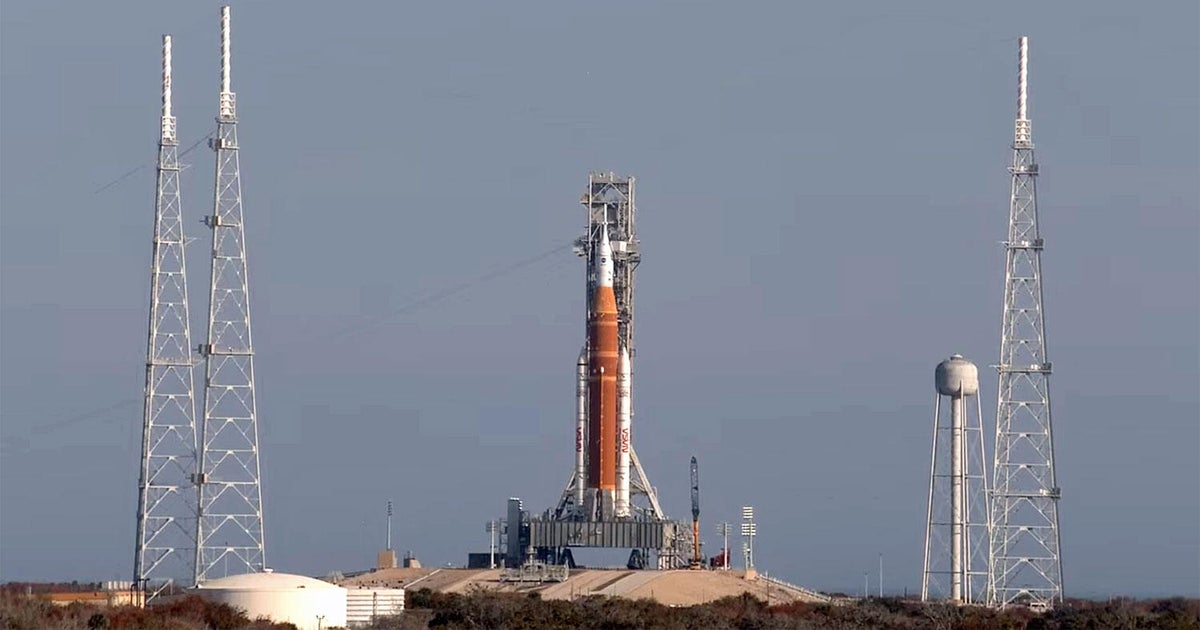
The Space Launch System represents the culmination of years of development and billions of dollars in investment, designed to give NASA the capability to send large payloads and crews beyond low Earth orbit for the first time since the Apollo era. At the business end of this behemoth sit four upgraded RS-25 engines—advanced versions of the main engines that powered the Space Shuttle for three decades—flanked by two massive solid rocket boosters that are themselves enhanced versions of shuttle-era hardware. Together, these propulsion systems will generate a staggering 8.8 million pounds of thrust at liftoff, making the SLS the most powerful operational rocket currently flying, exceeding even SpaceX’s Falcon Heavy.
The complexity of this system is evident in the intricate infrastructure required to fuel and launch it. Grey tail service masts—two of them positioned at the rocket’s base—feed multiple propellant lines carrying supercold liquid oxygen and hydrogen, along with nitrogen gas for purging, electrical cables for power and control, and data lines for telemetry and communications. During fueling operations, spectacular venting of gaseous hydrogen can be seen as the cryogenic fuel inevitably warms and boils off, requiring constant replenishment to keep the tanks topped off. The sight of this venting, which flares visibly in photographs as it’s burned off for safety, is reminiscent of the Apollo and Space Shuttle eras, connecting this new generation of lunar exploration to NASA’s storied past while pushing the boundaries of what’s technically possible in the present.