



A Groundbreaking Discovery: Scientists May Have Found an Entirely New Type of Planet
The universe continues to surprise us with its endless mysteries and phenomena. In what could be one of the most significant astronomical discoveries in recent years, scientists believe they may have identified a completely new category of planet existing beyond our solar system. This fascinating world, designated L 98-59 d, challenges everything astronomers thought they knew about how planets form and what they’re made of. While the exoplanet was initially spotted back in 2019, it’s only through recent detailed observations using some of humanity’s most advanced telescopes that researchers have begun to understand just how extraordinary this distant world truly is. What they’ve found is nothing short of remarkable: a planet unlike any other we’ve encountered before, featuring characteristics that don’t fit into any of our existing planetary classification systems.
A World of Molten Rock and Toxic Skies
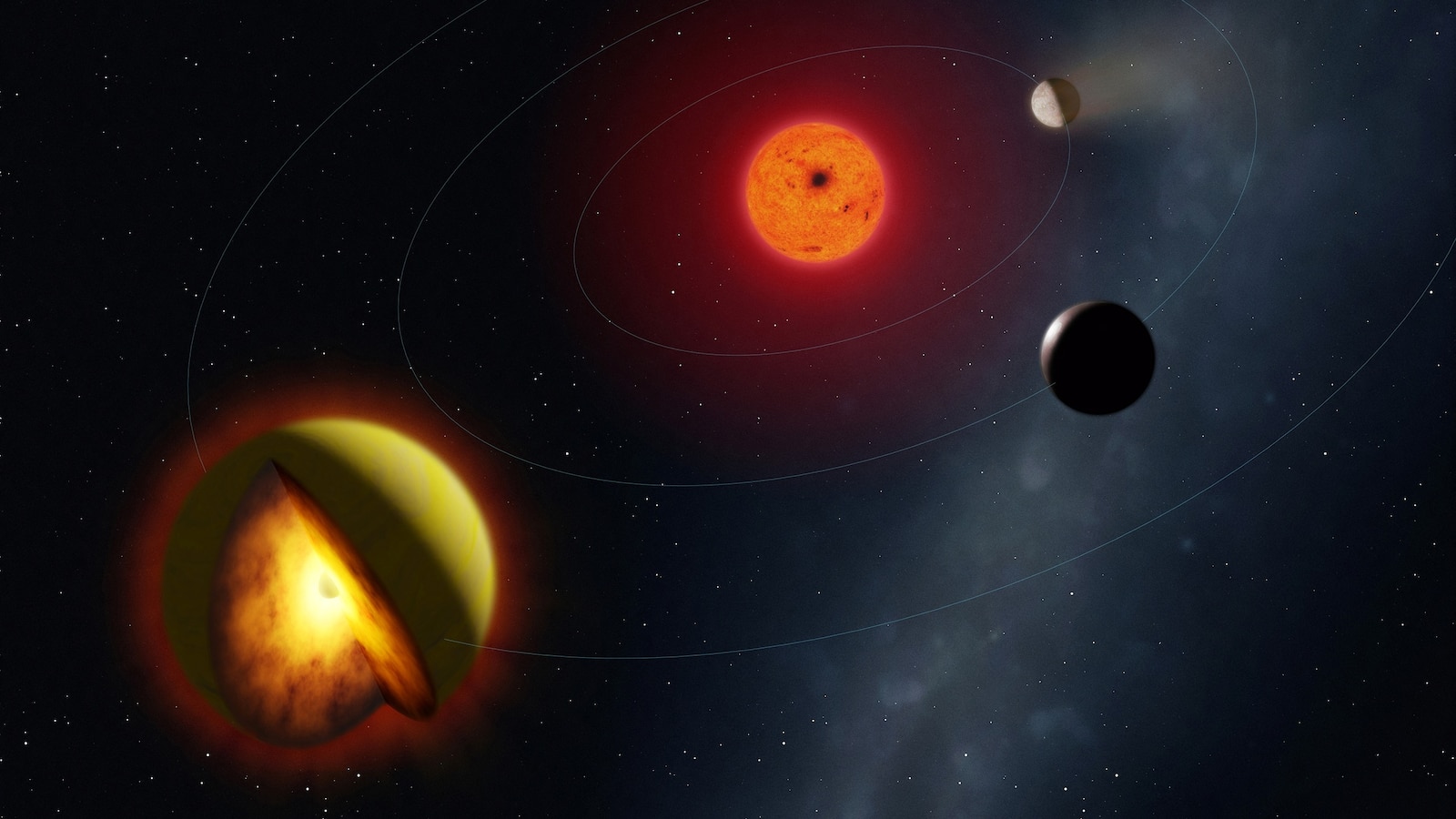
Imagine a world where the oceans aren’t made of water but of molten, churning magma, and where the air you’d breathe—if you could survive there at all—would be thick with sulfur compounds. That’s the hellish reality of L 98-59 d, according to research published Monday in the prestigious journal Nature Astronomy. This rocky planet is slightly larger than Earth, with a radius approximately 1.63 times greater and a mass about 1.64 times heavier than our home planet, as confirmed by NASA data. Located roughly 35 light years away from Earth—a cosmic stone’s throw in astronomical terms—this exoplanet orbits a red dwarf star alongside at least two sibling planets. The planet’s atmosphere is a toxic cocktail of gases including water vapor, sulfur dioxide, and hydrogen sulfide, the latter being the compound responsible for the notorious smell of rotten eggs. It’s the kind of place that would make even the most extreme environments on Earth seem pleasant by comparison, and it’s certainly not somewhere you’d want to plan a vacation.
Breaking the Mold: A Planet That Shouldn’t Exist
What makes L 98-59 d truly fascinating to astronomers isn’t just its extreme conditions, but the fact that it doesn’t conform to any of the established theories about how planets of its size should form and develop. Until now, scientists had two main scenarios to explain the formation of planets similar in size to Earth. The first is the “gas-dwarf scenario,” where planets develop rocky cores that then capture and accumulate a small percentage of hydrogen and helium gas from the surrounding nebula during their formation period. The second is the “water-world scenario,” in which planets contain substantial amounts of water, either in liquid or frozen form, incorporated into their structure. L 98-59 d fits neither of these models. Instead, its mantle appears to be composed primarily of molten silicate rock—essentially liquid stone—and its atmospheric composition suggests it contained significant amounts of sulfur and hydrogen early in its development. Over time, this unusual combination evolved into what researchers describe as a “volatile-rich atmosphere,” creating a planetary environment that’s completely unprecedented in our understanding of planetary science.
The James Webb Telescope: Humanity’s Window to Distant Worlds
The discovery and detailed characterization of L 98-59 d wouldn’t have been possible without the remarkable capabilities of the James Webb Space Telescope, arguably humanity’s most impressive achievement in observational astronomy. Since its launch and deployment in 2021, this technological marvel has been orbiting the sun at a point known as Lagrange Point 2, approximately one million miles from Earth, providing astronomers with an unprecedented view of the cosmos. The James Webb Telescope represents the pinnacle of space telescope technology, equipped with infrared sensors and mirrors so precise they can detect the faint light from distant galaxies and analyze the atmospheric composition of planets orbiting other stars. Its powerful instruments can pick up wavelengths of light that are invisible to human eyes and previous telescopes, allowing scientists to peer through cosmic dust and observe phenomena that were previously hidden from view. Since beginning its scientific operations, the telescope has delivered a steady stream of stunning discoveries, including numerous exoplanets that earlier telescopes simply couldn’t detect. The identification and analysis of L 98-59 d is just the latest in what promises to be a long line of groundbreaking findings that will reshape our understanding of the universe.
What This Discovery Means for Planetary Science
The identification of L 98-59 d as a potentially new category of planet has significant implications for our understanding of planetary formation and evolution. For decades, astronomers have worked to classify and understand the diverse worlds orbiting other stars, developing models and theories based on the planets in our own solar system and the exoplanets discovered so far. Each new discovery helps refine these models, but occasionally, scientists encounter something so unusual that it requires them to reconsider fundamental assumptions. L 98-59 d appears to be one of those game-changing discoveries. The planet’s unique combination of a molten silicate mantle and sulfur-rich atmosphere suggests formation and evolutionary processes that haven’t been previously documented or predicted. This could mean that planet formation is even more diverse and complex than we currently understand, with multiple pathways leading to different types of worlds. The existence of such a planet raises intriguing questions: How common are these magma ocean worlds? Could they represent a stage that other planets pass through during their development? Or are they a dead-end in planetary evolution, worlds that form under specific circumstances but never evolve into more hospitable environments?
The Search Continues: Implications for Life and Future Exploration
While L 98-59 d itself is almost certainly inhospitable to life as we know it—with its magma oceans, sulfurous atmosphere, and extreme temperatures—its discovery is actually encouraging for the broader search for extraterrestrial life. The identification of a new type of planet demonstrates that our universe is far more diverse than we previously imagined, which statistically increases the likelihood that somewhere among the trillions of planets in our galaxy, conditions suitable for life exist. Each discovery of an unusual planet helps astronomers refine their understanding of planetary systems and improves their ability to identify truly Earth-like worlds that might harbor life. Furthermore, the techniques and technologies used to characterize L 98-59 d—particularly the spectroscopic analysis of its atmosphere—are the same methods that will eventually be used to detect biosignatures on potentially habitable planets. As our telescopes become more powerful and our analytical methods more sophisticated, we’re developing the tools needed to not just find Earth-like planets, but to actually determine whether they host life. The discovery of L 98-59 d, strange and inhospitable as it is, represents another step forward in humanity’s quest to understand our place in the cosmos and to answer the age-old question: are we alone in the universe? As we continue to explore the vast expanse of space with instruments like the James Webb Telescope, we can expect many more surprises and revelations that will challenge our understanding and inspire wonder at the incredible diversity of worlds that exist beyond our own.