
The Tragic Shooting of Ruben Ray Martinez: When Body Camera Footage Contradicts the Official Story
A Mother’s Quest for Truth After Her Son’s Death
Rachel Reyes never imagined she would be fighting for answers about her son’s death nearly a year after losing him. In March 2025, her 23-year-old son, Ruben Ray Martinez, was fatally shot by an Immigration and Customs Enforcement (ICE) agent on South Padre Island, Texas, during what should have been a birthday celebration with friends. For almost eleven months, ICE remained silent about the incident, not confirming that one of their agents had killed Martinez until February of the following year. When the agency finally released information, their version of events painted Martinez as a dangerous individual who “accelerated forward” and “intentionally ran over” an agent, leaving the federal officer no choice but to fire “defensive shots.” However, newly obtained body camera footage tells a dramatically different story—one that has left a grieving mother demanding transparency and reform while struggling to find closure in a case that raises serious questions about the use of deadly force and accountability in federal law enforcement.
What the Body Camera Reveals
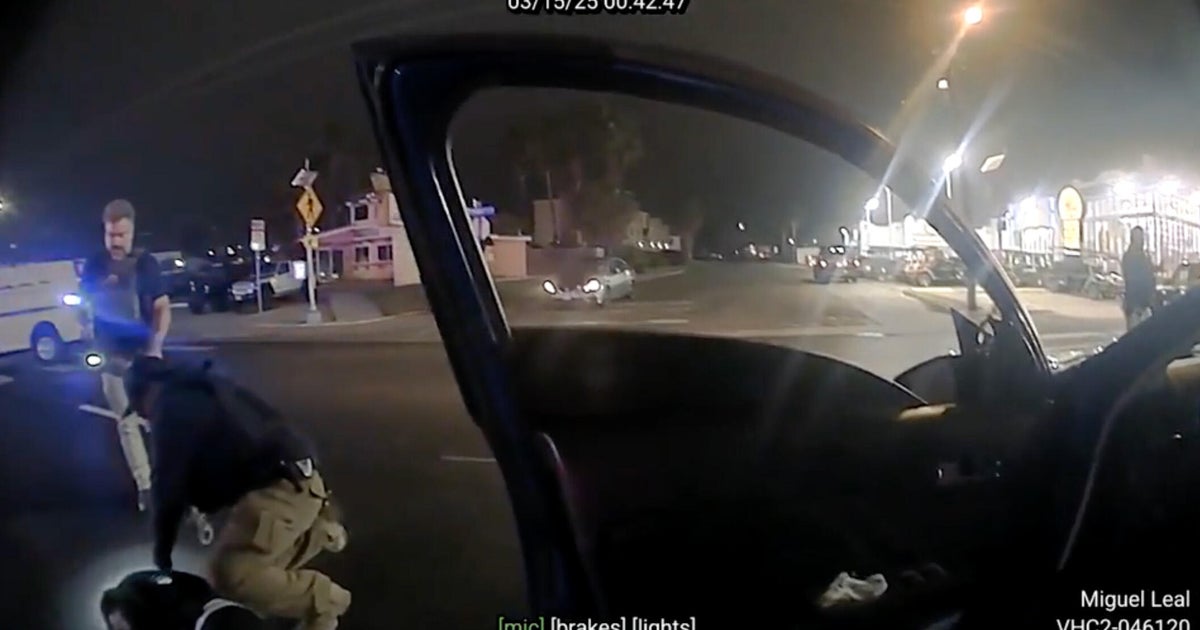
The body camera video, obtained by CBS News and worn by a South Padre Island police officer, provides a stark contrast to the narrative presented by the Department of Homeland Security and ICE. The footage shows that Martinez’s blue Ford Fusion was either stationary or moving at an extremely low speed when shots were fired. Most tellingly, the brake lights of Martinez’s vehicle were illuminated at the moment gunshots rang out—a detail that directly contradicts claims that he was accelerating toward officers. The video captures Martinez’s car approaching an area with heavy law enforcement presence following a traffic accident, where ICE agents were reportedly assisting local police with traffic control. As the vehicle slowly approaches, officers can be heard yelling commands, with some shouting “stop him” and “get him out.” Within moments, three gunshots are heard, and though the camera angle shows the rear of the vehicle during the shooting, the car appears to be barely moving, if moving at all. After being shot three times, Martinez is pulled from his vehicle by an ICE agent, thrown face-down on the ground, and handcuffed. Perhaps most disturbing is what the video doesn’t show: officers providing immediate medical care. Emergency responders are only seen checking Martinez for exit wounds and rendering aid about two minutes after he was shot, and only after he had been restrained and handcuffed while lying wounded on the pavement.
A Friend’s Final Testimony
Joshua Orta, Martinez’s best friend who was a passenger in the vehicle that night, provided crucial testimony that further challenges the official account—testimony that became all the more poignant when Orta himself died in a separate car crash before he could sign his formal declaration. In a draft statement and in a video-recorded interview with Texas Rangers, Orta described a young man who was nervous and panicked, not violent or threatening. According to Orta, he and Martinez had spent the evening celebrating Martinez’s birthday, eating at Whataburger and heading to a friend’s condo when they encountered the heavy police presence. When officers ordered Martinez to stop, Orta said his friend became “jittery” and “panicked.” Martinez did press the gas pedal “out of reaction,” Orta acknowledged, but emphasized “he didn’t floor it, it was barely moving.” The car moved slightly as Martinez turned the wheel, and while an officer may have gotten “on the hood a little bit” after potentially getting his feet caught, Orta maintained that Martinez never actually hit anyone. Orta speculated that his friend’s panic might have stemmed from an open container in the car or fear of being cited for driving while intoxicated—concerns of a young man worried about getting in trouble, not someone intent on harming law enforcement. “He definitely didn’t want to go to jail,” Orta told investigators, “but as far as running over an officer and endangering, he wouldn’t do that.”
The Legal Aftermath and Official Responses
Despite the questions raised by witness testimony and video evidence, the legal system has so far declined to hold anyone accountable for Martinez’s death. The Texas Department of Public Safety conducted an investigation into the shooting, but a grand jury declined to return criminal indictments in the case. The decision came last month, nearly a year after the incident, and around the same time that dozens of records related to the investigation were finally released. The family’s attorneys, Charles M. Stam and Alex Stamm, have been vocal in their criticism of the official narrative, stating that the videos “confirm that Ruben’s car was barely moving when he was shot. That he was braking, not accelerating. That nobody was on the hood of his car. That nobody was in front of his car when he was shot. That he was shot at point-blank range through his side window by an ICE agent who was in no danger.” They also emphasized that Martinez posed no threat, noting that according to Orta’s statement, Martinez’s last words after being shot were “I’m sorry, sir.” The body camera footage also captured a preliminary briefing given to the South Padre Island police chief about half an hour after the shooting, in which an officer claimed Martinez “stepped on it” and was “on top of the other agents in front” before being shot—a version of events that doesn’t fully align with what the video appears to show.
A Mother’s Measured Call for Reform
In her first television interview since losing her son, Rachel Reyes demonstrated a remarkable combination of grief, determination, and nuanced political perspective. Despite voting for President Trump in 2024, she isn’t afraid to call for accountability and reform within federal agencies. “I don’t blame President Trump for the death of my son, ’cause he wasn’t the one who pulled the trigger,” Reyes said, carefully separating her political preferences from her demand for justice. “But I do think that something needs to be changed in that department as far as the pattern of violence or abuse and impunity.” Her struggle for closure has been compounded by the nearly year-long delay in receiving any information, videos, or reports about what happened to her son on that March night. Reyes is calling on investigators to be transparent and for federal officials to reform how immigration agents conduct their duties—a plea that resonates beyond this single case to broader questions about oversight and accountability in federal law enforcement operations. Her pain is palpable, but so is her resolve to ensure that her son’s death might lead to meaningful change that could prevent other families from experiencing similar tragedies.
The Broader Implications and Unanswered Questions
The case of Ruben Ray Martinez raises troubling questions that extend far beyond the specifics of one tragic night in South Padre Island. Why did ICE wait nearly eleven months to confirm that one of their agents had killed an American citizen? How can federal agencies justify characterizing a shooting as “defensive” when video evidence appears to show the victim’s vehicle was stationary or barely moving with brake lights illuminated? What training and protocols govern the use of deadly force by ICE agents conducting traffic control operations? And perhaps most importantly, what accountability mechanisms exist when federal officers use lethal force in situations that may not have warranted it? The toxicology report showing alcohol and marijuana in Martinez’s system has been mentioned in official accounts, but as the family’s attorney noted, Martinez “was never stopped on suspicion of public intoxication or driving under the influence or anything of that nature.” The presence of substances in his system, while relevant to understanding his state of mind, doesn’t justify the use of deadly force against someone who appeared to be braking and whose last words were an apology. The fact that Martinez was shot at point-blank range through his side window, then pulled from his vehicle, thrown to the ground, and handcuffed before receiving medical attention raises additional questions about whether officers viewed him as a human being in need of help or as a threat to be neutralized and secured. As this case continues to unfold in the court of public opinion, it serves as a painful reminder of the importance of transparency, accountability, and the critical role that body camera footage can play in either confirming or contradicting official narratives about the use of force by law enforcement at all levels of government.