


Justice After Four Decades: How DNA Technology Finally Solved a Cold Case Murder
A Young Life Tragically Cut Short
On a spring Sunday in 1982, thirteen-year-old Sarah Geer left her friend’s house in Cloverdale, California, to take what should have been a simple walk downtown. It was May 23rd, and the young teenager had her whole life ahead of her. Tragically, she would never make it to her destination. According to prosecutors, Sarah was attacked by James Oliver Unick near an alley during her walk. The details of what followed are heartbreaking: she was forcibly dragged into a secluded area behind an apartment building, hidden from view by a fence. There, she was sexually assaulted and strangled to death with her own shorts. The next morning, a local fireman walking home after completing his shift discovered Sarah’s body. The discovery sent shockwaves through the small community of Cloverdale, leaving residents horrified and grieving for a young girl whose life had been so violently stolen. For Sarah’s family and friends, that day in May 1982 marked the beginning of decades of anguish, waiting for answers that seemed like they might never come.
The Long Wait for Justice
The Cloverdale Police Department immediately launched an investigation into Sarah’s murder, but they faced significant obstacles. As the Sonoma County District Attorney’s Office would later acknowledge, the investigation was “limited by the forensic science of the day.” In 1982, DNA profiling was still in its infancy and not yet available as a tool for criminal investigations. Detectives worked with what they had, but without the advanced technology that would later become standard in law enforcement, the case eventually went cold. For over two decades, Sarah’s killer remained unknown and unpunished, walking free while her loved ones carried the weight of their loss and the community lived with the unsettling knowledge that a murderer was among them. The case files remained open but dormant, a painful reminder of justice delayed. It wasn’t until 2003—more than twenty years after Sarah’s death—that a breakthrough finally emerged. A criminalist working with the California Department of Justice was able to develop a DNA profile using biological evidence—specifically sperm—that had been collected from Sarah’s underwear during the original investigation. This was a significant development, representing hope that modern science might succeed where traditional detective work had fallen short. However, even this advancement hit a wall: when the DNA profile was run through law enforcement databases, there were no matches. Once again, the investigation stalled, and Sarah’s family continued to wait.
The Breakthrough: When Old Evidence Meets New Technology
The year 2021 brought renewed determination to solve Sarah’s case. The Cloverdale Police Department made the decision to hire private investigator Kevin Cline, bringing fresh eyes and expertise to the decades-old mystery. They also enlisted the help of the FBI, which had access to resources and technology that local departments could only dream of. The key advancement that would finally crack the case was familial genealogical database searching—a relatively new investigative technique that had already proven successful in other cold cases around the country. This method involves comparing crime scene DNA to genetic information that people have voluntarily uploaded to genealogy websites, looking for family connections rather than exact matches. The FBI’s analysis of the DNA profile from Sarah’s case led investigators to a stunning conclusion: the source of the DNA belonged to one of four brothers, and one of those brothers was James Oliver Unick. This narrowed the field dramatically, but investigators still needed to confirm which of the brothers was responsible. This is where old-fashioned surveillance combined with modern science. FBI agents began watching Unick, waiting for an opportunity to collect a DNA sample without alerting him to their investigation. That opportunity came when Unick discarded a cigarette he had been smoking. Agents collected the cigarette butt, and laboratory analysis confirmed what investigators had suspected: the DNA from the cigarette matched the DNA profile they had been searching for since 2003. More significantly, it matched DNA that had been collected from numerous articles of Sarah’s clothing—clothing she had been wearing on the day she died. After forty-two years, investigators finally had their man.
Arrest and Denial
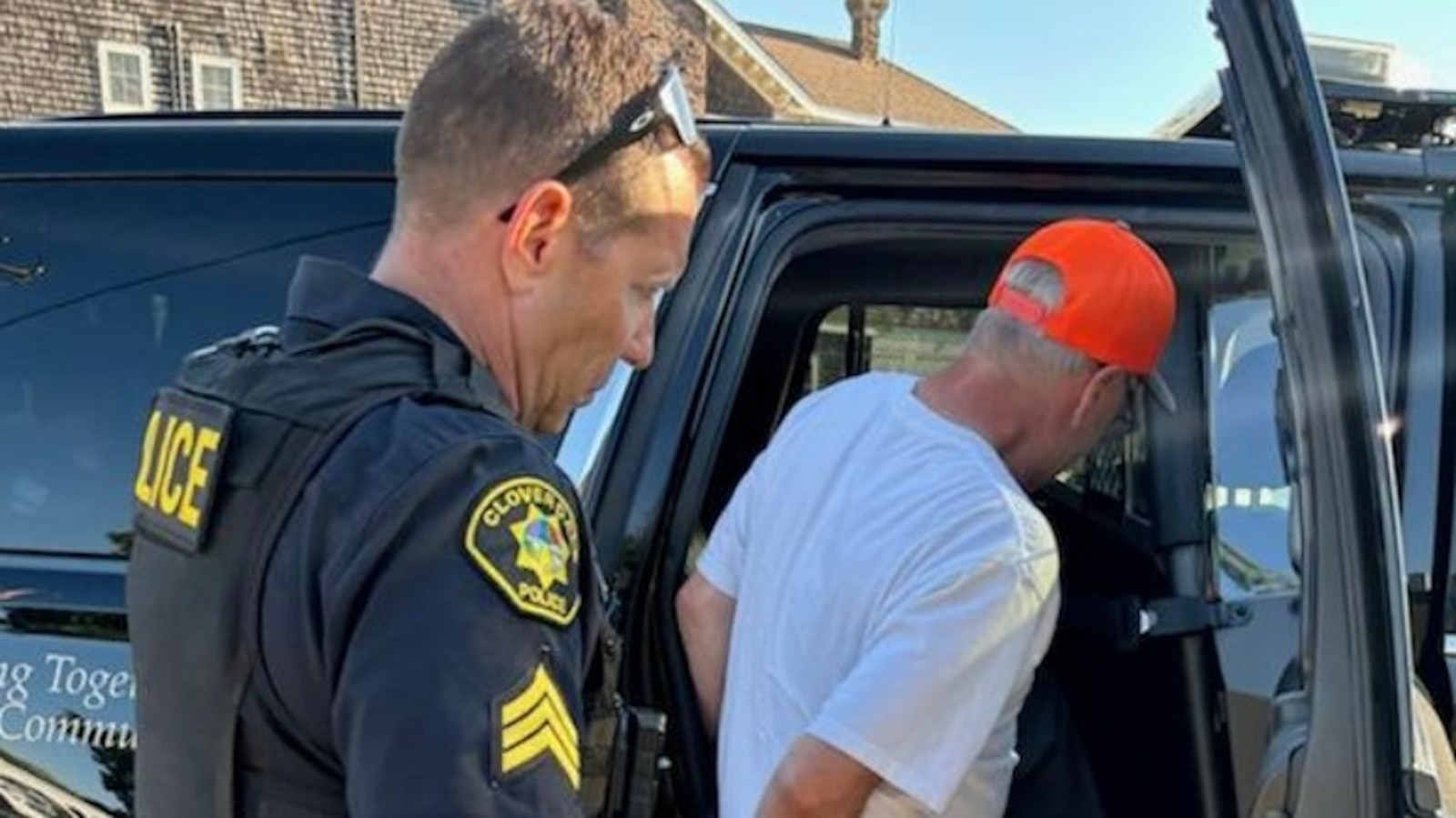
In July 2024, law enforcement officers arrived at James Unick’s home to arrest him for the 1982 rape and murder of Sarah Geer. The 64-year-old man was taken into custody, facing charges that would carry the most severe penalties available under California law. When questioned about the crime, Unick denied knowing Sarah at all. He claimed to have no recollection of what had happened on May 23, 1982—a statement that strained credulity given that he was being confronted with evidence of his involvement in a brutal murder. His denial set the stage for what would become a courtroom battle between scientific evidence and a defendant’s self-serving narrative. The arrest brought a mixture of emotions to Sarah’s loved ones and the Cloverdale community. After more than four decades of waiting, there was finally someone to hold accountable. But the arrest also meant reopening old wounds, reliving the trauma of Sarah’s death, and facing the man who had taken her life. For the investigators who had worked on the case—some for decades—the arrest represented the culmination of persistent effort and the validation that their determination to seek justice for Sarah had not been in vain.
A Trial and an Unbelievable Defense
When the case went to trial, Unick made the decision to testify in his own defense—a risky move that many criminal defense attorneys advise against. What he said on the witness stand shocked the courtroom and insulted the memory of a murdered child. According to Unick’s testimony, thirteen-year-old Sarah had propositioned him for sex while he was playing a video game at an arcade in Cloverdale. He claimed that the two had consensual sexual intercourse on a hillside near the Russian River. Then, in an attempt to explain away the evidence of Sarah’s violent death, Unick suggested that she must have been assaulted and murdered later that evening by what prosecutors described as “a phantom man who failed to leave behind any DNA evidence.” This defense strategy was as transparent as it was offensive. Unick was essentially blaming a murdered child for her own assault while simultaneously asking the jury to believe that another man—who conveniently left no trace evidence—was responsible for her death. The fact that Unick’s DNA, and only his DNA, was found on Sarah’s clothing made his story virtually impossible to believe. Moreover, his claim of “consensual” sex with a thirteen-year-old child revealed either a fundamental misunderstanding of the law or a willingness to admit to a different crime in hopes of avoiding conviction for murder. Under California law, a thirteen-year-old cannot legally consent to sex with an adult; such an act is statutory rape regardless of the circumstances. The prosecution presented the DNA evidence methodically, walking the jury through the scientific process that had linked Unick to the crime. They detailed the timeline of Sarah’s final hours, the discovery of her body, and the decades-long investigation that had finally led to this courtroom. The contrast between the solid forensic evidence and Unick’s implausible story could not have been starker.
Verdict, Sentencing, and the Meaning of Justice Delayed
The jury didn’t need long to reach their decision. After deliberating for just two hours, they returned a guilty verdict. James Oliver Unick, now 64 years old, was convicted of murdering Sarah Geer with a special circumstance related to sexual assault—a conviction that carries a mandatory sentence of life in prison without the possibility of parole. The Sonoma County District Attorney’s Office announced that the jury had “rejected Unick’s fictitious account and, after more than four decades, finally held him accountable for his crimes.” Sonoma County District Attorney Carla Rodriguez released a statement acknowledging the extraordinary nature of the case: “This guilty verdict is a testament to everyone who never gave up searching for Sarah’s killer. This is the coldest case ever presented to a Sonoma County jury. While 44 years is too long to wait, justice has finally been served, both to Sarah’s loved ones as well as her community.” Her words captured both the triumph of the conviction and the tragedy of the delay. Forty-four years is indeed too long to wait for justice, but the alternative—never finding Sarah’s killer—would have been even worse. The case raises important questions about justice, memory, and the role of technology in solving crimes. For Sarah’s family, no conviction can bring back the girl they lost or restore the years of birthdays, graduations, and milestones she never got to experience. The pain of her loss remains, even as the uncertainty about her killer’s identity finally ends. For the Cloverdale community, the resolution of this case closes a dark chapter in their history, though the memory of what happened to Sarah Geer will likely linger for generations. The case also stands as a powerful example of how advances in forensic science can breathe new life into cold cases. The DNA evidence that proved crucial in 2024 was collected in 1982, long before DNA profiling was even possible. The criminalist who developed the first DNA profile in 2003 couldn’t have known that it would take another two decades and the emergence of familial genealogical searching to identify a suspect. And the cigarette butt that provided the confirming evidence was collected using surveillance techniques that combined old-fashioned police work with cutting-edge science. As James Oliver Unick prepares to spend the rest of his life in prison, Sarah Geer’s memory is honored not just by the conviction of her killer, but by the dedication of everyone who refused to let her case be forgotten. From the fireman who discovered her body to the modern investigators who finally brought her killer to justice, Sarah’s story is a reminder that some people never stop fighting for those who can no longer fight for themselves. Justice may have been delayed, but it was not ultimately denied.