
The Departure of Marshall Yates: A Key Figure in the FBI’s Political Crossfire
Leading the FBI’s Congressional Bridge
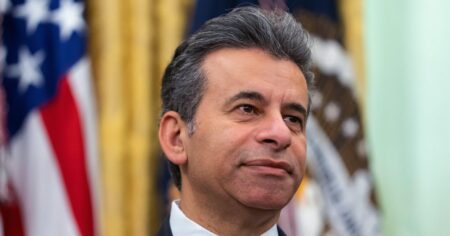
Marshall Yates, who has been serving as the head of the FBI’s congressional affairs office, is stepping down from his position at the bureau, according to multiple sources who spoke with CBS News. His role has been particularly significant as he served as the primary liaison between the FBI and Senate Judiciary Committee Chairman Charles Grassley, making him a crucial figure in managing one of the most politically sensitive relationships in Washington. Before joining the FBI, Yates brought with him extensive experience from Capitol Hill, having worked as a staffer for several Republican representatives. His background includes time with Representative Thomas Massie of Kentucky, who has been publicly feuding with the Justice Department over the handling and release of files related to Jeffrey Epstein. Additionally, Yates previously served as an aide to Congressman Mo Brooks and had connections to the Election Integrity Network, an organization led by Cleta Mitchell, a lawyer who played a role in efforts to challenge the 2020 presidential election results. Mitchell was notably involved in questioning ballots in Fulton County, Georgia, and participated in the now-infamous call between then-President Trump and Georgia’s secretary of state, during which Trump requested help to “find” enough votes to reverse Joe Biden’s victory in the state. Yates’ expected last day at the FBI is Friday, and according to a source familiar with his plans, he is leaving to spend more time with his family and is actively working to assist in finding a suitable replacement for his position.
Role in the Weaponization Working Group
During his tenure at the FBI, Yates took on a particularly controversial role as one of the bureau’s representatives on the Interagency Weaponization Working Group. This group, composed of dozens of government officials from at least twelve different government offices, was established to carry out President Trump’s stated objective of seeking retribution against his political adversaries, according to sources with direct knowledge of the matter. Yates was among several FBI employees assigned to this working group, which has raised serious concerns among civil liberties advocates and former law enforcement officials about the politicization of federal law enforcement agencies. His involvement extended to the Justice Department-led Weaponization Working Group as well, where he participated in discussions on highly sensitive and politically charged topics. These included the prosecutions of individuals involved in the January 6th Capitol riot, a topic that remains deeply divisive in American politics. He was also involved in deliberations about the potential reinstatement of former FBI agents who were terminated during the Biden administration and who subsequently claimed they were fired for raising complaints about COVID-19 protocols, expressing concerns about how the January 6th cases were being handled, and other politically sensitive issues. This involvement placed Yates at the intersection of law enforcement, politics, and the ongoing battles over how the federal government has responded to recent politically charged events.
The Arctic Frost Investigation and Agent Exposure
One of the most controversial aspects of Yates’ tenure involved his role in the relationship between the FBI and Senator Grassley, particularly concerning the release of sensitive documents related to the FBI’s investigation into President Trump, known as “Arctic Frost.” Over the past year, Chairman Grassley has repeatedly made public a series of documents connected to this investigation, and in doing so, he has released these materials without redacting the names of FBI agents involved in the investigation. This departure from standard practice, which typically protects the identities of law enforcement personnel, has had serious consequences for the agents whose names were exposed. Following the public disclosure of these agent names, the FBI proceeded to terminate their employment, creating a pattern that has alarmed former FBI officials and raised questions about whether political considerations influenced personnel decisions. The exposure of these agents’ identities has not only ended careers but has also potentially placed these individuals and their families at risk, as law enforcement personnel who work on politically sensitive cases often face threats and harassment when their identities become publicly known. This situation has created a chilling effect within the FBI, as agents may now fear that their involvement in politically sensitive investigations could lead to their identities being disclosed and potentially to termination.
The Giardina Case: A Humanitarian Concern Ignored
Among the most troubling individual cases arising from this pattern of agent exposure and termination is that of Walt Giardina, a former FBI agent who had worked on investigations involving Trump and his political allies. The circumstances surrounding Giardina’s case have become the subject of a lawsuit filed against the FBI by former Acting FBI Director Brian Driscoll and other former senior officials. According to the allegations in this lawsuit, the then-head of the FBI’s Washington D.C. office made an impassioned plea during a meeting with FBI Director Kash Patel and Marshall Yates, specifically requesting that they not disclose Giardina’s name to Capitol Hill. The reason for this urgent request was deeply personal and humanitarian in nature: Giardina’s wife was dying of cancer, and the D.C. office head warned that releasing Giardina’s name would not only compound the family’s suffering during this difficult time but would also “trigger a torrent of online abuse and threats of violence” against Giardina and his family. Despite this heartfelt warning and the extraordinary personal circumstances involved, Giardina’s name was subsequently released in records provided by Senator Grassley’s office. Following this disclosure, Giardina was fired from the FBI, losing his career at the same time he was dealing with his wife’s terminal illness. This case has become emblematic of concerns that political considerations and demands from Congress have taken precedence over basic humanitarian concerns and the traditional protections afforded to law enforcement personnel.
Implications for FBI Independence and Agent Safety
The departure of Marshall Yates comes at a critical moment for the FBI as an institution, as it grapples with questions about its independence from political pressure and its commitment to protecting its own personnel. The pattern of agent names being released without redaction, followed by terminations, represents a significant departure from historical norms that have typically protected the identities of law enforcement personnel working on sensitive investigations. This shift has created an atmosphere of fear and uncertainty within the bureau, as agents must now consider whether their professional judgment in pursuing investigations could later be second-guessed through a political lens, potentially resulting in exposure and job loss. The involvement of the Weaponization Working Group in what appears to be a systematic effort to identify and remove agents who participated in certain investigations raises fundamental questions about whether the FBI can maintain its traditional role as an independent law enforcement agency or whether it is becoming increasingly subject to political control. The fact that humanitarian concerns, such as those raised in the Giardina case, appear to have been disregarded in favor of political demands suggests a troubling prioritization that could have long-term consequences for the bureau’s ability to recruit and retain qualified personnel willing to work on politically sensitive matters.
Looking Forward: The Future of FBI Congressional Relations
As Marshall Yates prepares to leave his position, his departure raises important questions about the future direction of the FBI’s congressional affairs office and the broader relationship between the bureau and Capitol Hill. According to sources, Yates is working to help identify a successor, but whoever takes on this role will inherit a deeply challenging situation marked by intense political pressures and competing demands. The next congressional affairs chief will need to navigate the delicate balance between appropriate congressional oversight, which is a legitimate and necessary function in a democracy, and the protection of FBI personnel and operations from political interference that could compromise the bureau’s independence and effectiveness. The cases that emerged during Yates’ tenure, particularly the exposure and subsequent firing of agents involved in politically sensitive investigations, will likely cast a long shadow over the office and may influence how future occupants of the position approach their responsibilities. For the FBI as an institution, the challenge will be to restore confidence both internally, among its own workforce, and externally, among the American public, that it operates based on the rule of law rather than political considerations. The circumstances of Yates’ departure and the controversies that marked his tenure serve as a reminder of how difficult it has become to maintain traditional boundaries between law enforcement and politics in an increasingly polarized environment, and how the erosion of those boundaries can have real human consequences for the individuals caught in the middle.