
Federal Judge Halts White House East Wing Construction While Allowing Underground Security Work to Continue
Court Ruling Distinguishes Between Ballroom and Bunker Construction
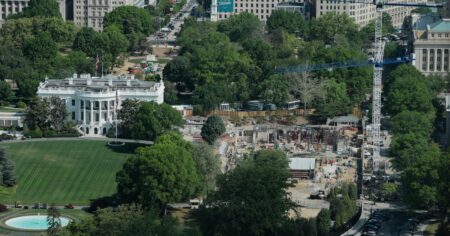
In a significant development affecting one of the Trump administration’s most ambitious construction projects, U.S. District Judge Richard Leon issued a nuanced ruling on Thursday that puts the brakes on above-ground construction at the White House East Wing while permitting underground work on presidential security facilities to move forward. This decision represents a careful balancing act between preserving historical landmarks and ensuring national security, as the judge attempts to navigate the complex legal and safety issues surrounding the controversial project. The ruling comes after months of legal battles that have seen various parties weighing in on what should happen to one of America’s most iconic buildings and the security infrastructure that protects the nation’s chief executive.
Judge Leon’s original order in March had temporarily blocked the Trump administration’s ambitious plan to construct a massive 90,000-square-foot ballroom designed to replace the existing White House East Wing. However, after a federal appeals court instructed him to reconsider the national security ramifications of completely halting the construction, Leon refined his position. His Thursday clarification allows for certain underground construction activities to proceed, specifically those related to presidential security and protection. The judge made it clear that any above-ground work must be “strictly necessary to cover, secure, and protect” the underground facilities. Importantly, he stipulated that this underground construction cannot “lock in the above-ground size and scale of the ballroom,” meaning the government cannot use the security infrastructure as a backdoor way to predetermine the dimensions of the controversial ballroom above.
What Construction Activities Are Still Permitted
Under Judge Leon’s refined order, certain essential construction activities can continue even as the broader project remains on hold. These permitted activities include waterproofing measures, water management systems, structural reinforcement work, and sealing off exposed construction areas that could be vulnerable to the elements or security threats. This allowance reflects the practical reality that leaving construction sites exposed and unsecured could create both structural problems and potential security vulnerabilities. The judge’s decision recognizes that some work must continue simply to maintain the integrity of what has already been built and to protect the underground security facilities that are considered essential to presidential safety. These exceptions show Leon’s attempt to find middle ground between completely halting a project that has already significantly altered the White House grounds and allowing the administration to move forward with potentially controversial plans without proper oversight and review.
The Government’s National Security Arguments
The legal battle intensified when lawyers from the Justice Department mounted an aggressive appeal of Leon’s original construction halt, arguing that his ruling “would imperil the President and national security and indefinitely leave a large hole beside the Executive Residence.” Their arguments painted a dire picture of the security implications of stopping work on the project. According to the government’s legal team, the new East Wing plan serves “critical national-security objectives” by protecting both the president and sensitive below-grade military facilities from an array of modern threats. They specifically cited dangers including “hostile attacks via drones, ballistic missiles, bullets, biohazards,” representing the full spectrum of threats that security professionals must consider in today’s complex threat environment. This line of argument proved persuasive enough that the U.S. Court of Appeals for the District of Columbia instructed Judge Leon to reconsider how his order affected presidential safety and security concerns, leading to his Thursday clarification that attempts to address these issues while still maintaining judicial oversight of the broader construction project.
The Timeline and Legal Process
The legal maneuvering around this construction project has followed a rapid and complex timeline. Judge Leon’s order stopping construction was originally scheduled to be enforced starting April 14, but a three-judge panel from the U.S. Court of Appeals for the District of Columbia stepped in on Saturday to extend the stay by three days, specifically to give the Trump administration time to seek review from the Supreme Court. Leon’s new, clarified order has been stayed for seven days to allow the government additional time to appeal, meaning the legal uncertainty continues. This back-and-forth between district court and appeals court reflects the high stakes involved in the case and the difficulty courts face in balancing competing interests of historical preservation, governmental authority, and national security. Each side continues to pursue every available legal avenue, suggesting this dispute is far from over and may indeed end up before the nation’s highest court for final resolution.
Background of the Controversial Project
The controversy began last summer when President Trump announced plans for a privately funded White House ballroom, a project that immediately raised eyebrows among historians, preservationists, and government watchdogs. The situation escalated dramatically in October when the administration unexpectedly demolished the existing East Wing, a move that shocked many observers and eliminated any possibility of preserving the historical structure in its original form. The East Wing has long been an integral part of the White House complex, housing various offices and serving important ceremonial functions. By late last year, the National Trust for Historical Preservation had filed a lawsuit to block construction of the new East Wing, arguing that the project threatened to destroy or irreparably alter historically significant aspects of the White House grounds. The lawsuit reflects broader concerns about whether any administration should have the authority to make such dramatic changes to a building that belongs not to any individual president but to the American people and their history.
Broader Implications and Looking Forward
This legal battle raises fundamental questions about presidential authority, historical preservation, and the balance between security needs and transparency. While every administration has made modifications to the White House to suit their needs and address contemporary security concerns, the scale of the proposed East Wing replacement is unprecedented in modern times. The involvement of private funding adds another layer of complexity, raising questions about who ultimately controls decisions about this most public of buildings. Judge Leon’s careful parsing of what construction can and cannot proceed demonstrates the judiciary’s role in ensuring that even projects cloaked in national security justifications receive appropriate oversight. As the case potentially moves toward the Supreme Court, it may establish important precedents about how much authority presidents have to alter historically significant federal property and how courts should weigh national security arguments against other important considerations. Whatever the ultimate outcome, the East Wing controversy has already ensured that any future major alterations to the White House will face heightened scrutiny from preservationists, legal experts, and the public.