


A Dream Fulfilled: Maxim Naumov’s Emotional Olympic Journey
Skating for Three: A Family’s Shared Olympic Dream
When Maxim Naumov glided onto the ice at the Milano Ice Skating Arena during the 2026 Winter Olympics, he carried more than just his own ambitions—he carried the dreams of his entire family. The 24-year-old American figure skater was there to fulfill a promise, not just to himself, but to his late parents, Evgenia Shishkova and Vadim Naumov, both former Olympic pairs skaters who tragically lost their lives in a devastating midair collision over the Potomac River the previous year. As Susan Hamel-Bottari, a coach at the Skating Club of Boston and close family friend, emotionally explained, “It was a dream that all of them had. He always says it’s not one, it’s three.” This powerful statement captured the essence of Maxim’s Olympic appearance—it wasn’t just his moment, but a continuation of a family legacy built on ice, dedication, and an unwavering love for figure skating.
The atmosphere in the arena was electric yet deeply emotional as Maxim prepared for his short program. Just before he stepped onto the ice, a message flashed across the jumbotron overhead that would bring tears to the eyes of everyone watching: “Mom and Dad, this is for you.” Those seven simple words carried the weight of tragedy, resilience, and determination. They spoke to the journey that brought him to this moment—a journey marked by unimaginable loss but also by the strength to persevere. As the music began and the lights reflected off the pristine ice, Maxim wasn’t just competing for medals or personal glory; he was honoring the memory of two people who had shaped not only his skating career but his entire life.
A Performance That Transcended Sport
Maxim’s performance that Tuesday in Milan was nothing short of extraordinary, both technically and emotionally. He delivered one of the strongest skates of his career, earning a solid score of 85.65—a mark that secured his advancement to the free skate round later in the week. But those numbers, as impressive as they were, told only a fraction of the real story unfolding on the ice. Every jump, every spin, every graceful movement across the rink was infused with meaning that went far beyond the technical elements judges were evaluating. As Maxim himself later reflected, “With every glide and step that I made on the ice, I couldn’t help but feel their presence. Almost like a chess piece on a chessboard.” His parents, through their years of training him and instilling in him their passion for the sport, were present in every movement he made.
When Maxim completed his program, the emotion that had been building throughout his performance finally overflowed. He dropped to his knees on the ice and looked upward, a gesture that spoke volumes about where his thoughts were in that moment. The crowd, fully aware of his story and the journey that brought him to Milan, erupted in a standing ovation that seemed to shake the very foundations of the arena. It wasn’t just applause for a well-executed program; it was recognition of something far more profound—human resilience, the power of love, and the courage it takes to pursue your dreams even when the people you wanted most to share them with are no longer physically present. In that moment, Maxim wasn’t just a competitor; he was an inspiration to everyone watching, both in the stadium and around the world.
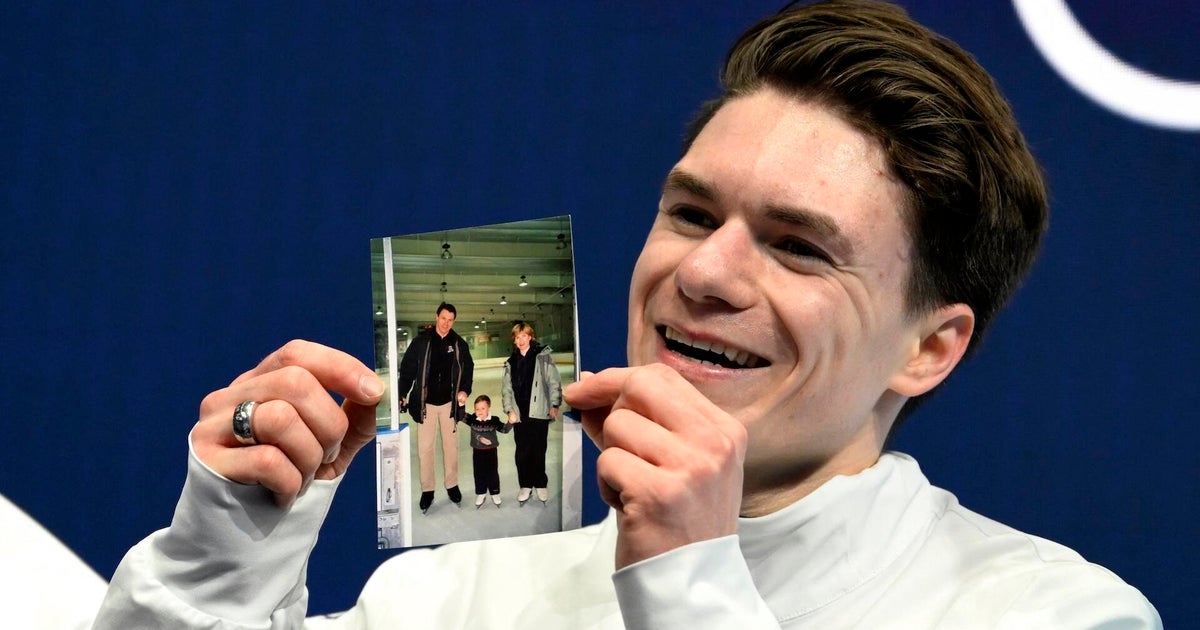
After leaving the ice, Maxim pulled out a photograph that encapsulated everything this moment meant to him—a picture of himself as a small boy, standing on the ice for the first time between his parents. That image represented the beginning of the journey, the foundation of the dream, and the source of his strength. “I didn’t know if I was going to cry, smile or laugh,” he said afterward, his voice thick with emotion. “All I could do was look up at them. I still can’t believe what just happened.” Inside his Team USA jacket, he carried another reminder of his father—a short message containing one of Vadim’s favorite pieces of advice: “Expect the unexpected.” Those words had taken on a heartbreaking new meaning over the past year, but they also represented the mindset that had helped Maxim navigate through the darkest period of his life.
Tragedy That Shook a Community
The past year had indeed tested the “expect the unexpected” philosophy in ways that no one could have imagined. Evgenia Shishkova and Vadim Naumov were among 67 people who lost their lives when the passenger aircraft they were traveling on collided with a military helicopter near Washington, D.C. The couple, who had competed together at the 1994 Winter Olympics in Lillehammer, Norway, were returning home from a skating development camp when tragedy struck. The news sent shockwaves through the figure skating community, particularly affecting the tight-knit group at the Skating Club of Boston, which lost several members in the disaster. For Maxim, the loss was incomprehensible—in an instant, he had lost not just his parents, but his coaches, his mentors, and his biggest supporters.
Susan Hamel-Bottari, who had worked closely with the family for years, remembers the overwhelming shock of that day and the difficult period that followed. “I didn’t know how to respond to him,” she recalled, her voice still carrying the weight of that moment. “I just told him I would always be there for him.” In the months following the tragedy, the skating community rallied around Maxim, offering support, encouragement, and a shoulder to lean on when the grief became too heavy to bear alone. But while the support was crucial, it was Maxim’s own inner strength and determination that would ultimately carry him forward. He made a choice—a choice to continue, to persevere, to honor his parents’ memory not through withdrawal and despair, but through action and achievement.
Finding Strength Through Resilience
Maxim’s resilience in the months leading up to the Olympics became a source of inspiration for everyone around him. According to Hamel-Bottari, his commitment never wavered, even on the days when the emotional burden must have seemed unbearable. “Every day he would come to the rink, no matter what,” she told CBS News with evident admiration. “No matter what he was feeling inside, he showed up. He’s mentally tough. He’s a fighter.” That daily dedication—showing up, lacing up his skates, and getting back on the ice even when grief threatened to overwhelm him—demonstrated a strength of character that went far beyond athletic ability. The ice, which might have served as a painful reminder of what he had lost, instead became a refuge and a connection to his parents. It was where he felt closest to them, where their teachings and their presence remained most vivid.
Maxim didn’t just lean into his training for personal solace; he also committed himself to continuing the work his parents had started. Evgenia and Vadim had founded Tomorrow’s Champions, a development program at the Skating Club of Boston designed to train young skaters through a comprehensive approach that included on-ice sessions, off-ice conditioning, gymnastics, and ballet. Even while preparing for the biggest competition of his life, Maxim continued teaching in the program, working with the next generation of skaters just as his parents had worked with him. “The kids love him,” Hamel-Bottari said with a warm smile. “He’s very positive. He learned from the best—from both of them.” By continuing this work, Maxim ensured that his parents’ legacy would live on not just through his own achievements, but through the countless young skaters whose lives they had touched and would continue to touch through his teaching.
A Community United in Support
Many of those young skaters were watching as Maxim took to the Olympic ice in Milan, their connection to him making the moment even more meaningful. Some had traveled all the way to Italy, holding up handmade signs decorated with their handprints and names—a touching tribute that showed how much he meant to them. Others cheered from home, gathering together to watch their teacher and mentor compete on the world’s biggest stage. For the entire Skating Club of Boston community, Maxim’s Olympic appearance represented more than just one athlete’s achievement; it symbolized healing, resilience, and the enduring power of community in the face of tragedy. “For us, as the Skating Club of Boston family, to see him and know what we went through, it just brings tears to your eyes,” Hamel-Bottari said, her voice breaking with emotion. “Tonight, he did it.”
Maxim had said before his performance that he wasn’t focused on achieving technical perfection or chasing a specific score. His goals were more fundamental, more human. “I wanted to go out there and just give my heart out,” he explained. “Leave everything out there. Have no regrets.” That mindset—focusing on effort, emotion, and authenticity rather than perfection—freed him to skate not just with technical precision but with genuine passion and feeling. It allowed him to transform what could have been a pressure-filled, anxiety-inducing experience into something meaningful and cathartic. In doing so, he gave everyone watching permission to embrace their own emotions, to acknowledge that sometimes the journey matters more than the destination, and that showing up and giving your best is a victory in itself, regardless of where you place on the scoreboard.
Beyond Medals and Standings
Among all the inspiring stories that emerge from every Olympic Games—tales of underdogs triumphing, veterans finally achieving their dreams, athletes overcoming injuries and setbacks—Maxim Naumov’s performance stood apart for reasons that transcended sports entirely. His story wasn’t just about an athlete reaching the Olympics; it was about a son honoring his parents, about finding purpose in the midst of profound loss, about choosing to move forward when every instinct might scream to give up. It was about the bonds that connect us to the people we love, and how those bonds can remain strong even when death tries to sever them. Every element of Maxim’s Olympic experience—from the tribute message on the jumbotron to the photograph he carried, from his upward glance after completing his program to the standing ovation that recognized not just his skating but his courage—reminded us that sports, at their best, reflect the deepest truths about human experience.
As Maxim moves forward to the free skate round, he carries with him not just the technical skills his parents taught him and the training he’s devoted his life to, but something far more powerful: the knowledge that he has already succeeded in the ways that matter most. He has honored his parents’ memory, inspired countless people around the world, demonstrated extraordinary resilience, and shown that even in our darkest moments, we can find the strength to pursue our dreams. Whether he medals or not, whether his scores place him on the podium or not, Maxim Naumov has already achieved something remarkable—he has reminded us all that love transcends loss, that dreams can survive even the most devastating tragedies, and that when we skate for those we’ve lost, we’re never truly alone on the ice. In fulfilling his family’s shared dream, he has created a legacy that extends far beyond figure skating, touching the hearts of everyone who believes in the power of perseverance, the strength of family bonds, and the courage it takes to keep moving forward when every reason to quit presents itself.