


The Return of Giants: Galápagos Tortoises Come Home to Floreana Island
A Historic Homecoming After 150 Years
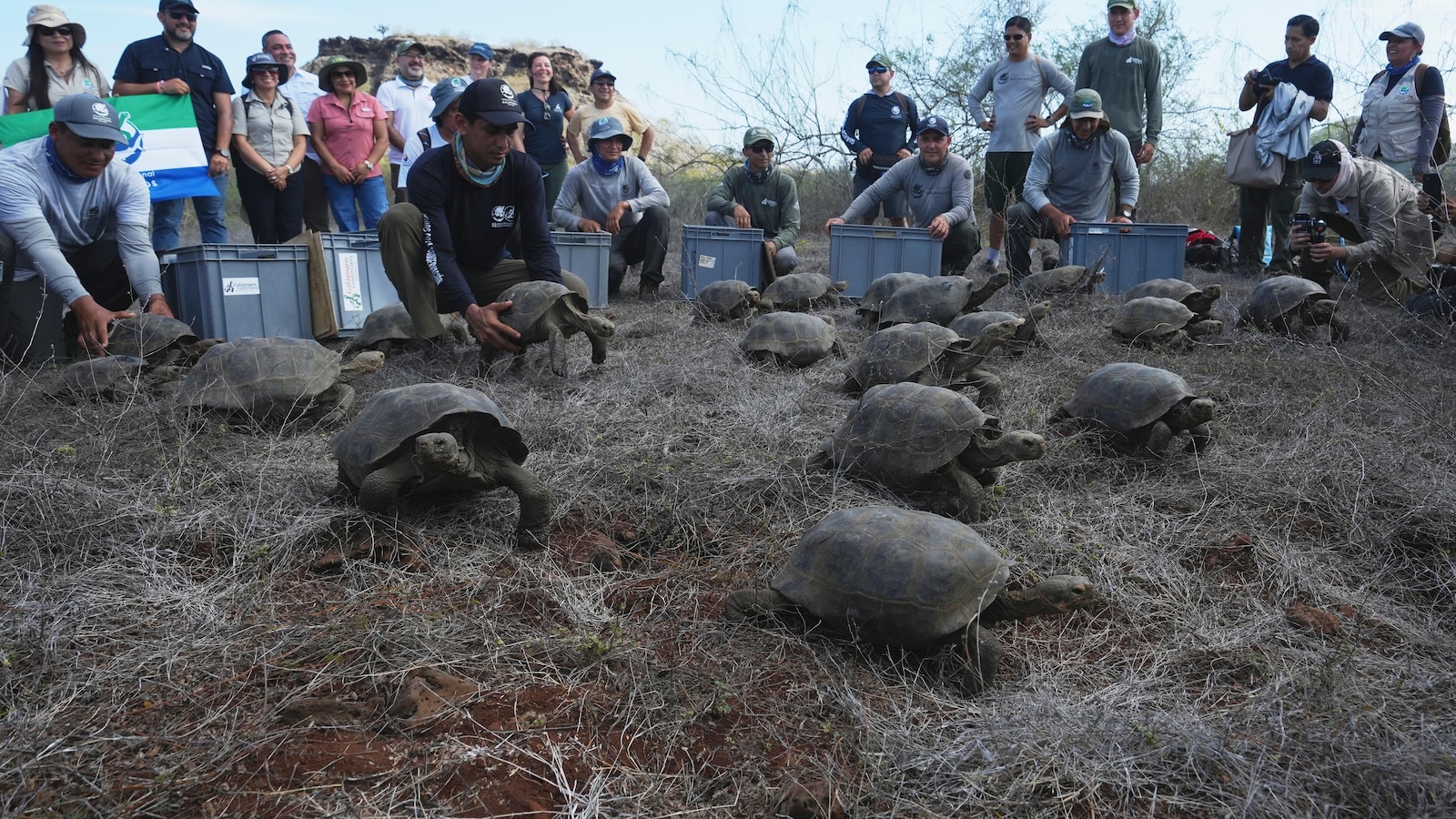
In a momentous conservation milestone, Floreana Island in Ecuador’s legendary Galápagos archipelago recently witnessed the return of giant tortoises after an absence spanning nearly a century and a half. This past Friday marked an emotional and scientifically significant occasion as 158 juvenile hybrid tortoises, ranging from 8 to 13 years old, were carefully released into their ancestral homeland. The timing couldn’t have been more perfect—the release coincided with the arrival of the season’s first winter rains, providing ideal conditions for these young giants to begin their journey of exploration and adaptation. As they ventured into the landscape their ancestors once roamed, these tortoises carried with them not just their own futures, but the hopes of restoring an entire ecosystem that has suffered from their absence for generations. The sight of these creatures taking their first steps on Floreana soil represents more than just a relocation project; it symbolizes humanity’s commitment to righting past wrongs and healing the natural world we’ve damaged.
The Science Behind the Revival
What makes this reintroduction particularly fascinating is the complex genetic story behind these tortoises. According to Christian Sevilla, director of ecosystems for the Galápagos National Park, these aren’t pure descendants of the original Floreana tortoises, but carefully bred hybrids carrying between 40% and 80% of the genetic makeup of Chelonoidis niger—the species that vanished from Floreana 150 years ago. The lineage of these remarkable creatures traces back to an unexpected source: Wolf Volcano on Isabela Island, a discovery that continues to intrigue and puzzle scientists today. The breeding program, overseen by experts like Fredy Villalba, director of the Galápagos National Park breeding center on Santa Cruz Island, has been meticulously designed to select the strongest specimens with the most robust genetic heritage. By choosing adults with the most significant genetic connection to the original Floreana species, conservationists aim to gradually restore the extinct species to something approaching its former genetic purity over successive generations. This ambitious plan involves the gradual introduction of 700 tortoises total, with the 158 recent arrivals representing just the first wave of this carefully orchestrated ecological restoration.
From Abundance to Extinction: A Tragic History
The story of how Floreana lost its tortoises is a sobering reminder of humanity’s devastating impact on fragile island ecosystems. Two centuries ago, this relatively small volcanic island teemed with life, supporting a population of approximately 20,000 giant tortoises that played crucial roles in maintaining the island’s ecological balance. However, the arrival of human activity brought catastrophe. Whaling ships frequently stopped at the Galápagos Islands, and sailors discovered that giant tortoises could be stored alive in ship holds for months, providing fresh meat during long ocean voyages. This practice, combined with a devastating fire and relentless exploitation by settlers and visitors, eventually drove the species to complete extinction on Floreana. Biologist Washington Tapia, a respected researcher and director of Biodiversa-Consultores, a firm specializing in Galápagos conservation, emphasized to the Associated Press that reintroducing a species with such a significant genetic component of the original population represents far more than a numbers game. It’s about restoring a lost lineage, bringing back an ecological architect that once shaped the very character of the island’s environment.
The Challenges Ahead: Sharing a Changed Landscape
The 158 young tortoises face a Floreana that differs dramatically from the island their genetic ancestors knew. Today, they’ll share their 173-square-kilometer (67-square-mile) volcanic homeland with a complex mix of native and introduced species. Approximately 200 human residents now call Floreana home, and the tortoises will coexist with spectacular native wildlife including flamingos, iguanas, penguins, sea gulls, and hawks. However, they must also navigate an environment compromised by invasive species introduced through human activity over the past two centuries. Invasive plants like blackberry and guava compete with native vegetation, while introduced animals including rats, cats, pigs, and donkeys present potential threats to the tortoises, particularly when they’re young and vulnerable. This is precisely why the breeding program waited until these tortoises reached ages 8 to 13 before releasing them. As Fredy Villalba explained, at this size and maturity, the tortoises can defend themselves against introduced predators like rats and cats. The careful selection process ensured that only the strongest, healthiest specimens with the best genetic credentials were chosen for this pioneering mission, giving them the best possible chance of survival in this altered landscape.
Community Pride and Ecological Significance
For the residents of Floreana, the return of the giant tortoises represents the fulfillment of a long-cherished dream. Local resident Verónica Mora captured the community’s sentiment when she described the release as “a dream come true,” expressing how the island’s inhabitants are witnessing the reality of a project that began years ago as little more than an ambitious hope. The immense pride felt by Floreana’s community reflects a growing understanding of what these creatures mean—not just as attractions or symbols, but as essential components of a functioning ecosystem. Giant tortoises serve as what ecologists call “ecosystem engineers,” species whose activities significantly modify their environments. They disperse seeds across vast distances, their grazing patterns influence plant community composition, and their movements create pathways used by other animals. Their absence for 150 years has left a tortoise-shaped hole in Floreana’s ecosystem, affecting everything from vegetation patterns to nutrient cycling. The United Nations recognized the extraordinary ecological value of the Galápagos Islands in 1978 when it designated them as a Natural World Heritage Site, acknowledging the archipelago’s unique abundance of terrestrial and marine species found nowhere else on Earth.
Hope for the Future: A Living Laboratory of Conservation
The Floreana tortoise reintroduction represents cutting-edge conservation science in action, demonstrating what’s possible when genetic research, careful breeding programs, and patient ecosystem restoration come together. Located in the middle of the Pacific Ocean, roughly 1,000 kilometers (621 miles) from mainland Ecuador, Floreana serves as both a reminder of conservation failures and a beacon of hope for ecological recovery. The gradual approach—introducing 700 tortoises over time rather than all at once—allows scientists to monitor how the animals adapt, how they interact with both native species and invasive threats, and how their presence begins to reshape the island’s ecosystem. Over the coming years and decades, these tortoises will grow to their full impressive size, potentially living for more than a century, slowly transforming the landscape through their feeding, movement, and reproductive behaviors. As successive generations are born on the island itself, the genetic lineage will hopefully strengthen, moving closer to the original Chelonoidis niger species with each breeding cycle. This project offers valuable lessons for conservation efforts worldwide, demonstrating that even species driven to complete extinction on their native grounds can sometimes be brought back through determined scientific effort, community support, and respect for the intricate genetic heritage that makes each species unique. The young tortoises now exploring Floreana carry on their backs not just their distinctive shells, but the weight of scientific hope and the promise of ecological redemption.