
Heated Capitol Hill Confrontation Leads to Injury and Arrest During Senate Hearing
When Protest Meets Policy: A Clash at the Senate Armed Services Subcommittee
What should have been a routine Wednesday morning hearing on military readiness at the Senate Armed Services subcommittee turned into a dramatic confrontation that resulted in a protester’s arrest, alleged injuries, and sharply conflicting accounts of what actually happened. The incident has raised questions about protest boundaries, the use of force in congressional buildings, and the growing tensions surrounding America’s military involvement in international conflicts, particularly the war with Iran.
Republican Senator Tim Sheehy of Montana found himself at the center of controversy when he physically intervened to help Capitol Police remove Brian McGinnis, a self-described Marine veteran and Green Party Senate candidate from North Carolina, from the hearing room. McGinnis had interrupted the proceedings to voice his opposition to U.S. and Israeli military operations against Iran. The altercation ended with McGinnis claiming his arm was broken during the struggle, while Capitol Police accused him of violently assaulting officers. The incident captured on video has sparked a heated debate about the appropriate response to civil disobedience in government buildings and whether the force used was justified or excessive.
The Protest and the Confrontation
Approximately thirty minutes into the hearing, which featured testimony from senior military officials discussing the state of America’s military readiness, McGinnis—dressed in military uniform—stood up and began shouting his objections. His most pointed statement, “America does not want to send its sons and daughters to war for Israel,” cut through the formal proceedings and immediately drew the attention of Capitol Police officers stationed in the room.
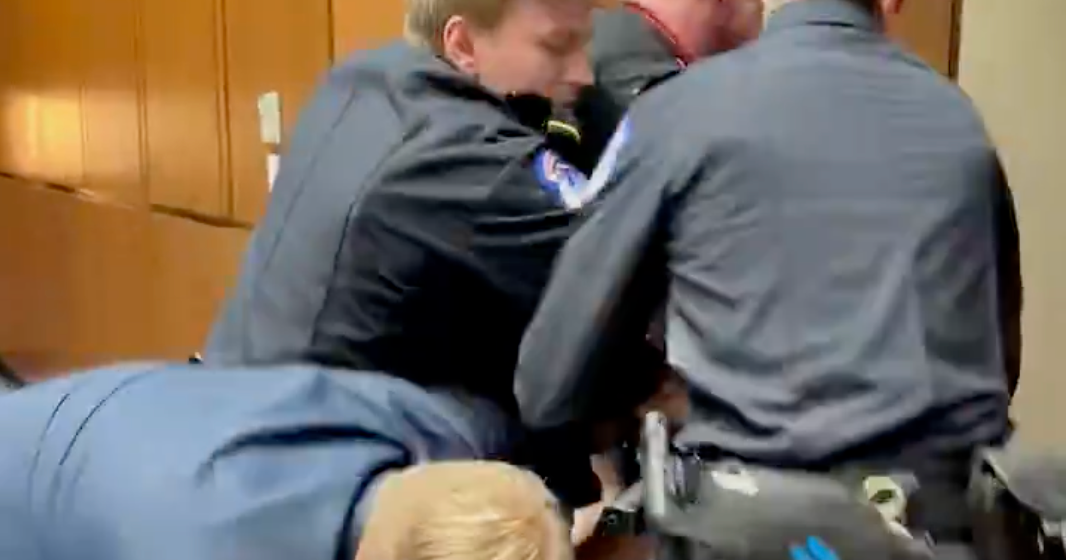
As officers moved to remove McGinnis from the hearing room, what followed was a physical struggle that escalated quickly. Video footage provided to CBS News by an antiwar activist shows McGinnis appearing to resist the officers’ attempts to escort him out. It was at this point that Senator Sheehy made the unusual decision to leave his position on the dais and join the Capitol Police in physically removing the protester. The senator can be seen helping officers lift McGinnis and move him toward the exit. The situation became particularly tense when McGinnis’s left hand became trapped between the door and the door frame as authorities attempted to pull him from the room. Sheehy appears in the video trying to free the stuck hand, and it’s at this moment that voices can be heard accusing the senator of breaking McGinnis’s hand. When asked if his hand was okay, McGinnis responded with a clear “No, it’s not.” After being removed from the hearing room, McGinnis could be heard stating that his left arm was broken.
Competing Narratives: Who’s Telling the Truth?
The aftermath of the incident has produced dramatically different versions of what happened, depending on who’s telling the story. Mark Elbourno, a Green Party official who serves as McGinnis’s Senate campaign manager and who attended the hearing with him, painted a picture of a citizen exercising his right to speak out who was then subjected to excessive force. Elbourno told CBS News that McGinnis, who works as a firefighter when not campaigning, had attended the hearing genuinely wanting to hear what officials had to say. However, according to Elbourno, McGinnis reached a breaking point where he “couldn’t take their lies anymore” and felt compelled to stand up and demand that the Senate stop funding the war with Iran.
Elbourno firmly denied that McGinnis assaulted anyone, characterizing his actions as simply wanting to be heard and speaking “loud and clear.” He flipped the narrative entirely, claiming that McGinnis was actually the victim: “He was assaulted, actually. They broke his arm.” Following the confrontation, McGinnis was placed under arrest and transported to George Washington University Hospital for treatment, though Elbourno indicated he was unsure of McGinnis’s exact medical condition at the time of his statement.
The U.S. Capitol Police, however, presented a starkly different account. In their official statement, they accused McGinnis of “putting everyone in a dangerous position by violently resisting and fighting our officers’ attempts to remove him from the room.” They claimed that McGinnis “got his own arm stuck in a door to resist our officers and force his way back into the hearing room,” suggesting his injury was self-inflicted in his resistance. The Capitol Police also reported that three of their officers were injured during the incident and required treatment from local emergency medical services. McGinnis now faces serious charges: three counts of assaulting a police officer, three counts of resisting arrest, and one count of crowding, obstructing, and incommoding—the legal term for blocking an entrance or passageway.
Senator Sheehy’s Defense of His Actions
Senator Sheehy took to social media platform X to defend his decision to physically intervene in the situation. He characterized his involvement as necessary because McGinnis was “fighting back” against police, and claimed he was attempting to “help out and deescalate the situation.” His post struck a somewhat dismissive tone toward the protester, stating, “This gentleman came to the Capitol looking for a confrontation, and he got one.” Sheehy concluded with what could be read as either genuine concern or pointed criticism: “I hope he gets the help he needs without causing further violence.”
The senator’s involvement raises interesting questions about the appropriate role of elected officials during security incidents. While Capitol Police are trained professionals responsible for maintaining order and safety in congressional buildings, Sheehy’s decision to personally assist them is unusual. Some might view it as a senator stepping up to help law enforcement in a chaotic situation, while others might question whether his involvement was necessary or appropriate, particularly given that the incident resulted in allegations of injury.
The Larger Context: Protests and Free Speech in Government Buildings
The Capitol Police were clear in their statement about the rules governing protests in congressional buildings: “Protests are not allowed inside the Congressional Buildings. There are plenty of other spots on Capitol Grounds, outside, where demonstrations are allowed.” This policy reflects the balance government institutions attempt to strike between protecting free speech rights and maintaining order necessary for government functions to proceed.
The restriction on indoor protests exists to ensure that legislative business can be conducted without disruption. Congressional hearings serve important oversight and informational purposes, and allowing unlimited disruptions would make it impossible to conduct the people’s business. At the same time, the right to petition the government and to protest government actions is fundamental to American democracy. The designated protest areas outside congressional buildings are meant to honor this right while keeping the interior spaces functional.
However, critics of this arrangement might argue that protests relegated to outdoor designated zones, often far from where actual decision-makers can hear them, lack the impact of direct confrontation with those in power. McGinnis’s decision to interrupt the hearing itself, rather than protest outside, appears to have been motivated by a desire to force senators and military officials to directly hear opposition to the Iran war from someone who has served in the military.
What This Incident Reveals About America’s Current Divisions
This confrontation at a Senate hearing represents more than just one protester’s disruption—it’s a flashpoint that reveals deeper tensions in American society. The involvement of a Marine veteran protesting war policy speaks to the complex feelings many service members and veterans have about how America employs its military. McGinnis’s statement that “America does not want to send its sons and daughters to war for Israel” touches on ongoing debates about U.S. foreign policy in the Middle East, the nature of the U.S.-Israel relationship, and questions about which conflicts justify American military involvement.
The fact that McGinnis is running as a Green Party candidate also highlights the frustration some Americans feel with the two major political parties’ approach to military engagement and foreign policy. Third-party candidates often struggle to get their messages heard through traditional channels, which may explain McGinnis’s decision to use dramatic direct action to draw attention to his antiwar position. The incident also demonstrates the challenges of political discourse in an increasingly polarized environment, where frustration with perceived government dishonesty or misguided policy can boil over into confrontations that end with injuries and criminal charges rather than productive dialogue. As this case moves through the legal system and both sides tell their stories, it will likely continue to serve as a reference point in discussions about protest rights, government transparency, and America’s military commitments abroad.