


Breaking the Silence: Dolores Huerta Speaks Out About Cesar Chavez
A Civil Rights Icon’s Dark Secret Revealed
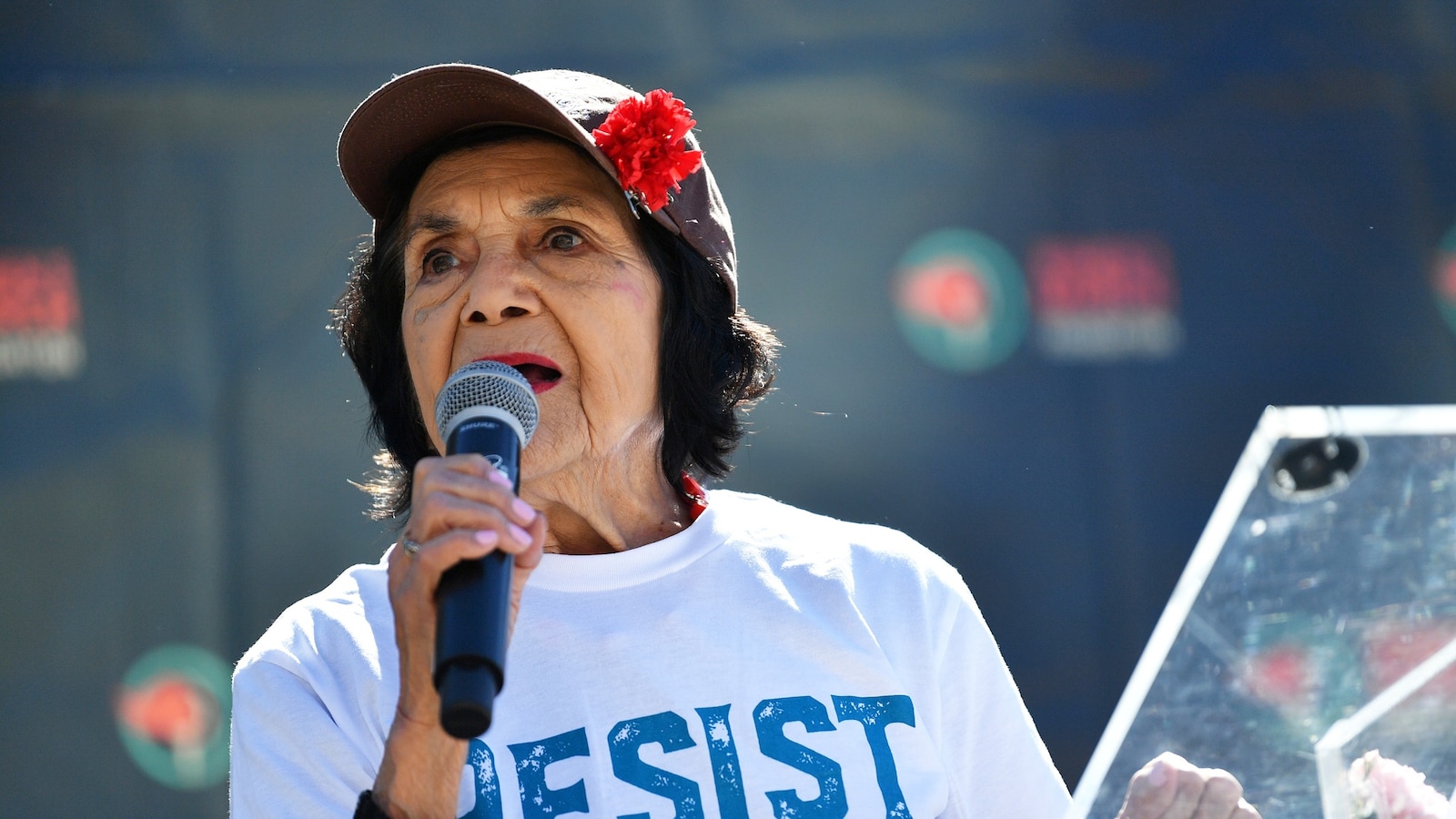
In a revelation that has sent shockwaves through the labor rights community, Dolores Huerta, the legendary 95-year-old labor activist and co-founder of the United Farm Workers, has broken decades of silence to share a deeply personal and painful truth. In a statement to ABC News, Huerta disclosed that she was “manipulated and pressured into having sex” with Cesar Chavez, her longtime collaborator and fellow civil rights icon. This admission comes in response to a comprehensive New York Times investigation that brought to light multiple allegations of sexual abuse against Chavez, who died in 1993 at age 66. The Times’ reporting detailed accounts from several survivors who claimed that Chavez used his position of power and influence within the farmworker movement to exploit women and minors for his own sexual gratification. For Huerta, who has spent her entire adult life fighting for the rights of farmworkers and championing social justice causes, the decision to come forward represents a profound moment of personal courage and a reckoning with a painful past she had kept hidden for more than half a century.
The Weight of Decades-Long Silence
Huerta’s decision to finally speak publicly about her experiences with Chavez came after reading the Times investigation, which made it clear to her that she was not alone in her suffering. “I can no longer stay silent and must share my own experiences,” she stated, explaining that the newspaper’s reporting “indicated that I was not the only one – there were others.” According to Huerta’s account, she had two separate sexual encounters with Chavez during the 1960s, both of which occurred during the formative years of their groundbreaking work together. The first incident, she described, involved manipulation and pressure from Chavez, leaving her feeling powerless to refuse because he was not only her boss but also someone she deeply admired and the leader of a movement to which she had already devoted years of her life. The second encounter was even more traumatic, as Huerta stated she was “forced, against my will, and in an environment where I felt trapped.” The power dynamics at play, combined with her commitment to the larger cause they were building together, created an impossible situation where speaking out seemed unthinkable.
The Hidden Consequences and Personal Sacrifice
Perhaps the most heartbreaking aspect of Huerta’s revelation is that both encounters with Chavez resulted in pregnancies that she kept secret throughout the decades. In an extraordinary act of personal sacrifice and pragmatism, Huerta arranged for these children to be raised by other families, a decision that allowed her to continue her work with the farmworker movement while protecting the reputation of the organization she had helped build. “Over the years, I have been fortunate to develop a deep relationship with these children, who are now close to my other children, their siblings,” Huerta shared in her statement. However, she added that “no one knew the full truth about how they were conceived until just a few weeks ago,” indicating that she has only recently begun sharing this information even with those closest to her. This revelation adds another layer of complexity to Huerta’s already remarkable life story, showing the personal costs she was willing to bear to protect the movement she believed in. Her decision to prioritize the farmworker cause over her own trauma speaks to both her extraordinary dedication and the impossible choices that survivors of abuse often face, particularly when their abusers hold positions of power and influence in movements they care deeply about.
A Pattern of Abuse Within the Movement
The New York Times investigation that prompted Huerta’s disclosure painted a disturbing picture of systematic abuse of power by Chavez. According to the newspaper’s reporting, one survivor alleged that she was only 12 years old when Chavez first touched her inappropriately, and 15 when he raped her in California. Another victim who spoke to the Times claimed she was summoned for sexual encounters with Chavez dozens of times over a four-year period, beginning when she was just 13 years old and he was 45. These allegations suggest a pattern of predatory behavior that Chavez used his position as leader of the United Farm Workers to facilitate and conceal. Huerta’s response to these revelations was unequivocal: “The knowledge that he hurt young girls sickens me. My heart aches for everyone who suffered alone and in silence for years,” she said. “There are no words strong enough to condemn those deplorable actions. Cesar’s actions do not reflect the values of our community and our movement.” Her statement makes clear that while she respects the work they accomplished together, she refuses to allow that legacy to excuse or minimize the harm Chavez caused to vulnerable women and girls.
The Movement Versus the Man
Huerta’s explanation for why she maintained her silence for so long illuminates the complex calculations that survivors often must make, particularly when their abusers are public figures associated with important social causes. “I carried this secret for as long as I did because building the movement and securing farmworker rights was my life’s work,” Huerta explained. “The formation of a union was the only vehicle to accomplish and secure those rights and I wasn’t going to let Cesar or anyone else get in the way.” This statement reveals the impossible position in which she found herself: speaking out about Chavez’s abuse could have undermined or destroyed the farmworker movement at a critical time when thousands of workers were depending on their advocacy for basic rights and protections. Huerta and Chavez co-founded the United Farm Workers in 1962, and their collaboration led to the first farmworker union contracts in U.S. history, fundamentally changing labor relations in American agriculture. Huerta’s own contributions to this work were recognized in 2012 when she received the Presidential Medal of Freedom for her decades of advocacy in civil rights and women’s equality. The tension between protecting the movement and acknowledging the truth about its co-founder represents one of the most challenging aspects of reckoning with abuse by powerful figures in social justice movements.
Institutional Response and Moving Forward
In the wake of these revelations, both the United Farm Workers and the César Chávez Foundation issued statements acknowledging the “disturbing” allegations against their founder. The César Chávez Foundation said it was “deeply shocked and saddened” by the reports, while the Chavez family released a statement expressing devastation at the New York Times article. “This is deeply painful for our family,” the family stated. “We wish peace and healing to the survivors and commend their courage to come forward. As a family steeped in the values of equity and justice, we honor the voices of those who feel unheard and who report sexual abuse.” The family’s statement attempted to balance acknowledging the survivors’ experiences while preserving the memory of the work Chavez did for farmworkers, saying they “carry our own memories of the person we knew. Someone whose life included work and contributions that matter deeply to many people.” This institutional response highlights the broader conversation society must have about how to handle revelations of abuse by historical figures whose public work has been widely celebrated. It raises difficult questions about how we honor the legitimate achievements of social movements while acknowledging the harm caused by their leaders, and how we create accountability even after death. For the survivors, including Huerta, the act of coming forward represents a crucial step toward healing and ensuring that future movements build cultures of safety and accountability from the beginning, rather than allowing powerful leaders to exploit their positions without consequence.