



Utah Mother Convicted of Murdering Husband After Publishing Children’s Book About Grief
A Shocking Verdict in a Case That Gripped the Nation
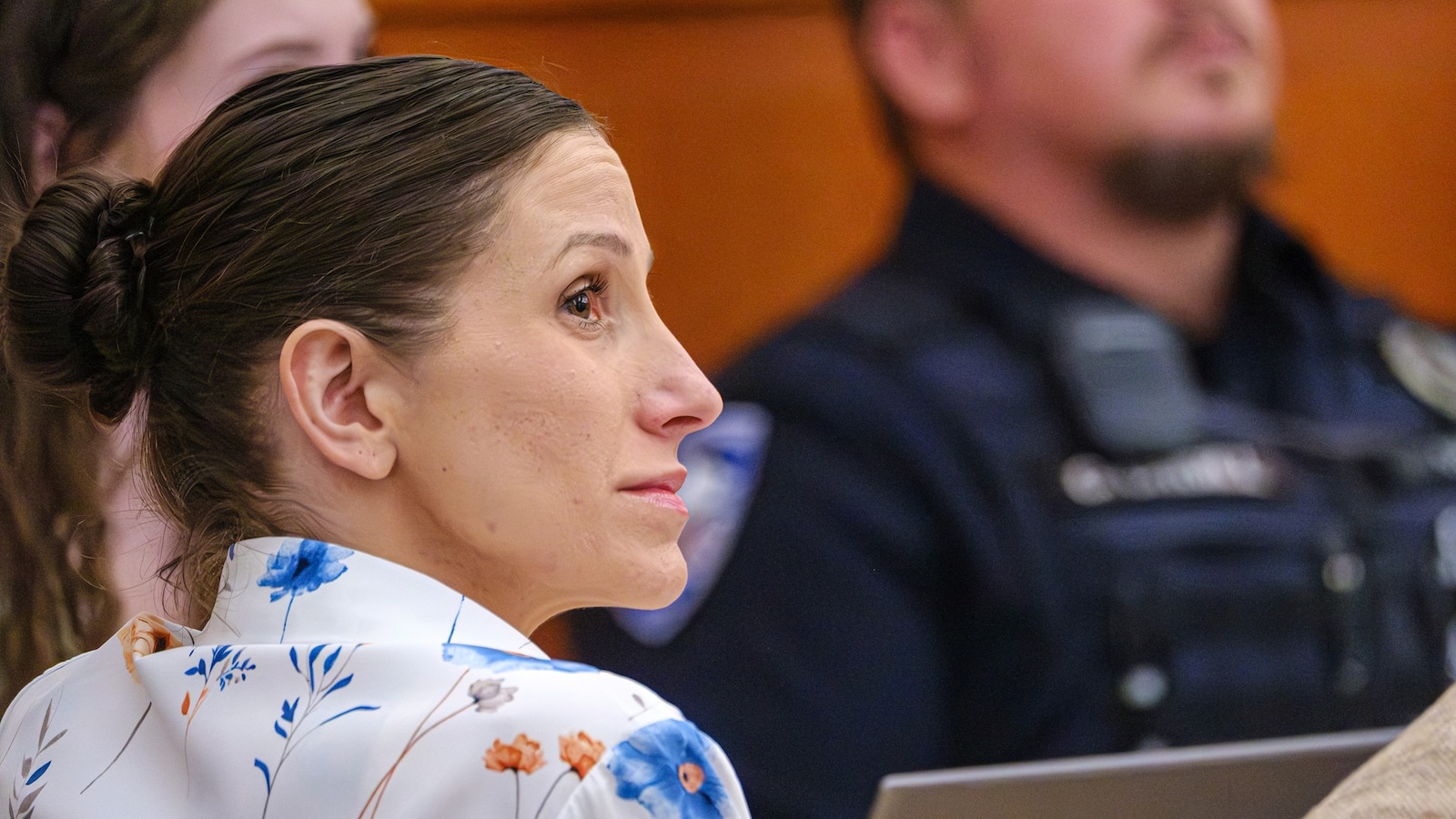
In a case that has captivated public attention for its disturbing contradictions, Kouri Richins, a 35-year-old Utah mother and real estate agent, has been found guilty of murdering her husband with fentanyl. The Summit County jury deliberated for approximately three hours on Monday afternoon before returning guilty verdicts on all five counts against her, including aggravated murder, attempted aggravated murder, and insurance fraud. What made this case particularly haunting was Richins’ decision to self-publish a children’s book about coping with grief following her husband’s death—a death that prosecutors successfully argued she orchestrated. As the judge read each guilty verdict, Richins looked down and remained motionless, her stoic demeanor offering no insight into her thoughts. Her sentencing is scheduled for May 13, where she will learn the consequences of actions that have left three young boys without both parents and torn apart multiple families in the community.
The prosecution painted a portrait of a woman desperately clinging to an image of success while drowning in debt, willing to commit the ultimate betrayal to escape her financial troubles. According to prosecutors, 39-year-old Eric Richins was found dead in bed on March 4, 2022, after what appeared to be a typical evening at home. An autopsy would later reveal the horrifying truth: he had died from fentanyl intoxication, with levels in his bloodstream approximately five times the lethal dose. The medical examiner determined this was illicit fentanyl, not medical grade, pointing toward a deliberate poisoning rather than an accidental pharmaceutical overdose. This discovery launched an extensive investigation that would eventually lead authorities to conclude that the person responsible for introducing this deadly substance into Eric’s system was none other than his wife—the mother of his three children and his partner of nine years.
The Prosecution’s Case: Financial Desperation and Premeditated Murder
During closing arguments, prosecutor Brad Bloodworth methodically laid out the state’s case against Kouri Richins, describing her as someone obsessed with appearing “privileged, affluent and successful” despite mounting financial troubles. He alleged that by October 2021, Richins found herself in what he called “the beginning of the downward financial death spiral,” with her home-flipping business accumulating debts approaching $8 million. According to Bloodworth, Richins believed that her husband’s death would provide the significant cash influx she desperately needed, not realizing that his assets were placed in a trust for their children rather than passing directly to her. The prosecutor argued that Kouri’s financial desperation drove her to seek out illicit fentanyl, asking multiple people for the “Michael Jackson drug”—a reference to the powerful painkillers that killed the pop star in 2009.
The evidence presented suggested that Richins’ murderous intentions dated back to at least December 2021, when she allegedly booked a vacation with her boyfriend for April 2022. “Kouri Richins did not book that trip thinking Eric Richins would be alive in April, she booked it knowing he would not,” Bloodworth told the jury. Testimony revealed that in December 2021, Kouri told a witness that “in many ways it would be better” if Eric “were dead.” Then, on February 19, 2022—just days after prosecutors say she made her first murder attempt—she texted her boyfriend saying, “If he could just go away and you could just be here! Life would be so perfect!!” These communications painted a picture of a woman actively wishing for her husband’s death and planning for a future without him.
The prosecution’s timeline alleged two separate attempts on Eric’s life. The first occurred on Valentine’s Day, February 14, 2022, when prosecutors say Kouri gave her husband a sandwich laced with fentanyl. When this initial attempt failed to kill him, she allegedly returned to her illicit drug source, asking for something stronger. Two weeks later, on March 4, Eric was found dead after what prosecutors say was a second, successful poisoning attempt. The source of these drugs, according to testimony, was Carmen Lauber, Richins’ former housecleaner, who testified under several grants of immunity about obtaining illicit drugs at Kouri’s request in the weeks prior to Eric’s death. Bloodworth also highlighted Kouri’s alleged attempts to cover up her crime, including deleting text messages and phone logs with multiple people, including Lauber, and conducting internet searches such as “can cops force you to do a lie detector test” and “can deleted text messages be retrieved from an iPhone.”
Defense Arguments: Sloppy Investigation and Confirmation Bias
Defense attorney Wendy Lewis mounted a vigorous challenge to the prosecution’s narrative, arguing that the case against her client was “sloppy” and “driven by bias” from the very beginning. Lewis contended that investigators suffered from confirmation bias, determining what happened and then selectively finding evidence to support their predetermined conclusion rather than following the evidence wherever it led. She pointed out what she characterized as investigative failures, including the lack of testing on an old prescription bottle found on Eric’s nightstand and the failure to thoroughly investigate his recent trip to Mexico, which the defense suggested could have been the actual source of the fentanyl. “Instead of looking at the evidence to determine what happened, the state has determined what happened, and then they found the evidence to support it,” Lewis argued in her closing statement.
The defense raised serious questions about the credibility of Carmen Lauber, the prosecution’s key witness regarding the drug purchases. Lewis argued that Lauber, who testified under immunity agreements that protected her from prosecution, had every incentive to provide testimony that satisfied investigators. “Carmen Lauber was not able to tell you that she bought fentanyl. She agreed on the stand that it was the detectives that first put the word fentanyl in her mouth, in her head,” Lewis told the jury. According to the defense, detectives fed Lauber the narrative they wanted, and she “took that story and she ran with it because she had everything to lose.” Lewis also challenged the prosecution’s characterization of the 911 call, Kouri’s relationship with her boyfriend (noting that she broke off the affair and they never took the planned trip), and the internet searches, arguing that an innocent person would naturally be worried and frightened upon learning they were a suspect in a homicide investigation.
On the financial motive that formed the cornerstone of the prosecution’s case, Lewis acknowledged that the house-flipping business was indeed “struggling” but argued that Eric was “worth so much more to Kouri alive” than dead. She suggested that the prosecution was asking the jury to judge Kouri for how she grieved rather than focusing on hard evidence of guilt. “They want you to look at a woman in the worst moment of her life and to judge her grief,” Lewis said. “There is no wrong way to grieve.” The defense even raised the possibility that if the jury believed Kouri “accidentally obtained fentanyl” and that Eric voluntarily took pills that resulted in his death, it would not constitute aggravated murder. Before the prosecution delivered its closing argument, the defense submitted a motion for mistrial, alleging that the state’s presentation was full of “wild speculation,” dehumanized Kouri Richins, and inappropriately commented on her demeanor. The motion was denied.
The Children’s Book and Public Persona: A Calculated Move or Genuine Grief?
Perhaps the most disturbing aspect of this case for many observers was Kouri Richins’ decision to publish a children’s book about coping with grief in the aftermath of her husband’s death. During the trial, the lead detective testified that Richins had paid a ghostwriter to create the book. Just one month before her arrest in May 2023, she appeared on “Good Things Utah,” a segment on Salt Lake City ABC affiliate KTVX, to promote the book and discuss her husband’s death. In that interview, she described Eric’s death as coming “unexpectedly” and said it “completely took us all by shock.” For prosecutors, this public appearance represented the ultimate act of deception—a woman who had allegedly murdered her husband now positioning herself as a grieving widow offering comfort to children dealing with loss.
The publication and promotion of this book raised profound questions about Richins’ psychology and motivations. Was this simply an elaborate effort to maintain her cover and deflect suspicion? Was it an attempt to control the narrative around her husband’s death while positioning herself as a sympathetic figure? Or could it possibly have been a genuine, if tragically misguided, attempt to help her sons process their father’s death while dealing with her own complicated emotions? The prosecution clearly viewed the book as part of a pattern of deception and image management, consistent with their portrayal of Richins as someone obsessed with appearing successful and put-together despite the chaos in her personal and financial life. The defense, meanwhile, might have argued that the book demonstrated a mother trying to help her children through genuine trauma, though notably, Kouri Richins did not testify during the three-week trial, and the defense called no witnesses.
The contrast between Richins’ public presentation and the allegations against her created a cognitive dissonance that fascinated and horrified the public. Here was a woman appearing on television to discuss helping children cope with loss while authorities were building a case that she was responsible for creating that loss in the most deliberate and cruel way possible. The book itself became a symbol of the duplicity prosecutors alleged was at the heart of Kouri’s character—a carefully constructed façade designed to hide darker truths. For the three Richins boys, now without their father and facing the likelihood of growing up without their mother as well, the book intended to comfort them through grief has become instead a painful reminder of the events that shattered their family.
Key Evidence and Testimony That Sealed the Verdict
Throughout the trial, several pieces of evidence emerged that prosecutors argued collectively painted an undeniable picture of guilt. Beyond the testimony from Carmen Lauber about obtaining drugs and the text messages expressing wishes for Eric’s death, prosecutors highlighted Kouri’s alleged attempts to cover her tracks. The deletion of text messages and phone logs with multiple contacts, particularly with Lauber, suggested consciousness of guilt. The internet searches about police interrogation techniques and retrieving deleted messages indicated someone worried about an investigation—not the behavior of an innocent person surprised by an unexpected tragedy, according to the prosecution.
Additional evidence included allegations of insurance fraud. Prosecutors claimed that Kouri took out a $100,000 life insurance policy on Eric with a forged signature, then submitted a claim following his death. Perhaps most damning was a letter reportedly found in Kouri’s jail cell that prosecutors said appeared to outline testimony for her brother, instructing him to claim that Eric had obtained fentanyl from Mexico. In his rebuttal during closing arguments, prosecutor Bloodworth addressed the defense’s emphasis on the circumstantial nature of much of the evidence: “People do not video themselves poisoning their spouse,” he noted. “But circumstantial evidence is just as good as direct evidence.” He argued there was “plenty of proof to convict” based on corroborated testimony and the accumulation of circumstantial evidence that, taken together, pointed toward only one conclusion.
The prosecution also emphasized Eric’s character and lifestyle to counter any suggestion that he might have accidentally overdosed or taken his own life. Friends and family testified that Eric did not use illicit drugs, and Bloodworth argued that he had “every reason to live,” primarily his three young sons. The toxicology results showing fentanyl levels five times the lethal dose suggested this was not an accidental ingestion but rather a deliberate poisoning. “All the evidence in this case proves that Kouri Richins murdered her husband, the father of her three children, Eric Richins,” Bloodworth told the jury in his final statement. “There is no other rational explanation.” He concluded by noting that despite all the evidence presented, “Kouri Richins doubles down and blames Eric”—a final act of deflection that characterized her behavior throughout the investigation and trial.
The Aftermath: Three Orphaned Boys and Questions About Justice
As Kouri Richins awaits sentencing on May 13, the full tragedy of this case comes into focus. Three young boys have lost their father to an alleged murder and will now lose their mother to the justice system. Eric Richins’ family has endured not only the loss of a loved one but the betrayal of learning that his death may have been at the hands of his wife, the woman he chose to build a life with. The community that once knew Kouri as a real estate agent and mother is left grappling with the revelation that someone among them was capable of such calculated violence. And across the country, people who followed this case are left with uncomfortable questions about how well we really know the people in our lives and what desperate circumstances might drive someone to commit an unthinkable act.
The conviction on all counts—aggravated murder, attempted aggravated murder, and insurance fraud—means Kouri Richins faces the possibility of spending the rest of her life in prison. The aggravated murder charge, in particular, carries serious penalties, and given that prosecutors successfully argued she made two attempts on her husband’s life, showing premeditation and persistence, the sentence is likely to be severe. The jury’s relatively quick deliberation of approximately three hours suggests that, despite the defense’s arguments about sloppy investigation and confirmation bias, the jurors found the accumulation of evidence compelling and the prosecution’s narrative convincing. For those who believe in the justice system, the verdict represents accountability for a heinous crime. For those who knew Kouri and Eric Richins personally, it represents a conclusion to a nightmare but not an end to the questions and pain that will likely persist for years.
This case serves as a dark reminder that financial desperation can drive people to unimaginable acts and that the facades people present to the world can hide devastating secrets. It highlights the importance of thorough investigation in suspicious deaths and the role that circumstantial evidence can play in securing justice even when there are no eyewitnesses to a crime. As the criminal proceedings move toward sentencing, the broader community is left to pick up the pieces, support the children left behind, and somehow make sense of a tragedy that shocked everyone who encountered it. The children’s book about grief that Kouri Richins promoted now stands as a painful irony—a document that, rather than offering comfort, serves as evidence in one of the most disturbing cases of alleged spousal murder in recent memory.