


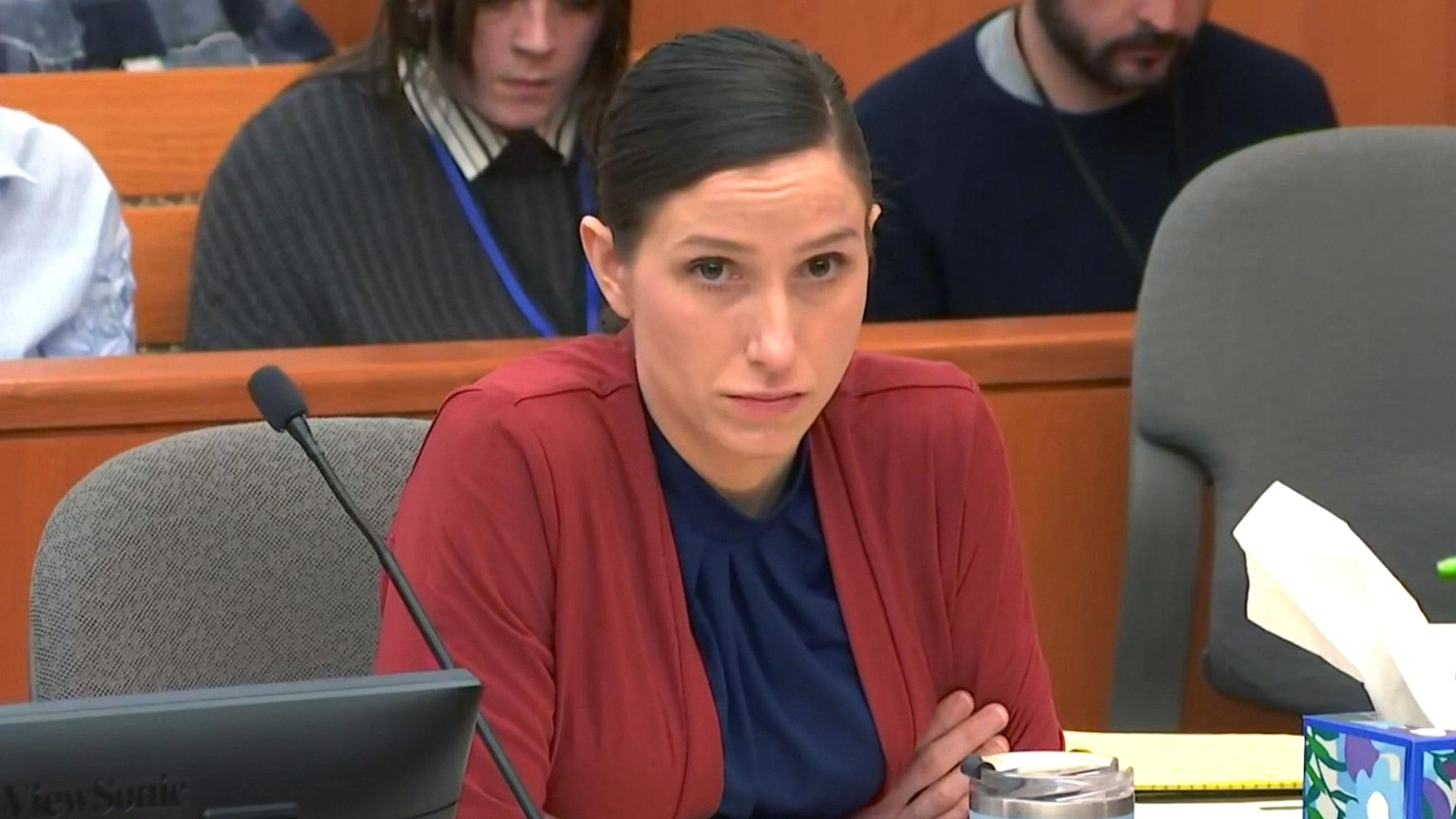

The Kouri Richins Murder Trial: A Tragic Tale of Alleged Betrayal and Fatal Deception
A House Cleaner’s Damning Testimony
In a Utah courtroom this week, the murder trial of Kouri Richins took a dramatic turn when her former house cleaner, Carmen Lauber, took the stand to deliver potentially devastating testimony. The 35-year-old realtor and mother of three stands accused of poisoning her husband, Eric Richins, with a lethal dose of fentanyl in March 2022. Lauber testified that she had purchased illicit fentanyl pills on behalf of Kouri on multiple occasions before Eric’s death, painting a disturbing picture of premeditation. According to Lauber’s account, Kouri initially approached her with what seemed like an innocent request—to buy pain medication for an investor she knew. What started as a simple favor allegedly evolved into three separate drug purchases, with Kouri reportedly requesting “something stronger” after each transaction. The final purchase, Lauber testified, involved fentanyl pills obtained from a second drug source. When Eric was found dead in their bed, and Lauber confronted Kouri about whether the pills had been for her husband, Kouri allegedly denied it, claiming Eric had died from a brain aneurysm. The testimony was emotional, with Lauber tearing up as she explained why she chose to cooperate with investigators despite her own legal troubles.
The Charges and the Evidence
The case against Kouri Richins is built on shocking allegations that read like a crime thriller. Prosecutors have charged her with aggravated murder in connection with Eric’s death, but that’s not all—she also faces attempted aggravated murder charges. According to the prosecution, Kouri made not one but two attempts on her husband’s life. The first alleged attempt occurred on Valentine’s Day 2022, just two weeks before Eric’s death, when prosecutors claim she gave him a sandwich laced with fentanyl. When that attempt apparently failed to kill him, she allegedly tried again on March 4, 2022, this time successfully spiking his cocktail with a massive dose of the deadly synthetic opioid. The autopsy results were chilling: Eric Richins, a 39-year-old stone mason and outdoor enthusiast, died from fentanyl intoxication with a blood concentration approximately five times the lethal dose. The medical examiner specifically determined that the fentanyl was illicit—not medical grade—which corroborates the prosecution’s theory that Kouri obtained the drugs illegally through Lauber. Eric’s death was initially unexplained, but a lengthy investigation eventually led authorities to charge Kouri more than a year later, after piecing together evidence that included witness testimony, text messages, and financial records.
Defense Strategy: Poking Holes in the Witness
The defense team representing Kouri Richins wasted no time in attacking the credibility of Carmen Lauber, the prosecution’s key witness. Defense attorney Wendy Lewis conducted an aggressive cross-examination designed to expose inconsistencies in Lauber’s story and question her motivations for testifying. Lewis highlighted several significant facts that could undermine Lauber’s reliability: she has a conviction for drug possession and distribution, faces pending marijuana and gun possession charges, and is testifying under multiple grants of immunity. The implication was clear—Lauber had every reason to tell investigators what they wanted to hear in order to avoid serious criminal consequences herself. Lewis pressed Lauber on the evolution of her story during police interviews, pointing out that she initially told detectives her memory “wasn’t the best” due to her past drug use. The defense suggested that Lauber only began referring to the drugs as fentanyl after detectives planted that word in her mind, and that she changed details about the drug transactions to align with the prosecution’s theory of the case. Lewis emphasized that during interviews, detectives had warned Lauber she could face a charge of distribution resulting in death—a serious federal offense—but then assured her they would “help her out” if she cooperated. Despite this withering cross-examination, Lauber stood by her testimony that her drug source had specifically told her he could get fentanyl pills and that Kouri had approved the purchase.
The Alleged Motive: Money, Affair, and a Fresh Start
Prosecutors have painted a portrait of Kouri Richins as a woman trapped in a marriage she desperately wanted to escape, motivated by financial desperation and romantic entanglement. According to the charging documents, Kouri’s realty company was drowning in debt, leaving her in significant financial distress. Investigators believe she calculated that she would be much better off financially with her husband dead than divorced—a cold calculus that allegedly led to murder. Beyond the money, prosecutors claim Kouri was having an extramarital affair and had confided to witnesses months before Eric’s death that she felt “stuck” and “trapped” in her marriage. Most chillingly, she allegedly told someone it would be better if Eric “just died.” During opening statements, prosecutor Brad Bloodworth framed the case in stark terms: “The evidence will prove that Kouri Richins murdered Eric for his money and to get a fresh start at life. More than anything, she wanted his money to perpetuate her facade of privilege, affluence and success.” This narrative suggests a woman so committed to maintaining an image of wealth and success that she was willing to kill the father of her three young sons to achieve it. The combination of financial pressure, romantic dissatisfaction, and the allure of insurance money and estate assets allegedly created the perfect storm of motivation for murder.
The Defense’s Alternative Theory
In their opening statement, the defense team didn’t deny that Kouri had obtained drugs—instead, they offered an entirely different explanation for why. Defense attorney Kathy Nester acknowledged that her client had purchased Oxycodone from Lauber, but claimed it was at Eric’s own request, not for nefarious purposes. According to this version of events, Eric Richins suffered from chronic back and knee pain due to his physically demanding work as a stone mason and his active outdoor lifestyle. The defense pointed out that Eric had recently returned from a trip to Mexico shortly before his death—a detail they suggested was highly significant. “Guess where the fentanyl comes into this country from—Mexico,” Nester reminded the jury, implying that Eric may have obtained the fatal drugs himself while abroad. The defense portrayed the Richins marriage not as irredeemably broken but as a normal relationship that had weathered some “rough times.” While they had contemplated divorce, Nester said, the couple had sought counseling and decided to work through their problems. This narrative presents Kouri as a devoted wife trying to help her husband manage his pain, not a cold-blooded killer plotting his demise. The defense’s theory requires the jury to believe that Eric’s death was either accidental—perhaps from drugs he obtained himself—or the result of some other explanation that doesn’t involve Kouri deliberately poisoning him.
The Aftermath and the Public Persona
Perhaps the most disturbing aspect of this case is what happened after Eric’s death. Rather than retreating from public view, Kouri Richins embarked on what now appears to many as a shockingly callous publicity campaign. She self-published a children’s book about grieving titled “Are You With Me?” which was ostensibly designed to help her three young sons cope with the loss of their father. Just one month before her arrest, Kouri appeared on a local television segment called “Good Things Utah” to promote the book, presenting herself as a grieving widow doing her best to help her children through an unimaginable tragedy. During that interview, she described her husband of nine years as having died “unexpectedly” in a way that “completely took us all by shock.” If the prosecution’s case is to be believed, this was an act of breathtaking deception—a woman who had allegedly murdered her husband now profiting from his death by selling a book about grief. The image of Kouri sitting in interviews, calmly discussing her loss while allegedly knowing she had caused it, has shocked many observers. As the trial continues, with Lauber’s cross-examination set to resume and more witnesses expected to testify, the question remains: was Kouri Richins a loving wife caught in tragic circumstances, or a calculating killer who poisoned her husband and then shamelessly exploited his death? The jury will ultimately have to decide which version of events to believe, but the testimony thus far has provided a window into a case that is as complex as it is tragic.