
The Unmasking of Banksy: Does Mystery Define the Art?
When Anonymity Becomes the Brand
Long before influencers perfected the art of personal branding on Instagram, one artist understood something profound about power and influence: sometimes the most effective way to be seen is to remain unseen. For decades, Banksy has operated in the shadows, creating provocative street art that challenges authority, questions social norms, and confronts injustice head-on. His identity has been as carefully guarded as state secrets, becoming an integral part of his artistic mythology. From spray-painting walls in Bristol to staging elaborate stunts at prestigious auction houses—including the now-legendary moment when one of his paintings self-destructed immediately after being sold—Banksy has built an empire on enigma. But recently, Reuters news agency published what many consider a definitive unmasking of the elusive artist, identifying him as Robin Gunningham, born around 1972, who later legally changed his name to David Jones. The revelation has sent shockwaves through the art world and sparked an intense debate: Does knowing the person behind the pseudonym diminish the power of the work itself?
The response from Banksy’s devoted following has been swift and emotionally charged. Many fans expressed genuine grief at losing the mystery that made following the artist’s career feel like being part of an exclusive club. Social media erupted with complaints directed at Reuters, with supporters accusing the news organization of ruining something precious and magical. Denver-based artist Thomas Evans captured the sentiment perfectly when he compared the experience to learning that Santa Claus isn’t real—that sudden, unwelcome transition from wonder to mundane reality. “I feel like they are telling me how a magic trick is done,” Evans lamented. “Sometimes I just want to enjoy the magic trick.” This reaction speaks to something deeper than simple fandom; it reflects how Banksy’s anonymity had become woven into the fabric of his appeal, creating a participatory mystery that made audiences feel like co-conspirators rather than passive consumers. The question that now hangs in the air is whether revealing the person behind the stencils strips away an essential layer of meaning from the art itself.
The Art Survives the Artist
Despite the passionate outcry from some fans, many experts in the art world remain remarkably unconcerned about the impact of Banksy’s apparent unmasking. Their perspective offers a more measured view: that while anonymity was certainly part of the Banksy phenomenon, it was never the entirety of his appeal. Acoris Andipa, director of the respected Andipa gallery in London, points out that collectors invest in Banksy’s work because they genuinely love the pieces themselves—the sharp social commentary, the technical skill, the dark humor, and the fearless confrontation of power. “The main feedback that I get is that they really, frankly, don’t care if they know who he is,” Andipa explains. This perspective suggests that Banksy’s value lies not in the puzzle of his identity but in what his art represents and accomplishes in the world.
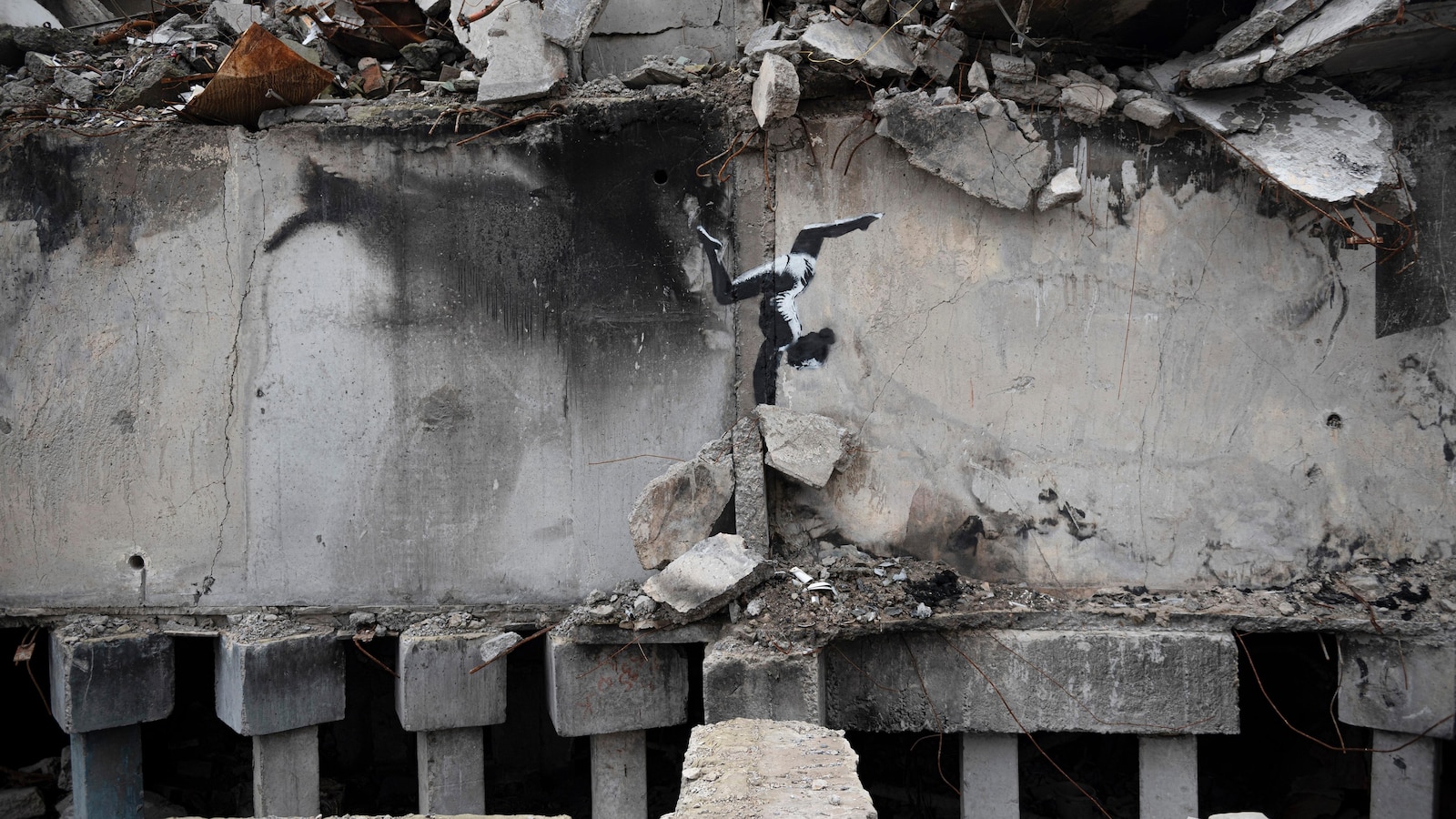
Banksy’s body of work speaks to universal human concerns that transcend any individual identity. His murals serve as powerful witnesses to injustice, oppression, and inequality across the globe. From the streets of his native England to the separation barrier in Bethlehem, from the bombed-out buildings of war-torn Ukraine to the gentrified neighborhoods of New York, Banksy’s art creates moments of reflection in unexpected places. In late 2022, as Reuters discovered through their investigation, someone matching the artist’s profile traveled to Ukraine and created seven powerful murals amid the devastation of Russian bombardment, including one depicting a child flipping an adult wearing a black belt—a clear reference to Vladimir Putin’s judo practice. These works function as acts of solidarity with victims of war, offering beauty and defiance in places scarred by violence. The power of that gesture exists independently of whether we call the artist Banksy, Robin Gunningham, or David Jones. The message transcends the messenger.
The Evolution of a Street Art Legend
Banksy emerged from a rich tradition of street artists who viewed unauthorized public art as a form of rebellion against establishment control of cultural spaces. The postindustrial landscape of Bristol provided his first canvas, where abandoned buildings and neglected walls became galleries accessible to everyone, not just those who could afford museum admission. As his reputation grew, the walls of London, New York, and eventually cities worldwide became his exhibition spaces, all perfectly timed with the rise of social media that would amplify his reach exponentially. What began as local guerrilla art became a global phenomenon, with each new piece generating instant international attention and debate.
Interestingly, Banksy’s identity was never quite as secret as it seemed. Fellow artists in Bristol’s tight-knit street art community have long known who he is, protecting one of their own with admirable loyalty. For those curious enough to search online, the name Robin Gunningham has been floating around since at least 2008, when The Daily Mail published what they called “compelling evidence” linking that name to the artist. Other outlets, including The Associated Press, have referenced this identification in subsequent years. What Reuters added to the story was investigative journalism that tracked the artist’s movements and financial footprint, discovering that after The Daily Mail’s initial report, someone named Robin Gunningham legally changed his name to David Jones—choosing the second most common name in Britain, and coincidentally sharing it with the late David Bowie, whose Ziggy Stardust alter ego Banksy had honored in a 2012 painting of Queen Elizabeth II.
When the Outlaw Becomes the Establishment
One of the most intriguing aspects of Banksy’s career is how he’s managed to maintain his outsider status even as the establishment he once protested has embraced him. This paradox is perfectly illustrated by an incident involving the Royal Courts of Justice, which carefully removed a Banksy stencil showing a bewigged judge beating an unarmed protester with a gavel. The piece was preserved rather than destroyed, treated as valuable art rather than vandalism—a courtesy that other street artists bitterly note they would never receive. For them, similar work would likely result in arrest and criminal charges; for Banksy, it’s cultural heritage worth preserving.
Yet there’s evidence suggesting the artist himself has faced consequences for his work. Reuters uncovered court records from September 17, 2000, documenting the arrest of a Robin Gunningham in New York for defacing a Marc Jacobs billboard on Hudson Street. In a handwritten confession, the defendant explained that after a night of drinking with friends, he “decided to make a humorous adjustment to a billboard,” adding “eyeshadow a new mouth and a speach bubble” to a male model’s photograph. He was charged with a misdemeanor—a reminder that before Banksy became a household name commanding millions at auction, he was just another graffiti artist risking arrest for unauthorized public art. This biographical detail, if accurate, reveals the artist’s evolution from small-time vandal to internationally recognized cultural commentator while maintaining the same irreverent spirit.
The Publicity Stunt Speculation
In the aftermath of Reuters’ report, a fascinating theory has emerged among art world insiders and social media sleuths: What if Banksy orchestrated his own unmasking? The artist’s career has been defined by elaborate stunts and satirical gestures that blur the lines between art, performance, and media manipulation. The self-shredding painting at Sotheby’s, the Dismaland “bemusement park,” the hotel with “the worst view in the world” overlooking Bethlehem’s separation wall—these aren’t just artworks but carefully choreographed events designed to generate conversation and challenge assumptions. Could the apparent revelation of his identity be the next chapter in this ongoing performance?
Madeleine White, senior sales and acquisitions consultant at London’s Hang-Up Gallery, observes that such a move “would be very much in line with his practice of stunts and satire,” noting the old adage that “all publicity is good publicity.” Significantly, Banksy himself has not denied the Reuters story, and neither his lawyer nor his spokeswoman has issued a clarification or contradiction. This silence could be strategic, allowing speculation to build and keeping the artist at the center of cultural conversation. What’s particularly telling is that the public backlash has been directed entirely at Reuters for “spoiling” the mystery, not at the artist himself. If this was indeed a Banksy production, it’s been remarkably effective at generating exactly the kind of debate that has always surrounded his work, turning his own identity into yet another piece of conceptual art that forces us to question our relationship with celebrity, privacy, and authenticity.
The Enduring Power of Presence Over Identity
Ultimately, the question of Banksy’s “real” name may be less important than what his work represents and accomplishes in the world. Art experts like Joe Syer, a Banksy specialist and founder of MyArtBroker, argue that the artist’s anonymity never functioned primarily as a celebrity gimmick but rather as a way to keep the work “universally accessible, detached from personality, ego, or biography.” By refusing to become a recognizable figure, Banksy allowed his art to exist in public spaces purely on its own terms, speaking to political and cultural issues without being filtered through the lens of personal biography that typically frames artistic interpretation. The work could simply be there—in war zones, on contested borders, in gentrified neighborhoods—carrying its message without the distraction of celebrity personality.
Christopher Banks, founder of the New York-based Objects of Affection Collection, offers perhaps the most insightful perspective, viewing the naming “not as a biographical event, but as a structural stress test” of how Banksy’s system functions. His observation cuts to the heart of the matter: “Banksy’s best works carry their meaning without the author. He was there,” referencing the Ukrainian murals and the solidarity they represent. “The name matters less than the presence. The presence was always what the work was about.” This suggests that even if we now know the artist’s birth name and legal name, it doesn’t fundamentally alter the relationship between the work and its audience. The murals on bombed buildings in Ukraine carry the same weight of witness and defiance regardless of whether we call their creator Banksy, Robin, or David. The art endures because it was never really about one person’s identity—it was about creating moments of beauty, provocation, and reflection in unexpected places, using public space to democratize access to art and social commentary. In the end, perhaps the true magic trick wasn’t keeping his name secret, but making us believe that knowing it would change anything at all.