


Michigan Wolverines Claim Historic National Championship, Ending 26-Year Title Drought
A Hard-Fought Victory Against a Dynasty in the Making
Monday night witnessed one of the grittiest performances in recent NCAA men’s basketball championship history as the Michigan Wolverines defeated the UConn Huskies 69-63 at Lucas Oil Stadium in Indianapolis. The victory ended a 26-year national championship drought for the Big Ten conference and secured Michigan’s second NCAA title in the program’s storied history—their first since the “Fab Five” era concluded in 1989. This wasn’t a game that will be remembered for its aesthetic beauty or offensive fireworks. Instead, it was a defensive slugfest that had the feel of basketball from a bygone era, where every possession was contested, every bucket was earned through blood, sweat, and determination. The Wolverines came into the tournament as an offensive juggernaut, having become the first team to score over 90 points in five consecutive tournament games. But on this night, they showed they could win ugly, grinding out a victory against a UConn program attempting to cement itself as a modern dynasty by capturing its third championship in four years—a feat not accomplished since John Wooden’s legendary UCLA teams dominated the sport in the 1960s and 70s.
The Stars Who Rose to the Occasion
Freshman guard Elliot Cadeau emerged as the unlikely hero for Michigan, leading all Wolverines scorers with 19 points in a game where offense was harder to find than a parking spot in downtown Indianapolis. His performance was particularly crucial given that Michigan’s best player, graduate transfer Yaxel Lendeborg, was clearly hampered by injuries to both his knee and foot that prevented him from elevating on his shots. Lendeborg, who transferred from UAB, managed just 13 points on an inefficient 4-for-13 shooting, a far cry from the dominant performances he’d delivered throughout Michigan’s tournament run. The game’s complexion changed dramatically when Cadeau finally broke Michigan’s three-point shooting drought, draining the team’s first triple with 7:04 remaining in the second half. The Wolverines had missed their first eleven attempts from beyond the arc, and the arena erupted when Cadeau’s shot finally found the bottom of the net. The second three-pointer of the night for Michigan came from another freshman, Trey McKenney, whose shot with 1:50 remaining felt like a dagger through UConn’s championship hopes, extending Michigan’s lead to nine points. McKenney would prove crucial again in the final seconds, calmly sinking two free throws to seal the victory and bring Michigan’s free throw shooting to an impressive 25-for-28 on the night—a stark contrast to their struggles from long range, where they finished a dismal 2-for-15.
UConn’s Valiant But Unsuccessful Quest for History
For UConn and their fiery head coach Dan Hurley, the loss represented a bitter end to what had been another magnificent season. The Huskies entered the championship game with designs on becoming the first program since John Wooden’s UCLA dynasty to win three championships in four years, but they simply couldn’t overcome their own shooting woes and massive foul trouble that plagued them throughout the evening. UConn finished shooting just 30.9% from the field and, mirroring Michigan’s struggles, missed their first eleven three-point attempts of the second half. Despite the loss, certain UConn players refused to go quietly into the night. Alex Karaban fought valiantly, finishing with 17 points, and Braylon Mullins—the hero of UConn’s Final Four victory over Duke—kept launching shots even as they refused to fall, finishing 4-for-17 from the field. However, Mullins did connect on a pair of late three-pointers that kept UConn within striking distance. Solo Ball also provided a moment of hope, banking in a three-pointer with just 37 seconds remaining to cut Michigan’s lead to four points. The most heartbreaking moment for UConn came after Michigan missed two free throws, giving the Huskies one final opportunity. Karaban launched a three-pointer that would have cut the deficit to just one point with 17 seconds remaining, but the shot barely grazed the rim, and with it went UConn’s hopes of a third title. In a gesture that spoke volumes about Hurley’s competitive nature and perhaps his desire to teach his team a lesson about embracing defeat with eyes open, the coach kept his players on the court to watch the entire trophy presentation ceremony, witnessing the championship hardware head to Ann Arbor rather than back to Storrs, Connecticut.
A Game From Another Era
Head coach Dusty May perfectly captured the essence of this championship game when he described it as having “a 1950s feel to it.” This wasn’t the high-flying, three-point shooting extravaganza that has come to define modern college basketball. Instead, it was a defensive struggle where every possession felt like a battle in the trenches, where the 69 combined points would have been considered respectable in the pre-shot clock era. May’s postgame comments revealed his own disbelief at the manner of victory: “If you’d told me we would shoot it this poorly and be dominated on the glass and still find a way to win, I don’t know if I would have believed you. This team just found a way all season.” Indeed, Michigan’s ability to win despite shooting just 2-for-15 from three-point range and being outrebounded by a UConn team featuring superior size and athleticism speaks to the Wolverines’ resilience and mental toughness. This was a team that had steamrolled opponents throughout the tournament, featuring 7-foot-3 center Aday Mara and a defense that had amassed eight or more blocks in each of their first four tournament games—the first time that feat had been accomplished since blocks became an official statistic in the 1980s. Against Arizona in the Final Four, Michigan had scored 91 points in what was supposed to be the competitive game of the tournament but turned into a rout. Yet when faced with adversity in the championship game, when their offensive rhythm abandoned them and their best player was clearly compromised by injury, the Wolverines found another way to win, proving that championship teams aren’t defined by style points but by the ability to secure victory regardless of circumstances.
The Portal-Built Champions and the New College Basketball Reality
Perhaps the most fascinating storyline surrounding Michigan’s championship run is the composition of the roster itself. All five of Michigan’s starting players had played college basketball at other institutions, and all except Nimari Burnett had arrived in Ann Arbor just this season. This is the new reality of college basketball in the transfer portal era, where programs can essentially rebuild their entire roster in a single offseason, and coaches who master the art of talent acquisition and rapid team-building hold a significant competitive advantage. Critics have labeled teams like Michigan as “mercenaries,” a collection of hired guns with no genuine connection to the university they represent, simply chasing championships and NIL money. Lendeborg directly addressed these criticisms during the trophy presentation, declaring: “They might be still calling us mercenaries but we’re the hardest-working team. We’re the best in college basketball and we’ll be one of the greatest ever.” His words highlight the defensive posture that portal-built teams must adopt against accusations that their success is somehow less legitimate than programs that develop players over multiple years. Dusty May has shown no reluctance in utilizing the transfer portal to build a championship contender, but his ability to take a group of players who had never played together before and forge them into a cohesive unit capable of winning a national championship should not be understated. Chemistry cannot be transferred or purchased—it must be built through coaching, culture, and shared sacrifice.
A Season Nobody Will Forget
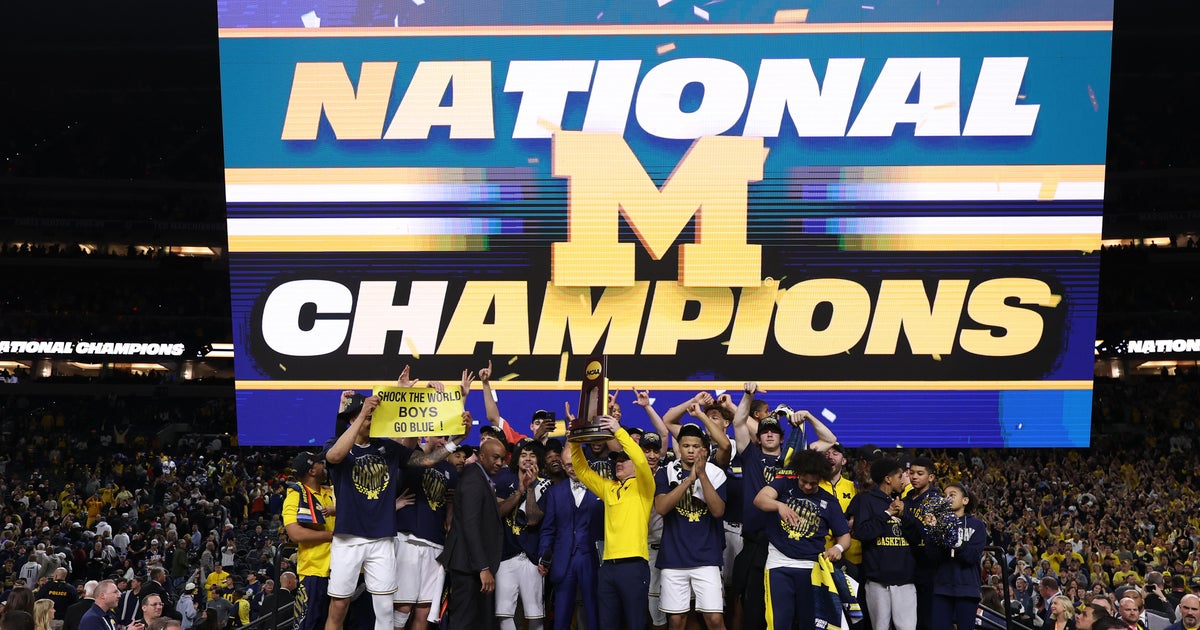
As confetti rained down on the court at Lucas Oil Stadium and Dusty May hoisted the championship trophy above his head, the 2026 Michigan Wolverines cemented their place in college basketball history. Elliot Cadeau, standing on the presentation stage surrounded by falling confetti, summed up the team’s mentality perfectly: “Nobody cared about stats the whole season. Nobody cared about nothing but winning.” That singular focus on winning, regardless of individual accolades or style points, defined Michigan’s championship run from start to finish. The Wolverines finished the season with an impressive 37-3 record, overcoming adversity, criticism, and a UConn team desperate to establish itself as a modern dynasty. While UConn covered the 6.5-point spread and certainly didn’t embarrass themselves in defeat, finishing with a 35-5 record, this night belonged to Michigan. For the Big Ten conference, the championship represented validation after 26 years of watching other conferences claim college basketball’s ultimate prize. For Ann Arbor, it meant celebration would continue long into the night and beyond, as a fan base that had waited more than a quarter-century for another title finally had something to celebrate. Whether this Michigan team will be remembered as “one of the greatest ever,” as Lendeborg boldly proclaimed, remains to be seen. But on this Monday night in Indianapolis, they were undeniably the best team in college basketball, and they have the championship trophy to prove it—regardless of how they got there or where their players came from.