


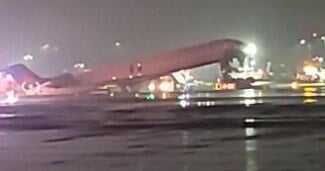

LaGuardia Airport Incident: Air Canada Express Plane Collides with Ground Vehicle
Airport Operations Halted Following Runway Collision
Late Sunday night brought unexpected chaos to New York’s LaGuardia Airport when an incoming Air Canada Express aircraft was involved in a collision with a ground vehicle on one of the airport’s runways. The incident, which was reported by multiple aviation tracking services including FlightRadar24, immediately triggered emergency protocols and resulted in the closure of one of New York City’s busiest airports. What should have been a routine landing turned into a significant aviation incident that captured the attention of federal authorities, local emergency services, and countless travelers whose plans were suddenly thrown into disarray. The collision represents yet another challenge for an airport that has long been working to improve its infrastructure and safety record while managing the constant demands of serving millions of passengers in one of the world’s most congested airspaces.
Federal Response and Ground Stop Implementation
The Federal Aviation Administration wasted no time in responding to the emergency situation, immediately issuing a ground stop for LaGuardia Airport. According to reports from the French news service AFP, aviation officials indicated there was a “high” likelihood that this ground stop order would be extended beyond the initial emergency period. A ground stop is one of the most serious operational decisions an airport can make, effectively freezing all departures and potentially diverting incoming flights to alternative airports. This decision reflects the gravity of the situation and the need to ensure passenger safety while investigators work to understand exactly what happened on that runway. The FAA’s quick action demonstrates the robust safety protocols that exist within American aviation infrastructure, where any incident that could potentially compromise safety results in immediate and comprehensive responses, regardless of the inconvenience to travelers or airlines.
Emergency Services Deploy to Incident Scene
The New York Fire Department confirmed their rapid deployment to the scene, with a spokesperson telling CBS News that crews “responded to a reported incident involving a plane and vehicle on runway.” This response would have included specialized airport rescue and firefighting (ARFF) units, which are specifically trained and equipped to handle aviation emergencies. These specialized teams maintain constant readiness at major airports precisely for situations like this one, where the potential for fire, fuel spills, or passenger injuries requires immediate expert intervention. The New York Police Department’s public information bureau also confirmed the collision to CBS News, indicating that multiple city agencies were coordinating their response. This multi-agency approach is standard procedure for airport incidents, ensuring that all aspects of emergency response, from immediate medical care to scene security and investigation support, are handled by the most appropriate personnel.
Investigation Begins as Transportation Safety Board Takes Lead
The National Transportation Safety Board, America’s premier aviation accident investigation agency, confirmed to CBS News that it had received notification of the incident and would be involved in determining what went wrong. When the NTSB becomes involved in an aviation incident, it signals that federal authorities are treating the matter with the utmost seriousness. The agency’s investigators are renowned for their thorough, methodical approach to understanding every factor that contributes to aviation accidents and incidents. They will examine everything from radio communications between the aircraft and air traffic control, to the movements and authorization of the ground vehicle, to weather conditions, visibility, and the airport’s ground traffic management systems. This investigation could take weeks or even months to complete, as the NTSB leaves no stone unturned in its quest to understand what happened and, more importantly, how similar incidents can be prevented in the future.
Understanding Airport Ground Operations and Potential Risks
Airport runways are highly controlled environments where precise coordination between aircraft, ground vehicles, and air traffic controllers is absolutely essential for safe operations. Ground vehicles at airports serve numerous critical functions, from aircraft maintenance and fueling to baggage handling and runway inspection. Each of these vehicles operates under strict protocols and requires specific authorization before entering active runway areas. The collision at LaGuardia raises important questions about how a ground vehicle came to be in the path of an arriving aircraft. Was there a breakdown in communication? Did someone misunderstand their clearance? Were there visibility issues or equipment failures? These are exactly the types of questions that NTSB investigators will be working to answer. Modern airports use sophisticated ground radar systems and communication protocols designed to prevent exactly this type of incident, making any breach of these safety systems a matter of serious concern for aviation authorities.
Impact on Travelers and Airport Operations Moving Forward
For the countless travelers passing through LaGuardia Airport, this incident served as a stark reminder of the complex choreography required to keep modern aviation safe and efficient. The immediate impact was significant disruption to flight schedules, with departures halted and arrivals potentially diverted to nearby airports like John F. Kennedy International or Newark Liberty International. Passengers already at the airport likely faced extended delays, while those planning to travel to or from LaGuardia in the coming hours would have needed to check with their airlines for updated flight information. Beyond the immediate operational impacts, this incident will likely prompt a comprehensive review of ground operations procedures at LaGuardia and potentially other airports across the country. While the full details of what occurred remain under investigation, the aviation community’s commitment to learning from every incident, no matter how minor or major, helps ensure that air travel remains one of the safest forms of transportation available. The professionalism demonstrated by the FAA, emergency responders, and airport personnel in their immediate response to this incident reflects the layers of safety culture that protect millions of passengers every single day.