

Chaos at Houston Airport: A Ground-Level Look at America’s TSA Crisis
Unprecedented Wait Times Create Travel Nightmare
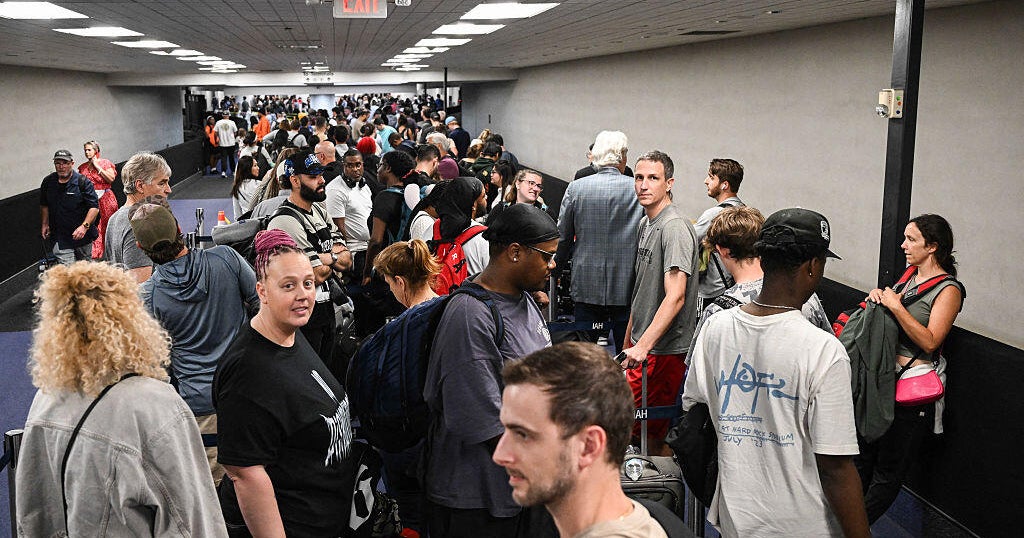
Houston’s George Bush Intercontinental Airport has become ground zero for one of the most severe travel disruptions in recent memory, with passengers facing wait times that seem almost unbelievable in modern America. Our CBS News team experienced the chaos firsthand, spending two grueling hours navigating a security line that snaked through three different terminals and into the airport’s basement subway corridor. But our experience was relatively fortunate compared to many travelers around us. By late Tuesday morning, the security line in Terminal E had grown so long it extended three full stories, spilling outside the terminal building and winding around bus drop-off stations. In Terminal A, the situation was equally dire, with lines stretching across three levels and wrapping through three terminals in the basement subway area—a space never designed for human occupancy for extended periods, lacking basic amenities like food vendors, water fountains, functional air conditioning, or accessible restrooms. Cell phone service was spotty at best, leaving travelers unable to easily notify loved ones or employers of their predicament. The line’s serpentine path took passengers on an exhausting journey: starting in the basement corridor, winding up escalators to the baggage claim area, looping through another set of escalators, and finally emerging at the third-floor ticketing area. For many, this odyssey took not two hours, but five or more.
The Human Cost of Government Dysfunction
The scenes throughout the airport told stories of exhaustion, frustration, and resignation that went far beyond mere inconvenience. Families with young children struggled to keep their kids entertained and calm during waits that stretched longer than many cross-country flights. The cries of infants echoed through the corridors, their normal routines completely disrupted. Pets confined to carriers for hours showed visible signs of stress, and their owners faced the impossible choice between staying in line and tending to their animals’ basic needs. Nearly everyone in the security line around our CBS News team was missing their scheduled flights, with most having already accepted this reality and simply planning to rebook once they finally cleared security. The airport’s overhead announcement system periodically delivered what had become a grimly routine message: passengers with departures scheduled within the next four hours should consider rebooking immediately. One traveler’s story particularly captured the absurdity of the situation. Summer Martinez spoke with CBS News about her attempts to fly to Tulsa—she had already missed three flights and was now making her fourth attempt to actually board a plane. Her perseverance, while admirable, highlighted how the crisis had transformed air travel from a routine activity into an endurance test that required multiple days and attempts to accomplish what should take hours.
Empty Planes and Strained Operations
The ripple effects of the TSA staffing shortage extended far beyond long lines, fundamentally disrupting the entire aviation ecosystem at one of America’s busiest airports. A pilot boarding the airport tram shared a telling statistic with fellow passengers: his busiest flight the previous day had departed with just 50 passengers aboard a 220-seat aircraft. Other flights, he noted, were carrying even fewer people. These near-empty planes represented not just lost revenue for airlines, but wasted fuel, unnecessary carbon emissions, and the frustration of passengers who had successfully cleared security but found their flights delayed or canceled due to crews that couldn’t get through security in time. The root cause of this operational collapse was stark: TSA staffing at Houston’s airport had fallen to approximately 36% of normal levels, a shortage that had persisted for several days. While Immigration and Customs Enforcement (ICE) personnel had reportedly been reassigned to assist with security screening, their presence was not evident during the Tuesday morning crisis our team observed. The disconnect between announced solutions and on-the-ground reality only deepened the sense that the situation had spiraled beyond anyone’s ability to quickly control it.
A Surprising Solidarity Among the Stranded
Despite hours-long waits in uncomfortable conditions, the atmosphere among passengers revealed something unexpected about how Americans were processing this crisis. Tensions were certainly high, but the frustration wasn’t primarily directed at the TSA officers working the security checkpoints. Instead, many travelers expressed genuine sympathy for these frontline workers, recognizing that they had been placed in an impossible situation through no fault of their own. Conversations in line frequently centered on broader political frustrations with Washington rather than anger at individual TSA employees. Passengers understood that the officers screening bags and checking IDs were themselves victims of the funding impasse—working without pay while facing the impossible task of processing normal passenger volumes with roughly one-third of normal staffing. This recognition created an unusual sense of solidarity between screeners and the traveling public, a rare moment of shared understanding that both groups were suffering due to decisions made far from the airport. The political frustration found expression in gallows humor and calls for accountability. “Remember to vote,” one traveler called out to the crowd. “For who?” another immediately responded, prompting laughter that carried equal parts amusement and bitterness. The exchange captured the mood: Americans were angry, but that anger was diffuse, directed at a political system that seemed incapable of performing basic governmental functions.
The Funding Fight Behind the Crisis
The immediate cause of Houston’s airport chaos—and similar scenes playing out at major airports across the country—stems from a political standoff over Department of Homeland Security funding that has resulted in a partial government shutdown now stretching into its sixth week. The Transportation Security Administration, as part of DHS, has been operating without full funding, leading to the severe staffing shortages creating havoc for travelers. As of the latest reports, the Senate appeared to be closing in on a deal that would restore funding to the Department of Homeland Security, with one notable exception: Immigration and Customs Enforcement would remain separately funded. Some senators expressed cautious optimism that the impasse could be resolved by week’s end, though such predictions had been made before during this protracted standoff. The funding situation for ICE was particularly complex, as the agency had already been funded separately through 2029 under last year’s “One Big Beautiful Bill Act,” adding another layer of legislative complexity to an already tangled situation. For TSA workers on the front lines, the political maneuvering in Washington translated into very real financial hardship. They were almost certain to miss their second complete paycheck of the shutdown on the coming Friday. After the shutdown began 39 days prior, they had received one partial paycheck containing only half their normal pay. Even if Congress reached a deal and the President signed funding legislation this week, TSA workers would still face approximately five more business days before seeing their paychecks restored—meaning the financial pain would continue even after a political resolution.
No End in Sight as Travelers Adapt to New Reality
As Tuesday wore on at George Bush Intercontinental Airport, it became clear that the situation represented not a temporary glitch but a new operational reality that could persist for days or weeks more. Airport operations remained severely strained, with no immediate relief visible on the horizon despite the political negotiations in Washington. Travelers were being forced to adapt their expectations and plans around what had become an unpredictable and unreliable system. The crisis at Houston’s airport serves as a microcosm of broader questions about government functionality and the real-world consequences of political gridlock. When funding disputes in Washington drag on for weeks, the impact isn’t abstract—it’s families missing reunions, business travelers unable to reach important meetings, and workers going without paychecks while still being expected to show up and perform their duties. The empty planes, the children crying in endless security lines, and the exhausted TSA officers trying to process impossible volumes of passengers all represent the human cost of dysfunction at the highest levels of government. As the nation watches to see whether senators can indeed reach a deal by week’s end, thousands of travelers continue to arrive at airports across the country, uncertain whether they’ll reach their destinations on schedule or join the ranks of those spending hours in line, missing flights, and wondering when air travel will return to something resembling normalcy. For now, the prevailing advice for anyone planning to fly through Houston or other affected airports remains simple but dispiriting: arrive extraordinarily early, prepare for the worst, and hope for the best.