


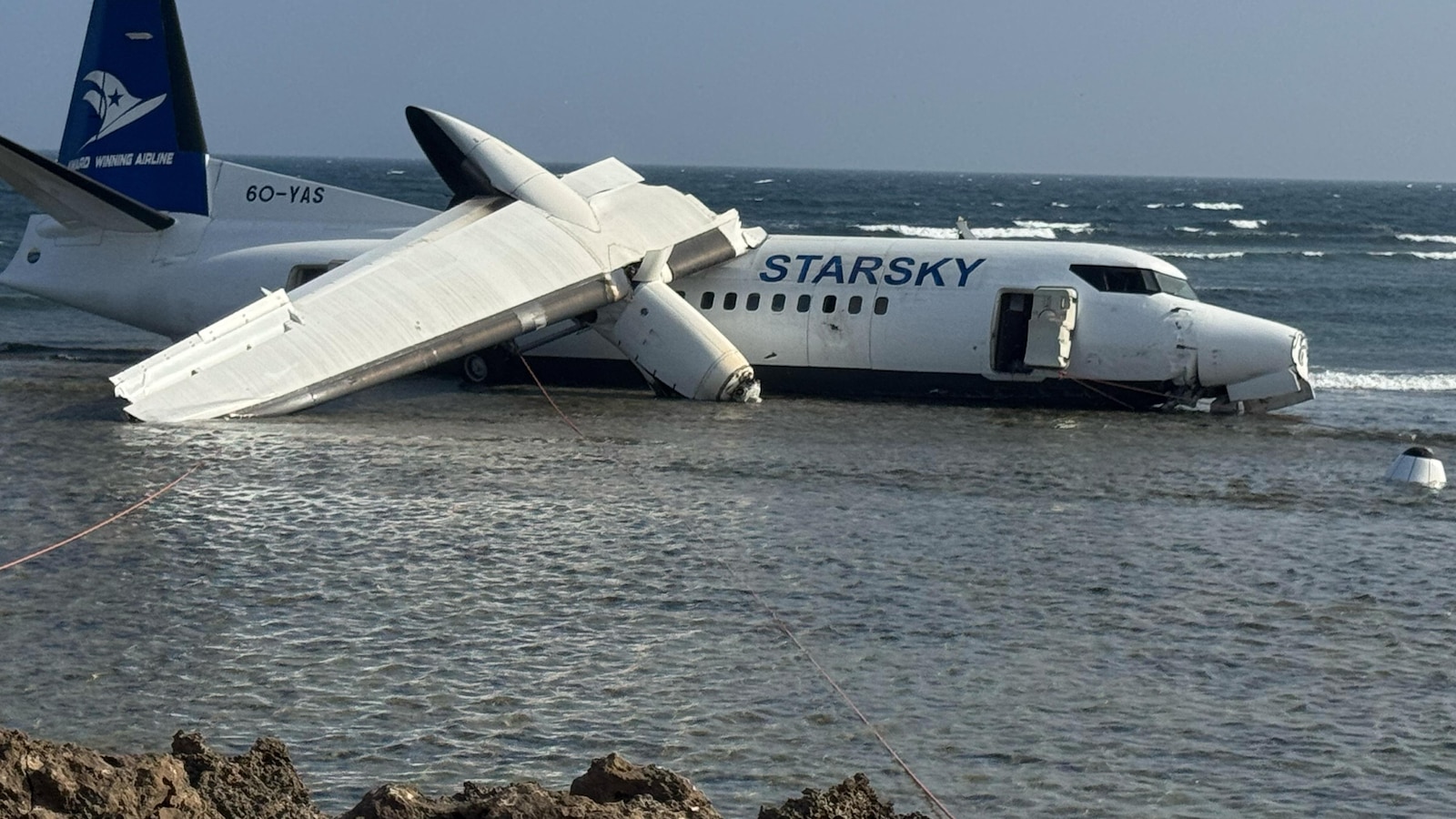

Narrow Escape at Mogadishu Airport: Plane Overshoots Runway Into Ocean Waters
Emergency Landing Ends Without Casualties
In what could have been a devastating tragedy, a commercial passenger aircraft carrying 55 people aboard dramatically overran the runway at Somalia’s busiest airport on Tuesday, ultimately coming to rest in the shallow waters of a nearby beach along the Indian Ocean. The Starsky Aviation flight, which was departing from Mogadishu’s Aden Abdulle International Airport bound for the northern Somali city of Gaalkacyo, experienced technical difficulties shortly after takeoff that forced the pilots to attempt an emergency return to the airport. Despite the harrowing circumstances and the aircraft’s final resting place partially submerged in coastal waters, all 50 passengers and 5 crew members emerged from the incident completely unharmed, according to airline officials and government authorities.
The incident serves as a reminder of both the unpredictable nature of air travel and the critical importance of proper emergency response procedures. Ahmed Nur, the Chief Executive Officer of Starsky Aviation, confirmed in an official statement that while “the aircraft overran on the runway” before settling on the shoreline of the Indian Ocean adjacent to the airport grounds, the outcome was as positive as could be hoped for given the circumstances. “No injuries, no deaths,” Nur emphasized, highlighting what many are calling a miraculous outcome to a potentially catastrophic situation. The successful evacuation of all individuals aboard the aircraft speaks to the professionalism of the flight crew and the effectiveness of emergency protocols that kicked into action the moment the aircraft began experiencing difficulties.
Technical Problems Force Emergency Return
According to Ahmed Moalim, the Director of Somalia’s Civil Aviation Authority who spoke with local media outlets about the incident, the aircraft had been airborne for approximately 15 minutes when the flight crew first detected technical problems that would ultimately force them to abort their journey to Gaalkacyo. While the specific nature of the technical malfunction has not been publicly disclosed pending a full investigation, the issue was serious enough that the pilots made the critical decision to turn the aircraft around and attempt an emergency landing back at Mogadishu’s Aden Abdulle International Airport. This decision, while undoubtedly difficult and made under extreme pressure, likely prevented a far worse outcome had the crew attempted to continue the flight with a compromised aircraft. The 15-minute window between takeoff and the recognition of the problem suggests that whatever went wrong with the aircraft manifested relatively quickly, giving the pilots limited time to assess the situation and determine the safest course of action for everyone aboard.
Dramatic Runway Overrun Leads to Ocean Landing
The most dramatic moments of the incident occurred during the attempted emergency landing itself, when the aircraft failed to stop within the confines of the runway and instead continued past the designated landing area. Moalim explained that during the landing approach, the aircraft veered off the runway and traveled beyond the airport’s perimeter until it reached the shoreline of the Indian Ocean, where it finally came to a complete stop in shallow water. The geography of Mogadishu’s Aden Abdulle International Airport, which is located in close proximity to the coastline, meant that the overrunning aircraft had limited distance to travel before encountering the beach and ocean waters. While runway overruns can have catastrophic consequences depending on what lies beyond the end of the runway—whether buildings, rough terrain, or steep drops—in this case, the relatively soft landing area provided by the beach and shallow water may have actually contributed to the absence of injuries by gradually slowing the aircraft rather than bringing it to a sudden, violent stop.
Swift Rescue Operations Account for All Aboard
Somalia’s Transportation Minister, Mohamed Farah Nuh, commended the rescue team for their swift and efficient response to the emergency, noting that they managed to account for every single person who had been aboard the aircraft. The evacuation process, which successfully removed all 55 individuals from the compromised aircraft without any reported injuries, demonstrated the preparedness of airport emergency services to respond to such incidents. Minister Nuh confirmed that while all passengers and crew members escaped unharmed, the aircraft itself sustained damage during the incident—the full extent of which will be determined as part of the forthcoming investigation. The minister’s statement provided reassurance to the public that despite the dramatic nature of the accident, human life was prioritized and protected throughout the emergency response. The fact that rescue personnel were able to quickly mobilize and safely evacuate everyone from an aircraft that had come to rest partially in ocean waters speaks to their training and readiness for such contingencies.
Investigation to Determine Root Causes
As is standard procedure following any aviation incident of this magnitude, Minister Nuh announced that a comprehensive investigation would be launched to determine the exact causes of the crash and the sequence of events that led to the runway overrun. This investigation will likely examine multiple factors, including the specific technical problem that forced the emergency landing, the aircraft’s maintenance history, the decisions made by the flight crew during the emergency, weather conditions at the time of the incident, and the condition of the runway itself. Investigators will also review flight data recorders and cockpit voice recorders if available, interview the pilots and crew members, and inspect the damaged aircraft for any evidence of mechanical failure or other contributing factors. The findings of such investigations are crucial not only for understanding what went wrong in this particular incident but also for identifying any safety improvements or procedural changes that might prevent similar occurrences in the future. For Starsky Aviation, the investigation represents an opportunity to demonstrate transparency and commitment to safety, while for Somalia’s aviation authorities, it provides valuable data for enhancing the overall safety of air travel in the country.
Broader Context and Reflections on Aviation Safety
This incident at Mogadishu’s main airport, while ending without loss of life or injury, nonetheless highlights the ongoing challenges facing aviation in Somalia and the broader region. Somalia has been working to rebuild and modernize its aviation infrastructure following decades of conflict and instability, and incidents like this underscore the importance of continued investment in airport facilities, aircraft maintenance, pilot training, and emergency response capabilities. The successful outcome of Tuesday’s emergency landing—with all 55 people aboard walking away unharmed—represents both a testament to the skill of the flight crew and a stroke of good fortune given the circumstances. For the passengers who lived through this frightening experience, the incident will likely remain vivid in their memories as a reminder of how quickly routine travel can become a life-threatening emergency, and how the difference between tragedy and survival can come down to split-second decisions, proper training, and sometimes simple luck. As Somalia continues to develop its aviation sector and connect its cities through air travel, ensuring that safety remains the paramount concern will be essential for building public confidence and supporting the country’s economic development and connectivity goals.