


Pope Leo XIV Makes Historic Good Friday Statement by Carrying Cross Through All 14 Stations
A Powerful Return to Tradition
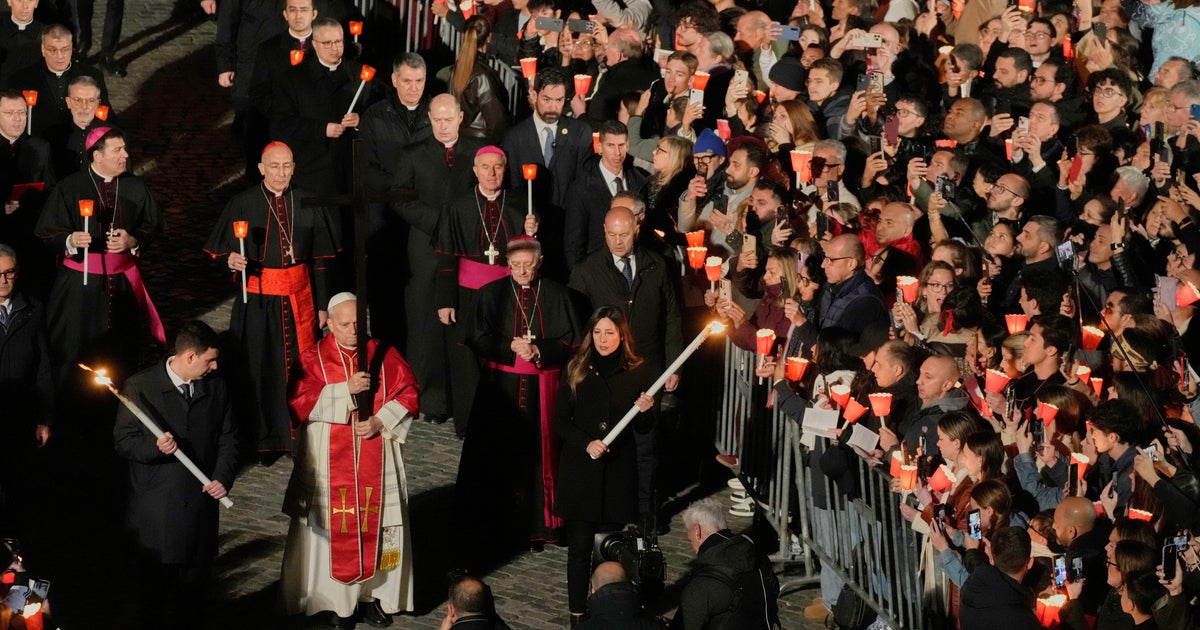
In a deeply meaningful gesture that resonated with Catholics worldwide, Pope Leo XIV personally carried a wooden cross through all 14 stations of the Way of the Cross at Rome’s ancient Colosseum during his first Good Friday as pontiff. This marked a historic moment, as it had been decades since a pope had physically carried the cross through the entire traditional procession. The hourlong ceremony began inside the iconic Colosseum, with Leo lifting the five-foot wooden cross and proceeding through the gathered crowds, flanked by two torchbearers who accompanied him throughout the journey. The procession wound its way through the throngs of faithful observers outside the monument before ascending the steep stairs to Palatine Hill, where the pope delivered the final blessing. Speaking to reporters earlier in the week from the papal retreat at Castel Gandolfo, Leo explained the profound significance of his decision: “I think it will be an important sign because of what the pope represents, a spiritual leader in the world today, and for this voice, that everyone wants to hear, that says Christ still suffers. I carry all of this suffering in my prayer.” His words underscored the symbolic weight of the cross he would bear—not just a physical burden, but a representation of the suffering of Christ and humanity.
Meditations on Power and Responsibility
The spiritual reflections prepared specifically for Pope Leo XIV’s first Good Friday carried particular weight and relevance for today’s troubled world. At the first station, which commemorates the moment when Jesus was condemned to death by Pontius Pilate, the meditation emphasized a sobering message about authority and accountability. Those who hold positions of power, the meditation reminded listeners, will ultimately have to answer to God for how they exercise that authority. The meditation, written by Reverend Francesco Patton, who served as custodian of the Holy Land from 2016 to 2025, spoke directly to those wielding influence: “The power to judge; the power to start or end a war; the power to instill violence or peace; the power to fuel the desire for revenge, or for reconciliation.” These words resonated particularly strongly in our current global climate, where conflicts rage in multiple regions and leaders face consequential decisions that affect millions of lives. Father Patton’s role had included the sacred responsibility of caring for holy sites in Jerusalem and the surrounding areas, giving him unique perspective on the intersection of faith, politics, and human suffering. His meditations for the stations were crafted to challenge not just political leaders but all people to consider how they use whatever authority they possess in their daily lives.
A Gathering of the Faithful
Approximately 30,000 people gathered outside the ancient Roman amphitheater to witness and participate in this sacred observance, following along as the stations were broadcast through loudspeakers for the crowd. The diverse gathering included visitors from around the world who had traveled to Rome specifically to experience Holy Week in the Eternal City. Among them was Sister Pelenatita Kieoma Finau from Samoa, a member of the Missionary Sisters of the Society of Mary, who expressed her profound emotion at being present for the event. “We have been part of our parish stations of the cross, but this is so exciting,” she shared with evident joy. “It is very meaningful to have the experience of being with the people of Rome on this special occasion.” Her sentiments captured what many in the crowd felt—that bearing witness to the pope carrying the cross through all stations added a special dimension to their faith experience. The atmosphere combined solemnity with communal devotion, as people from vastly different backgrounds and cultures united in contemplating Christ’s passion. The torchlit procession, an ancient tradition, created a dramatic and moving spectacle against the backdrop of the Colosseum, a structure that once witnessed the martyrdom of early Christians.
Breaking from Recent Papal Practice
Pope Leo XIV’s decision to carry the cross through all fourteen stations represented a significant departure from the practice of his immediate predecessors and a return to an earlier tradition. Pope John Paul II had carried the cross for the entire procession from his first Good Friday as pontiff in 1979 until 1995, when hip surgery limited his physical capabilities. After his surgery, John Paul II carried the cross only partway through the procession, acknowledging the physical limitations that came with age and health challenges. His successor, Pope Benedict XVI, established a different pattern during his papacy. For the first two years, Benedict carried the cross only for the first station inside the Colosseum before following other designated bearers in the procession that concluded on the platform atop Palatine Hill. Pope Francis, who passed away after a long illness on Easter Monday of the previous year (April 21), never carried the cross himself but participated in the procession until declining health made even that impossible. The differences in how these popes approached the Good Friday observance reflected not any lack of devotion but the simple reality of physical limitations. Pope John Paul II was just 58 years old when he assumed the papacy and was well-known as an outdoorsman, hiker, and athletic figure who maintained physical fitness. In contrast, both Benedict XVI and Francis were in their late seventies when they became pope, with Francis also dealing with the long-term effects of having lost part of a lung to a pulmonary infection in his youth.
The Significance of Youth and Vitality
At 70 years old, Pope Leo XIV brings a different physical presence to the papacy than his immediate predecessors. While certainly not young by ordinary standards, he is notably younger than Francis and Benedict were when they assumed the role, and he maintains an impressive level of physical fitness. The pope is known to be an avid tennis player and swimmer, and before his elevation to the papacy, he regularly worked out at a gym near the Vatican. According to his former trainer, Leo followed a fitness regimen that would be appropriate for someone in their early fifties—a testament to his commitment to maintaining his health and physical capabilities. This physical vitality enabled him to carry the cross through all fourteen stations, ascending steep stairs and maintaining the pace of the hourlong procession. His ability to complete this physically demanding ritual carries symbolic weight beyond the immediate gesture. In an era when the Catholic Church faces numerous challenges and when many wonder about the institution’s vigor and relevance, a pope who can physically bear the cross through the entire Way of the Cross presents an image of strength and commitment. This doesn’t diminish the equally valid witness of popes who couldn’t carry the cross due to age or infirmity—their suffering itself became part of their witness—but Leo’s action represents a different kind of statement about presence and active engagement.
Holy Week Continues with Ancient Rituals
The Good Friday observance represented just one part of the holiest period in the Catholic liturgical calendar. Following the Way of the Cross, Pope Leo XIV prepared to preside over additional sacred ceremonies that would lead the faithful through the commemoration of Christ’s death and celebrate his resurrection. On Holy Saturday, the pontiff was scheduled to lead a late-night Easter vigil, one of the most solemn and beautiful liturgies of the year. During this service, he would baptize new Catholics, welcoming converts into the faith and formally initiating them into the Church. This ceremony symbolizes the movement from death to life, from darkness to light, as the Church anticipates the joy of Easter morning. Then, on Easter Sunday itself, Leo would celebrate an open-air Mass in St. Peter’s Square, likely drawing hundreds of thousands of pilgrims and visitors. Following the Mass, he would deliver his first Easter message as pope and offer the traditional “Urbi et Orbi” blessing—a Latin phrase meaning “to the city and to the world.” This ancient blessing, given only on special occasions, extends the pope’s apostolic benediction not just to those physically present in Rome but to Catholics and all people of goodwill throughout the world. As Reverend Patton wrote in his introduction to the Good Friday meditations, “The Way of the Cross is not intended for those who lead a pristinely pious or abstractly recollected life. Instead, it is the exercise of one who knows that faith, hope and charity must be incarnated in the real world.” Pope Leo’s actions during his first Holy Week as pontiff embodied this principle, demonstrating that faith requires not just contemplation but active witness, not just words but deeds, not just symbolic gestures but genuine physical commitment to following Christ’s path of suffering and redemption.