


Historic Discovery: Sleeper Shark Found in Antarctic Waters Challenges Scientific Assumptions
An Unexpected Giant in the Deep
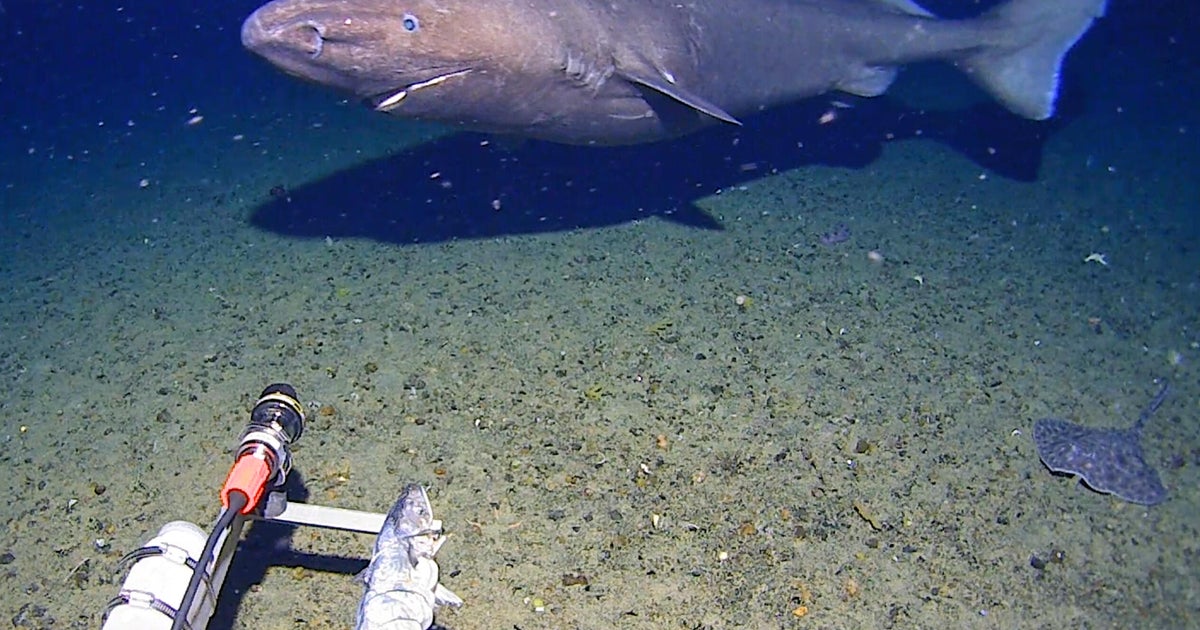
In a groundbreaking discovery that has challenged long-held scientific beliefs, researchers have captured the first confirmed footage of a shark swimming in Antarctic waters. The remarkable encounter occurred in January 2025, when a substantial sleeper shark, estimated to be between 10 and 13 feet long, wandered into view of a deep-sea camera positioned off the South Shetland Islands near the Antarctic Peninsula. Alan Jamieson, the founding director of the Minderoo-UWA Deep-Sea Research Centre at the University of Western Australia, described the sighting as completely unexpected, noting that the scientific community had operated under the general assumption that sharks simply didn’t exist in Antarctica’s frigid waters. The ungainly, barrel-shaped predator moved slowly and cautiously through the pitch-black depths, its massive form briefly illuminated by the camera’s spotlight as it cruised over the barren seabed far beyond the reach of sunlight. Jamieson’s excitement was palpable as he described the creature: “It’s not even a little one either. It’s a hunk of a shark. These things are tanks.”
Extreme Conditions and Surprising Company
The extraordinary footage was captured at a depth of 1,608 feet, where the water temperature hovered just above freezing at 34.29 degrees Fahrenheit—conditions that most would consider inhospitable to shark life. The camera, operated by the research center that specializes in investigating life in the deepest parts of the world’s oceans, was strategically positioned well inside the boundaries of the Antarctic Ocean, also known as the Southern Ocean, which is defined as the area below the 60-degree south latitude line. What makes the footage even more intriguing is that the sleeper shark wasn’t alone in this extreme environment. The video also captured a skate—a shark relative that resembles a stingray—resting motionless on the seabed, appearing completely unfazed by the passing predator. Unlike the shark’s appearance, however, the skate’s presence came as no surprise to scientists, as these creatures were already known to inhabit such southern waters. The contrast between the expected and unexpected inhabitants of this frozen realm highlights just how much remains unknown about life in Earth’s most remote ocean.
A First for Science
The significance of this discovery cannot be overstated. After thoroughly searching existing scientific records, Jamieson concluded that he could find no previous documentation of any shark ever being found in the Antarctic Ocean. Peter Kyne, a conservation biologist from Charles Darwin University who was not involved with the research project, independently confirmed the historic nature of the sighting, agreeing that a shark had never before been recorded this far south. The implications of this discovery extend beyond simple documentation of a species’ range. It opens up entirely new questions about marine life in Antarctica, an environment that has been understudied due to its extreme remoteness and harsh conditions. The fact that a creature as large and substantial as a 10-to-13-foot shark could have gone undetected in these waters for so long speaks volumes about how little humans truly understand about the planet’s most inaccessible ecosystems. As Kyne enthusiastically stated, “This is great. The shark was in the right place, the camera was in the right place and they got this great footage. It’s quite significant.”
Climate Change Questions and Ancient Mysteries
The discovery has naturally prompted questions about whether climate change might be driving sharks into waters they previously avoided. As ocean temperatures rise globally, many marine species have been documented shifting their ranges toward the poles in search of cooler waters. However, Kyne cautioned that there is currently limited data on range changes near Antarctica because of the region’s extreme remoteness and the challenges involved in conducting marine research there. This lack of baseline data makes it difficult to determine whether the sleeper shark’s presence represents a recent arrival driven by changing ocean conditions or if these creatures have simply been there all along, quietly going about their business in the depths without anyone noticing. The slow-moving nature of sleeper sharks, combined with the extreme difficulty of conducting deep-sea surveys in Antarctic waters, means these animals could have maintained a population in the region for centuries or even millennia without human detection. The mystery of how long sharks have inhabited Antarctic waters remains open, waiting for future research to provide answers.
Life in the Layered Depths
The shark’s behavior and habitat choice revealed fascinating details about survival strategies in Antarctic waters. Jamieson observed that the photographed shark was maintaining a remarkably consistent depth of around 1,640 feet along a seabed that sloped away into much deeper water. This wasn’t a random swimming pattern but rather a deliberate choice based on the unique physical properties of Antarctic waters. The shark was positioning itself in the warmest available water layer—though “warmest” is a relative term in an environment where temperatures hover just above freezing. The Antarctic Ocean exhibits heavy stratification, with distinct water layers stacked upon each other from the surface down to depths of approximately 3,280 feet. These layers don’t readily mix due to conflicting properties, including colder, denser water from below that doesn’t easily blend with the fresh water running off from melting ice above. The shark’s ability to navigate and exploit this complex three-dimensional environment demonstrates a sophisticated adaptation to one of Earth’s most challenging marine habitats.
The Hidden World Below
Based on this single sighting, Jamieson theorizes that other Antarctic sharks likely exist at similar depths, potentially maintaining sparse populations that feed on the carcasses of whales, giant squids, and other marine creatures that die and sink to the ocean floor. This proposed ecosystem would represent a unique Antarctic food web that operates in complete darkness and near-freezing temperatures, sustained by the steady rain of organic matter from above. However, detecting and studying such a population presents enormous challenges. Very few research cameras are positioned at this specific depth range in Antarctic waters, and those that do exist can only operate during the Southern Hemisphere summer months from December through February, when conditions are marginally less hostile and researchers can access the region. Jamieson pointed out that for the remaining 75% of the year, essentially no one is observing these depths at all. This massive gap in observation time explains why surprises like the sleeper shark discovery occur—vast stretches of time and space remain completely unmonitored. The historic footage serves as a reminder that Earth’s oceans, particularly in extreme environments like Antarctica, still harbor mysteries waiting to be uncovered, and that even our most basic assumptions about where marine life can and cannot exist may need to be reconsidered.