



Ancient Roman Board Game Mystery Solved With AI Technology
Discovery of an Enigmatic Roman Artifact
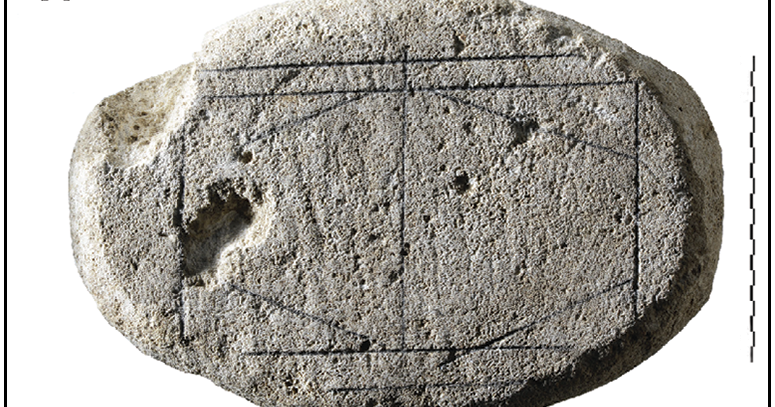
For years, archaeologists and researchers have been puzzled by a curious artifact discovered in the Netherlands—a smooth, circular piece of white limestone dating back to the Roman era. The stone’s surface is marked with an intriguing pattern of diagonal and straight lines carefully cut into its surface, but its purpose remained a mystery. Unlike other Roman artifacts that could be easily identified through comparisons with known objects or historical records, this particular stone defied simple categorization. It didn’t fit neatly into any known category of Roman artifacts, whether decorative, architectural, or functional. The lines appeared deliberate and purposeful, suggesting the object had a specific use, but without context or similar examples to compare it to, researchers were left guessing about its true function. The stone sat in collections, studied and pondered over, waiting for new technology and innovative thinking to unlock its secrets. Now, thanks to cutting-edge artificial intelligence technology and the collaborative efforts of researchers from multiple institutions, scientists believe they’ve finally solved this ancient riddle: the mysterious stone was actually an ancient board game, and they’ve even managed to reconstruct how it might have been played.
Advanced Technology Reveals Hidden Clues
The breakthrough in understanding this Roman artifact came through the application of modern 3D imaging technology. The restoration studio Restaura created detailed three-dimensional scans of the limestone piece, which allowed researchers to examine the stone with unprecedented precision. This advanced imaging revealed something that hadn’t been apparent through traditional visual inspection—some of the carved lines were noticeably deeper than others, and there were patterns of wear along specific paths on the stone’s surface. Walter Crist, an archaeologist at Leiden University in the Netherlands who has dedicated his career to studying ancient games, recognized the significance of these wear patterns immediately. “We can see wear along the lines on the stone, exactly where you would slide a piece,” Crist explained in a statement. This observation was crucial because it suggested repeated movement along certain paths, exactly what you would expect to see on a game board that had been used many times over the years. The appearance of the stone, combined with these distinctive wear patterns, strongly pointed toward its use as a game rather than any other purpose. This physical evidence provided the foundation for what would come next—using artificial intelligence to figure out not just that it was a game, but how that game was actually played.
AI Steps In to Reconstruct Ancient Rules
With the hypothesis that the stone was indeed a game board established, researchers at Maastricht University took on the remarkable challenge of trying to determine the rules of a game that hadn’t been played in nearly two thousand years. They employed an innovative artificial intelligence program called Ludii, which has been specifically designed to deduce the rules of ancient games based on their physical boards. The researchers trained this AI system by feeding it the known rules of approximately one hundred ancient games from the same geographical area and historical period as the Roman stone. This gave the AI a comprehensive understanding of the types of games Romans and their contemporaries enjoyed, the mechanics they favored, and the strategic elements that made these games engaging. The computer then analyzed the pattern of lines on the mysterious stone and produced dozens of possible rule sets that could work with that particular board configuration. But the AI didn’t stop there—in a fascinating demonstration of machine learning capabilities, it then played each version of the game against itself, testing out these different rule variations to identify which ones would actually be enjoyable for humans to play. According to Dennis Soemers from Maastricht University, this process allowed the AI to narrow down the possibilities to “a few variants that are enjoyable for humans to play,” effectively filtering out rule combinations that would have made for tedious or nonsensical gameplay.
Confirming the Most Likely Game Rules
After the AI generated its list of potential rule sets, researchers took the critical step of cross-referencing these possibilities with the actual physical evidence on the stone itself. They compared the wear patterns revealed by the 3D imaging with the game movements suggested by each rule set, looking for the best match between how the game would be played and where the stone showed signs of repeated use. This interdisciplinary approach—combining artificial intelligence, archaeological analysis, and physical evidence—allowed them to identify the most likely set of rules for the ancient game. However, the researchers have been careful not to claim absolute certainty about their findings. Soemers offered an important caveat: “If you present Ludii with a line pattern like the one on the stone, it will always find game rules. Therefore, we cannot be sure that the Romans played it in precisely that way.” This acknowledgment of the limitations of their methodology demonstrates the scientific rigor of their approach. Despite this uncertainty, the researchers are confident they’ve come remarkably close to reconstructing the original game. According to their analysis, the game was a “deceptively simple but thrilling strategy game” where the objective was to hunt and trap the opponent’s pieces in as few moves as possible. The game would have been played using pieces made from common Roman materials such as glass, bone, or earthenware, which would have been moved along the carved lines on the stone board. This type of strategy game fits well with what we know about Roman recreational activities and their appreciation for games requiring tactical thinking.
Scholarly Validation and Broader Context
The research team’s findings have now been published in the prestigious journal Antiquity, lending academic credibility to their conclusions. The journal even created a video explaining the reconstructed game and shared it on social media, highlighting how this discovery pushes back the evidence for playing blocking games in Europe by several centuries. Karen Jeneson, curator of The Roman Museum in Heerlen, provided additional context for the significance of this discovery: “We know the rules we found explain the wear marks on the stone and that they are consistent with games from comparable cultural periods.” The team didn’t arrive at their game-board conclusion hastily; they carefully considered alternative explanations for the stone’s purpose, including the possibility that it might have been an architectural decorative feature. However, after thorough investigation, they found no viable alternative explanation that could account for the specific pattern of lines and wear marks. “So, the stone really is a board game,” Jeneson concluded with confidence. This discovery doesn’t exist in isolation—it connects with other archaeological findings about Roman recreational life. In 2015, scientists uncovered board game pieces, including dice, in an ancient Roman settlement in a German town along the Rhine River, demonstrating that gaming was indeed a significant part of Roman culture in this region of their empire.
Implications for Understanding Roman Life
This breakthrough represents more than just identifying one mysterious artifact—it opens a window into the daily life and leisure activities of ordinary Romans living in the Netherlands nearly two millennia ago. Games and recreation were important aspects of Roman culture across all social classes, and discovering new examples of these games helps us understand how people spent their free time, what they valued in entertainment, and how cultural practices spread throughout the Roman Empire. The successful application of AI to this archaeological puzzle also demonstrates the exciting potential of combining traditional archaeological methods with cutting-edge technology. As artificial intelligence systems become more sophisticated, they may be able to help researchers solve other long-standing mysteries about ancient artifacts and practices. The Ludii program, specifically designed for analyzing ancient games, could potentially be applied to other mysterious game boards that have been discovered but not fully understood. This research reminds us that the past isn’t as distant or incomprehensible as it might seem—with the right tools and approaches, we can reconstruct even something as specific as the rules to a game that nobody has played for thousands of years. The people who carved this stone and moved pieces across its surface were engaging in the same fundamental human activity that we still enjoy today: playing strategic games for entertainment and competition.