


Senator Fetterman Speaks Out Against GOP’s SAVE America Act and Mail-In Voting Flip-Flop
Pennsylvania Democrat Criticizes Republican Reversal on Voting Practices
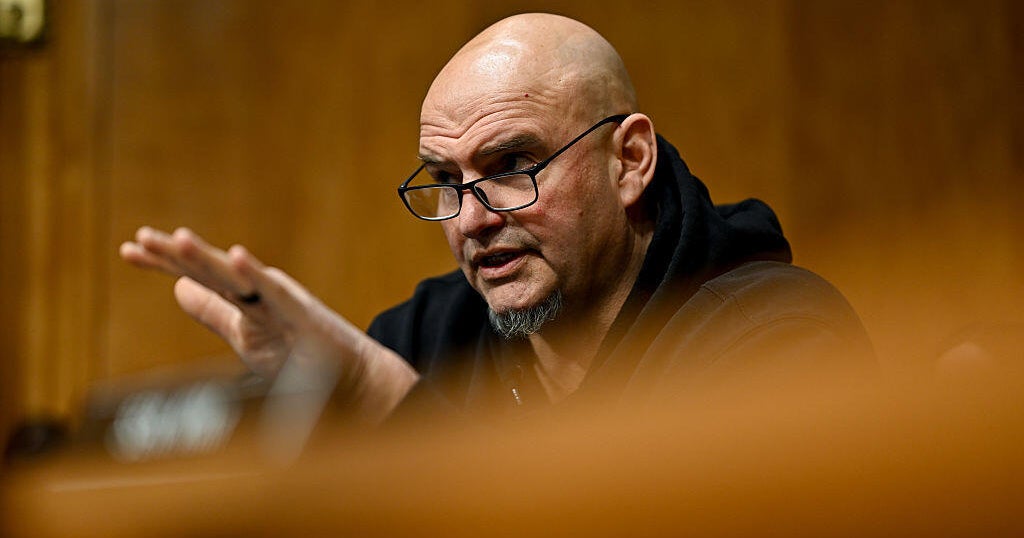
Pennsylvania’s Democratic Senator John Fetterman has come forward with strong criticism of the SAVE America Act, a contentious piece of election legislation being championed by the Trump administration and Republican lawmakers. In a candid conversation with CBS News chief White House correspondent Major Garrett on Wednesday, Fetterman didn’t mince words about his stance on the bill, stating plainly that he doesn’t support it in its current form. His primary concern centers around what he views as a glaring inconsistency in the Republican party’s position on mail-in voting – a complete turnaround from their previous support of the practice to their current opposition, seemingly following former President Trump’s lead on the matter.
The proposed SAVE America Act includes provisions that would mandate proof of citizenship for anyone voting in federal elections and require voters to present photo identification when casting their ballots. Taking things a step further, President Trump has pushed for Republicans to add an amendment that would outright ban mail-in voting across the country. Fetterman finds this position absurd, pointing out that mail-in voting has proven to be both safe and effective in numerous states across the nation. He specifically highlighted states like Ohio and Florida – both traditionally Republican strongholds – as prime examples of places where mail-in voting has been successfully implemented and operates smoothly. The senator’s frustration is palpable when discussing the president’s constant criticism of mail-in voting, which he characterizes as completely divorced from reality and the actual track record of this voting method.
The Pennsylvania Experience: A Case Study in Political Reversal
Drawing from his personal experience in Pennsylvania politics, Fetterman offered a particularly illuminating example of Republican inconsistency on this issue. He recalled Act 77, a piece of legislation that sailed through the Pennsylvania legislature in 2019 with overwhelming bipartisan support. This law legalized mail-in voting in the Keystone State, and interestingly, it was Republican lawmakers who were the driving force behind it. At the time this legislation was being debated and passed, Fetterman was serving as Pennsylvania’s lieutenant governor, a position that gave him what he described as a “unique perspective” on the entire process. He remembered clearly how Republicans in Pennsylvania were enthusiastic advocates for mail-in voting, even insisting that Democrats give up the straight party line option as part of the negotiation to get the mail-in voting provision passed.
However, the political winds shifted dramatically after 2019. Following former President Trump’s repeated criticisms of mail-in voting – criticisms that intensified after the 2020 election – many of the same Republican state lawmakers who had voted in favor of Act 77 suddenly changed their tune. In a stunning reversal, a group of these legislators, many of whom had been supporters just two years earlier, filed a lawsuit in 2021 attempting to overturn the very law they had helped create. This about-face perfectly illustrates what Fetterman sees as the Republican party’s willingness to abandon previously held positions when they conflict with Trump’s narrative. The attempt to overturn Act 77 ultimately failed when the Pennsylvania Supreme Court upheld the law in 2022, but the damage to the GOP’s credibility on this issue, in Fetterman’s view, had already been done. As he put it, these Republican lawmakers had to “walk back and explain why, unanimously, every single Republican voted for that in 2019” after Trump decided mail-in voting was suddenly wrong.
The Filibuster: A Democratic Shield Against Republican Legislation
When it comes to the SAVE America Act’s chances of becoming law, Fetterman expressed confidence that it will “never pass” due to the Senate’s filibuster rule. This procedural mechanism has become one of the most significant factors in determining what legislation can actually make it through the upper chamber of Congress. While Senate legislation technically only needs 51 votes to pass, the filibuster rule requires 60 votes to end debate on a bill and bring it to the floor for an actual passage vote – a procedure known as invoking cloture. When the Senate cannot muster those 60 votes, a filibuster effectively blocks the legislation from moving forward. This 60-vote threshold has proven to be an insurmountable obstacle for many partisan bills in today’s deeply divided political climate.
In a moment of candid reflection, Fetterman acknowledged the irony of Democrats’ current relationship with the filibuster. He noted that he and many of his fellow Democrats who ran for Congress in 2022 campaigned, at least in part, on getting rid of the filibuster, viewing it as an outdated procedural rule that prevented the majority party from governing effectively. However, now that Republicans control the Senate and are pushing legislation that Democrats oppose, the tables have turned completely. “Now, we find ourselves as Democrats, we love the filibuster, we cling to that,” Fetterman admitted with apparent self-awareness about this political shift. This reversal highlights how political parties’ attitudes toward Senate procedures often depend entirely on whether they’re in the majority or minority at any given time.
Republican Leadership Acknowledges Lack of Support
Fetterman’s assessment that the SAVE America Act faces long odds was essentially confirmed by Senate Majority Leader John Thune on Wednesday. The Republican leader indicated that the controversial elections bill simply doesn’t have enough support in the Senate to overcome the procedural hurdles it would face. “There are no easy ways to do this,” Thune said Tuesday, adding, “Believe me, we’ve examined all the options.” This statement from the Senate’s top Republican suggests that even within their own party, there isn’t unanimous support for the bill in its current form, making it virtually impossible to attract the necessary Democratic votes to reach the 60-vote threshold needed to break a filibuster. The acknowledgment from Republican leadership that they’ve hit a wall on this legislation validates Fetterman’s confidence that the bill won’t become law as currently written.
Finding Common Ground on Voter ID Requirements
Despite his opposition to the SAVE America Act as a whole, Fetterman demonstrated a willingness to find middle ground on at least one aspect of the broader voting debate: voter identification requirements. The Pennsylvania senator pointed to a Pew Research Center survey released in August 2025 that showed overwhelming public support for some form of voter ID, with 83% of Americans favoring a requirement that all voters show government-issued photo identification to cast a ballot. This level of public consensus caught Fetterman’s attention and influenced his thinking on the matter. He suggested that if Republicans were willing to strip away the more controversial elements of their proposal and focus simply on requiring voters to show basic state ID, he would be open to supporting such a measure. “So if the Republicans would ever just make it showing basic state ID to vote, hey, I’m not going to tell 83% of Americans that they’re wrong, or that they are Jim Crow,” Fetterman explained.
This pragmatic approach from Fetterman illustrates his willingness to work across the aisle when there’s genuine public support for a policy, even if it means breaking with some members of his own party who might view any voter ID requirement as voter suppression. By acknowledging the broad public support for voter ID and expressing openness to a reasonable version of such a requirement, Fetterman is staking out a position that could serve as the basis for bipartisan compromise on voting legislation. His comments suggest that the real sticking points in the current debate aren’t necessarily about basic voter identification but rather the additional requirements around citizenship verification and the attacks on mail-in voting that Republicans have bundled into their proposals. If lawmakers could separate these issues and address them individually rather than as an all-or-nothing package, there might be room for progress on election security measures that enjoy broad public support while preserving voting methods that have proven safe and effective.