Supreme Court Delivers Major Blow to Trump’s Tariff Strategy
In a landmark decision that reshapes the balance of power between the executive and legislative branches, the Supreme Court ruled on Friday that President Donald Trump overstepped his constitutional authority by imposing widespread tariffs using emergency powers legislation. This ruling represents one of the most significant judicial rebukes of presidential economic policy in recent decades and fundamentally challenges the administration’s approach to trade policy. The decision strikes at the heart of Trump’s economic agenda, which has relied heavily on tariffs as both a negotiating tool and a means of reshaping America’s trade relationships with countries around the world. Legal experts are calling this a watershed moment that clarifies the limits of presidential power when it comes to regulating international commerce, an area traditionally overseen by Congress. The ruling doesn’t just affect current tariffs—it sets a precedent that will guide how future presidents can and cannot use emergency declarations to implement economic policy.
The Court’s decision centered on the question of whether the President can invoke emergency powers to bypass the normal legislative process when implementing tariffs. Trump had argued that various threats to national security and economic emergencies justified his use of executive authority to impose tariffs on imports from numerous countries, including close allies. However, the majority opinion found that the language of the emergency powers statute didn’t grant such sweeping authority to act unilaterally on trade matters without congressional approval. The justices emphasized that the Constitution explicitly gives Congress the power to regulate commerce with foreign nations, and while presidents have some flexibility in responding to emergencies, that flexibility doesn’t extend to fundamentally rewriting trade policy through executive action alone. This interpretation aligns with the constitutional principle of separation of powers, which prevents any single branch of government from accumulating too much authority. The ruling effectively tells the executive branch that even in times of perceived crisis, there are constitutional guardrails that cannot be breached without proper legislative backing.
Immediate Economic Impact and Market Reactions
The financial markets responded swiftly to the Supreme Court’s announcement, with investors trying to calculate the far-reaching implications of this sudden shift in trade policy. Stock markets initially showed volatility as traders digested the news, with export-oriented companies generally rising on the expectation that trading partners might reduce their own retaliatory tariffs in response to the Court’s decision. Industries that had been hit hardest by tariffs—particularly manufacturing sectors that rely on imported materials like steel and aluminum—expressed relief at the prospect of lower input costs. However, domestic producers who had benefited from tariff protection expressed concern about renewed foreign competition. Currency markets also saw movement, with the dollar fluctuating as investors reconsidered the trajectory of U.S. trade relationships. Economists noted that while the immediate market reaction was mixed, the long-term implications could be substantial, potentially affecting everything from consumer prices to international supply chains that companies had restructured in response to the tariff regime of recent years.
Beyond Wall Street, the ruling has real-world consequences for American businesses and consumers who have been living with the effects of these tariffs for years. Many companies had restructured their supply chains, relocated manufacturing facilities, or absorbed higher costs due to the tariffs. Now they face fresh uncertainty about whether those changes were necessary or wise in retrospect. Small businesses, in particular, which often lack the resources to quickly adapt to policy changes, may find themselves in a difficult position as they reassess their operational strategies. Consumer goods that became more expensive due to tariffs—from electronics to clothing to household appliances—could potentially see price reductions, though economists caution that prices rarely fall as quickly as they rise. The agricultural sector, which faced significant retaliation from trading partners in response to Trump’s tariffs, is watching carefully to see whether this ruling might lead to the lifting of counter-tariffs that have hurt American farmers’ ability to export their products to key markets like China and the European Union.
Political Ramifications and Congressional Response
The Supreme Court’s decision immediately became a political flashpoint, dividing lawmakers along predictable partisan lines while also revealing some unexpected fault lines within both parties. Republican legislators found themselves in a delicate position—many had privately expressed discomfort with Trump’s expansive use of executive power on tariffs but had been reluctant to publicly challenge a president from their own party. Some GOP senators who prioritize constitutional principles and legislative prerogatives welcomed the decision as a restoration of congressional authority over trade policy, even if they supported the policy goals Trump had pursued. Meanwhile, Democrats largely celebrated the ruling as a necessary check on presidential overreach, though some noted the irony that they were cheering a decision that might make it harder for future Democratic presidents to take swift executive action on other issues. The decision sets up a new dynamic where Congress will need to play a more active role in trade policy, potentially requiring lawmakers to take difficult votes on specific tariff measures rather than allowing the president to shoulder the political burden alone.
Looking ahead, the ruling forces Congress to confront questions about trade policy that many members had been content to leave to the executive branch. Will lawmakers pass legislation explicitly authorizing some tariffs while rejecting others? Will they create a new framework for how presidents can respond to trade emergencies? These are questions without easy answers, particularly in a deeply divided Congress where reaching consensus on controversial issues has become increasingly difficult. Trade policy has traditionally been one of the few areas where bipartisan cooperation was possible, with both parties containing pro-trade and protectionist factions, but the political polarization of recent years has made even this issue more partisan. Some legislators are already proposing new bills that would give the president authority to implement certain tariffs while creating stronger congressional oversight mechanisms. Others argue that Congress should reclaim its constitutional role more fully and require legislative approval for any significant tariffs, returning to a system closer to what the Founders envisioned when they granted commerce regulation powers to Congress rather than the president.
International Implications and Trade Relations
The global community watched the Supreme Court’s decision with intense interest, as it has profound implications for America’s trading relationships and the rules-based international order that has governed commerce since World War II. Allied nations that found themselves targeted by Trump’s tariffs—including Canada, Mexico, and European countries—may see this as an opportunity to reset relationships that were strained by what they viewed as arbitrary and unjustified trade barriers. The ruling could potentially reinvigorate multilateral trade negotiations and strengthen international institutions like the World Trade Organization, which had been sidelined as countries increasingly turned to unilateral actions and bilateral negotiations. However, there’s also uncertainty about what comes next, as the decision creates a period of transition where the rules governing American trade policy are unclear. Foreign governments and businesses that have grown accustomed to navigating trade policy through the White House may need to develop new strategies for engaging with Congress, a more diffuse and unpredictable power center.
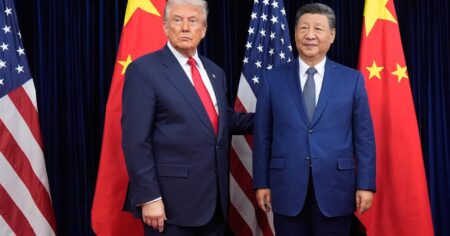
China’s response to the ruling will be particularly consequential given the centrality of U.S.-China trade tensions to global economics. The tariffs on Chinese goods had been among the most extensive and controversial aspects of Trump’s trade policy, and Beijing had retaliated with its own barriers to American exports. If these tariffs are rolled back or modified, it could create an opening for renewed negotiations, though it’s unclear whether either side has the political will to make the compromises necessary for a comprehensive agreement. The Supreme Court decision doesn’t resolve the underlying issues that prompted the trade conflict—concerns about intellectual property theft, technology transfer requirements, market access, and industrial subsidies—but it does change the tools available to American policymakers for addressing these challenges. This shift in approach could either lead to more sustainable, negotiated solutions that have congressional buy-in and are therefore more durable, or it could result in policy paralysis if Congress proves unable to forge consensus on how to handle complex trade disputes with strategic competitors.
The Supreme Court’s ruling on Trump’s tariffs represents far more than a technical legal decision about the interpretation of emergency powers statutes—it’s a defining moment in the ongoing negotiation between efficiency and accountability in American governance. The decision reaffirms that even when presidents believe swift action is necessary to protect national interests, they cannot bypass the constitutional structure that requires congressional involvement in major policy decisions. As the country moves forward from this ruling, businesses, consumers, workers, and policymakers will all need to adapt to a new reality where trade policy is once again subject to the slower, more deliberative, and often frustrating process of legislative action. Whether this leads to better, more sustainable policies or simply to gridlock and inaction remains to be seen, but one thing is certain: the Supreme Court has ensured that future trade policy will be shaped not by presidential decree alone, but through the constitutional process the Founders intended.