
Senate Leader Signals Trouble for Trump’s Election Bill Despite Presidential Pressure
The Legislative Standoff Takes Shape
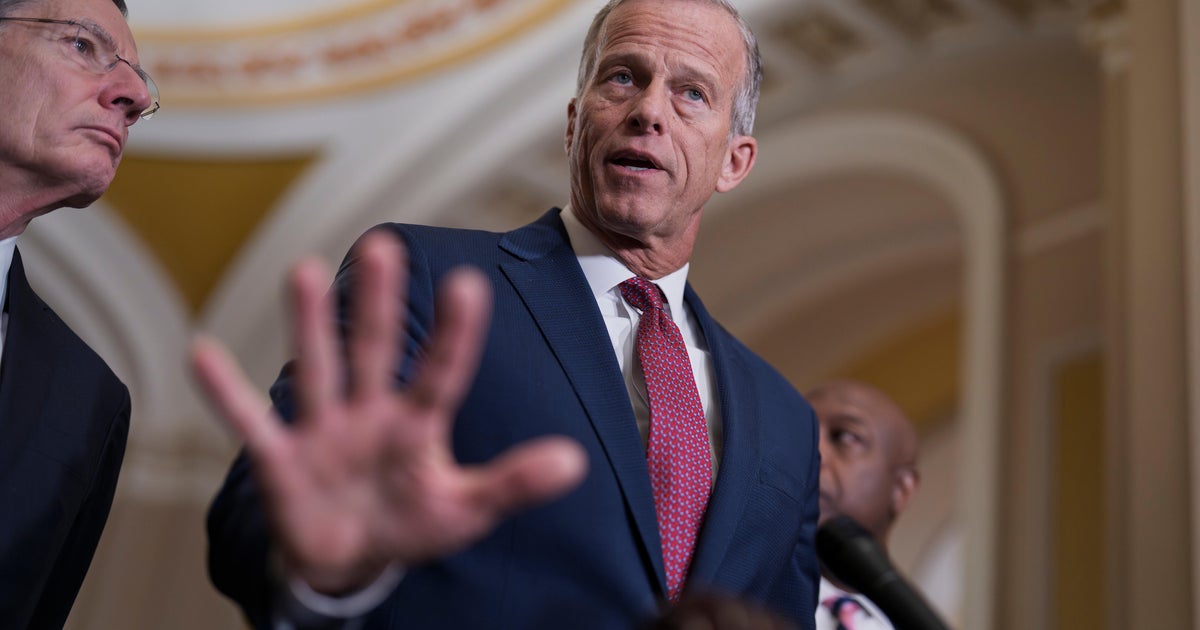
In a frank assessment that underscores the growing tension between pragmatic governance and political demands, Senate Majority Leader John Thune delivered some unwelcome news to the White House this week: President Trump’s insistence on passing the SAVE America Act faces nearly insurmountable obstacles in the Senate. Speaking to reporters on Tuesday, the South Dakota Republican didn’t mince words about the challenges ahead, acknowledging that his team has explored every possible avenue to advance the controversial elections legislation. “There are no easy ways to do this,” Thune admitted, revealing the difficult position Senate leadership finds itself in as they navigate between presidential expectations and legislative reality. “Believe me, we’ve examined all the options.” The statement reflects the uncomfortable truth that sometimes even when a party controls both chambers of Congress and the White House, the mechanics of the Senate can still throw up roadblocks that political will alone cannot overcome.
What’s Actually in the Bill and Why Trump Wants More
The SAVE America Act, which already cleared the House last month, would fundamentally change how Americans register and vote by requiring proof of citizenship to register and photo identification to cast a ballot. While these provisions alone have sparked fierce debate, President Trump isn’t satisfied with the bill in its current form. He’s demanding that lawmakers go significantly further by completely banning all mail-in ballots—a voting method that millions of Americans, including many in the military and elderly populations, have relied upon for years. But the president’s wish list doesn’t stop there. He’s also pushing to load the legislation with provisions that have nothing to do with voting procedures, including restrictions on transgender athletes competing in women’s sports and limitations on gender-affirming medical care for minors. These additions have transformed what was already a contentious voting rights bill into an even more politically charged package that touches on some of the most divisive cultural issues of our time. On Sunday, Trump escalated the stakes dramatically, declaring on Truth Social that he would essentially bring the legislative process to a halt until Congress delivers the SAVE America Act to his desk. “It supersedes everything else,” the president wrote, adding that the measure “must be done immediately.” The White House later walked back the blanket threat slightly, clarifying that Trump would still sign legislation to fund the Department of Homeland Security, which remains shut down—a small concession that reveals the practical limits of even a president’s leverage.
The Math Problem That Won’t Go Away
The fundamental challenge facing the SAVE America Act comes down to simple arithmetic, and Thune has been straightforward about the numbers not adding up. Democrats are nearly unanimous in their opposition to the bill, warning that its citizenship verification requirements could prevent millions of legally eligible voters from exercising their constitutional rights. With Republicans holding 53 seats in the Senate—a comfortable majority but far from overwhelming—they would need at least seven Democrats to cross party lines to reach the 60-vote threshold required to overcome a filibuster under normal Senate procedures. That level of bipartisan cooperation seems virtually impossible given the current political climate and the substantive concerns Democrats have raised about voter disenfranchisement. Faced with this reality, voices on the right flank of the Republican Party have been pressuring Senate leadership for weeks to employ what’s known as a “talking filibuster.” This procedural maneuver would theoretically allow Republicans to bypass the 60-vote requirement, but it comes with its own set of severe complications. The process would essentially bring all other Senate business to a grinding halt for weeks while requiring near-perfect unity among Republican senators—something that has proven elusive on this issue. Based on historical precedent, Thune expressed deep skepticism about this approach on Monday, saying it’s “very hard to see” how it would result in the bill actually becoming law.
The Unprecedented Challenge of Forcing Passage
When Thune says that Senate leadership has examined all the options, he means it literally. The talking filibuster strategy that some conservative Republicans have championed isn’t just difficult—it’s something that has never successfully been used to pass major legislation in the Senate’s history. “You have to have unified support, not only in support of the ultimate goal, which is the SAVE America Act, but on the process to be able to defeat amendments that would undo the legislation in the first place,” Thune explained to reporters. “We can’t find a piece of legislation in history that’s been passed that way.” This historical perspective matters because it highlights why Senate leaders are hesitant to embark on what could become a weeks-long legislative spectacle with no guarantee of success. The problem is that during a talking filibuster, opponents can offer unlimited amendments, and if even a handful of Republicans vote for changes that Democrats support, the entire bill could be gutted or transformed beyond recognition. It would require Republican senators to vote against amendments they might actually support substantively, simply to preserve the legislation’s chance of passage—a level of party discipline that the Senate rarely achieves. Meanwhile, President Trump remained defiant even after Thune’s initial skepticism became public. During a news conference on Monday, he framed the issue in stark, uncompromising terms: “We’re going for the gold, and we’re going to have to fight like hell. We don’t have a country if we’re going to have elections that are so corrupt and so dishonest, like we’ve witnessed over the last period of time.” The president’s rhetoric suggests he sees this not as a typical legislative negotiation but as an existential battle over election integrity—a framing that makes compromise or alternative approaches harder to sell politically.
Leadership Delivers the Hard Truth
By Tuesday morning, the gap between presidential demands and legislative reality had become impossible to ignore. Thune revealed that he hadn’t even spoken with President Trump since the weekend threats to block all other legislation, and he delivered perhaps his most direct assessment yet of where things stand. “The votes aren’t there, one, to nuke the filibuster, and the votes aren’t there for a talking filibuster,” Thune stated plainly. “It’s just a reality. And I’m a person who has to deliver, sometimes, the not-so-good news that the math doesn’t add up. But those are the facts. There’s no getting around it.” This kind of public acknowledgment from a majority leader about the limits of his own party’s power is relatively rare in Washington, where leaders typically project confidence even when facing long odds. Thune’s candor reflects both the genuine difficulty of the situation and perhaps a calculation that managing expectations now is better than allowing false hope to build only to collapse later. Some Republicans, refusing to give up, have floated the idea of using the budget reconciliation process—a special procedure that allows the majority party to pass certain legislation with just 51 votes if the provisions have direct budgetary impacts. It’s the same process that has been used to pass tax cuts and, during previous administrations, attempts at healthcare reform. But Thune threw cold water on this idea too, calling it “very, very difficult” and noting that after exploring the option thoroughly, “you kind of come back to the same place.” The problem is that much of what’s in the SAVE America Act doesn’t directly relate to federal spending or revenue in ways that would satisfy the strict rules governing reconciliation.
Where Things Go From Here
Despite all the obstacles and the blunt assessment of the challenges, Thune was careful to emphasize that Republican leadership shares the policy goals behind the legislation and wants to find a way forward. “We want to get the outcome, we want to get the result,” he said, noting that “there’s almost unanimous agreement on the policy” within the Republican conference. The disagreement isn’t fundamentally about whether election security measures are needed, but rather about the process for achieving them and whether the specific provisions in the bill would accomplish their stated goals without unintended consequences. What Thune made absolutely clear, however, is that one option is completely off the table: eliminating the filibuster entirely. “But the process and how to get there, you know, are not going to include nuking the filibuster,” he stated definitively. “That’s just not going to happen.” This position is significant because it represents a line that Senate Republican leadership won’t cross, even under direct pressure from a president of their own party. Many Republicans remember that the filibuster has served as their most powerful tool when they’ve been in the minority, and they’re unwilling to surrender it for short-term legislative gains, knowing that political control of the Senate inevitably shifts over time. The standoff leaves Washington in a state of uncertainty, with a president demanding immediate action on legislation that his own party’s Senate leader says cannot pass through any available procedural pathway. How this tension resolves—whether through compromise, creative legislative maneuvering, or simply the passage of time and shifting priorities—remains one of the central questions hanging over the Capitol as both parties navigate the complex intersection of policy objectives, procedural realities, and political pressures.