
The Clinton Depositions: What We Learned About Jeffrey Epstein
Historic Testimony Released to the Public
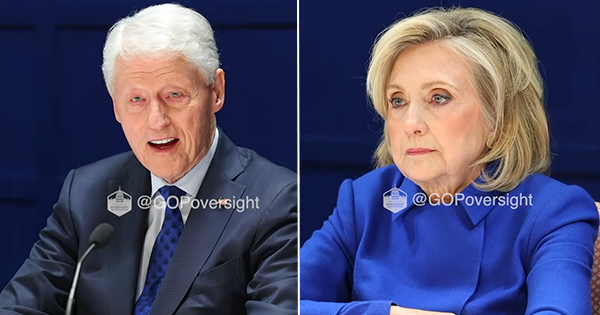
In a significant development that has captured national attention, the House Oversight Committee made public on Monday the complete video recordings of depositions from former President Bill Clinton and former Secretary of State Hillary Clinton. These testimonies, which were conducted last week as part of an ongoing congressional investigation into the crimes of convicted sex offender Jeffrey Epstein, represent a rare moment of public accountability from two of America’s most prominent political figures. The depositions were conducted behind closed doors in the Clintons’ hometown of Chappaqua, New York, with Hillary Clinton appearing before the committee on Thursday and Bill Clinton following the next day. Each session was extensive, with Bill Clinton’s testimony running 4 hours and 33 minutes, while Hillary Clinton’s lasted slightly longer at 4 hours and 35 minutes. The release of these videos marks the culmination of what Representative James Comer of Kentucky, the Republican chairman of the committee, characterized as a prolonged and challenging effort to obtain testimony from the couple regarding their knowledge of Epstein and his associate Ghislaine Maxwell, who is currently serving time in federal prison on sex trafficking charges.
The Clintons’ Longstanding Denials and Opening Statements
Throughout the years since Epstein’s crimes became public knowledge, both Bill and Hillary Clinton have consistently maintained that they had no awareness of the illegal activities perpetrated by Epstein or Maxwell. This position has remained unchanged, and both former officials released their prepared opening statements to the committee prior to delivering their testimony. However, the video footage reveals that the former president chose to deviate from his prepared remarks during the actual deposition, offering more candid and personal reflections on his limited interactions with the disgraced financier. The decision to stray from scripted responses suggests a desire on Bill Clinton’s part to address the matter more directly and personally than a carefully crafted legal statement might allow. This approach seemed designed to acknowledge certain facts while maintaining the core position that neither he nor his wife had any knowledge of Epstein’s criminal behavior. The contrast between prepared statements and actual testimony highlights the tension between legal caution and the desire to appear forthcoming and transparent before congressional investigators and, ultimately, the American public.
A 1993 Encounter and Defense of Hillary Clinton
One of the more revealing moments in Bill Clinton’s testimony came when he discussed a photograph showing him and Hillary Clinton shaking hands with Jeffrey Epstein. According to the former president, this encounter occurred during a photo line at a White House Historical Association fundraiser in 1993, during Clinton’s first year in office. Clinton emphasized that neither he nor Hillary remembered this brief handshake until the photograph surfaced years later, underscoring how fleeting and insignificant the interaction was at the time. What proved particularly noteworthy was Clinton’s visible frustration with the committee’s decision to call his wife for questioning based on such minimal contact. “Neither she nor I remembered shaking his hand all those years ago,” he testified, before directly criticizing the committee’s approach: “So I don’t think that was right.” However, Clinton immediately pivoted to acknowledge that his own questioning was justified, stating, “On the other hand, I do think you should be talking to me. I think you should have called me. I did take those plane trips with him, and you have a right to ask those questions.” This statement represented a significant acknowledgment that his connection to Epstein, while limited, warranted congressional scrutiny in a way that his wife’s casual 1993 encounter did not.
The Flights and the Relationship Timeline
The most substantive portion of Bill Clinton’s testimony focused on his use of Jeffrey Epstein’s private aircraft and the nature of their relationship during the early 2000s. According to Clinton’s account, his first clear memory of actually meeting Epstein occurred in 2002 during a flight on Epstein’s plane. The former president testified that he took approximately four or five flights on the aircraft, traveling to destinations including Asia, Africa, and northern Europe in connection with his philanthropic efforts through the Clinton Foundation. These trips, Clinton emphasized, were related to the foundation’s charitable work in developing regions of the world. He also mentioned one additional occasion when Epstein offered him a ride from Florida to New York, though Clinton testified that he and Epstein happened to be in Florida for completely unrelated reasons. The former president was careful to frame these interactions as transactional and related to his foundation work rather than personal friendship. He explained that his relationship with Epstein effectively ended in 2003, providing a specific rationale for the break: there were other donors who knew Clinton better and demonstrated more genuine interest in the Clinton Foundation’s mission and activities.
Clinton’s Assessment of Epstein’s Character and Motivations
During his testimony, Bill Clinton offered a measured but telling assessment of Jeffrey Epstein as a person and potential donor. “I thought Mr. Epstein was an interesting man, but I didn’t think he was really interested in what I was doing,” Clinton testified, suggesting that he sensed Epstein’s support for the foundation was not driven by genuine commitment to its humanitarian goals. This observation provides insight into why Clinton chose to distance himself from Epstein relatively early in their acquaintance. The former president explained his general philosophy regarding donor relationships, stating that he makes an effort not to overstay his welcome with financial supporters, particularly when he senses their interest is superficial or motivated by factors other than the actual work of the foundation. Clinton also addressed his connection to Ghislaine Maxwell, Epstein’s longtime associate and later convicted accomplice. He testified that it had been approximately 10 or 12 years since he last saw Maxwell, noting that she had been in a romantic relationship with a mutual friend of his. This detail helped establish that whatever limited social connections existed between the Clintons’ circle and Epstein’s orbit, they were indirect and had been severed long before the full scope of Epstein and Maxwell’s crimes became public knowledge.
The Birthday Letter and Looking Forward
In another revealing portion of the deposition, Bill Clinton confirmed that he had written a letter to Jeffrey Epstein that was subsequently included in a commemorative book created for Epstein’s 50th birthday celebration. When questioned about this contribution, Clinton acknowledged the letter’s existence but stated that he did not remember the specific circumstances that led him to write it or the content of what he had written. He suggested that the most likely explanation was that members of his staff had requested the contribution, possibly as a routine courtesy extended to various donors and acquaintances during that period. This admission highlights how seemingly minor gestures—common in the world of high-level politics and fundraising—can take on troubling significance when the recipient is later revealed to be involved in serious criminal activity. As of the time of the video’s release, the committee had not yet published written transcripts of either deposition, which means additional details and nuances from the questioning may emerge when those documents become available. The release of these depositions represents an important moment of public accountability, allowing Americans to hear directly from two prominent political figures about their connections, however limited, to one of the most notorious criminals in recent American history. While both Clintons have maintained their lack of knowledge regarding Epstein’s crimes, the public release of these extensive testimonies allows for transparency and continued scrutiny of these important questions.