



The Struggle of a Lost Humpback Whale in Germany’s Baltic Sea
A Whale’s Repeated Strandings Capture National Attention
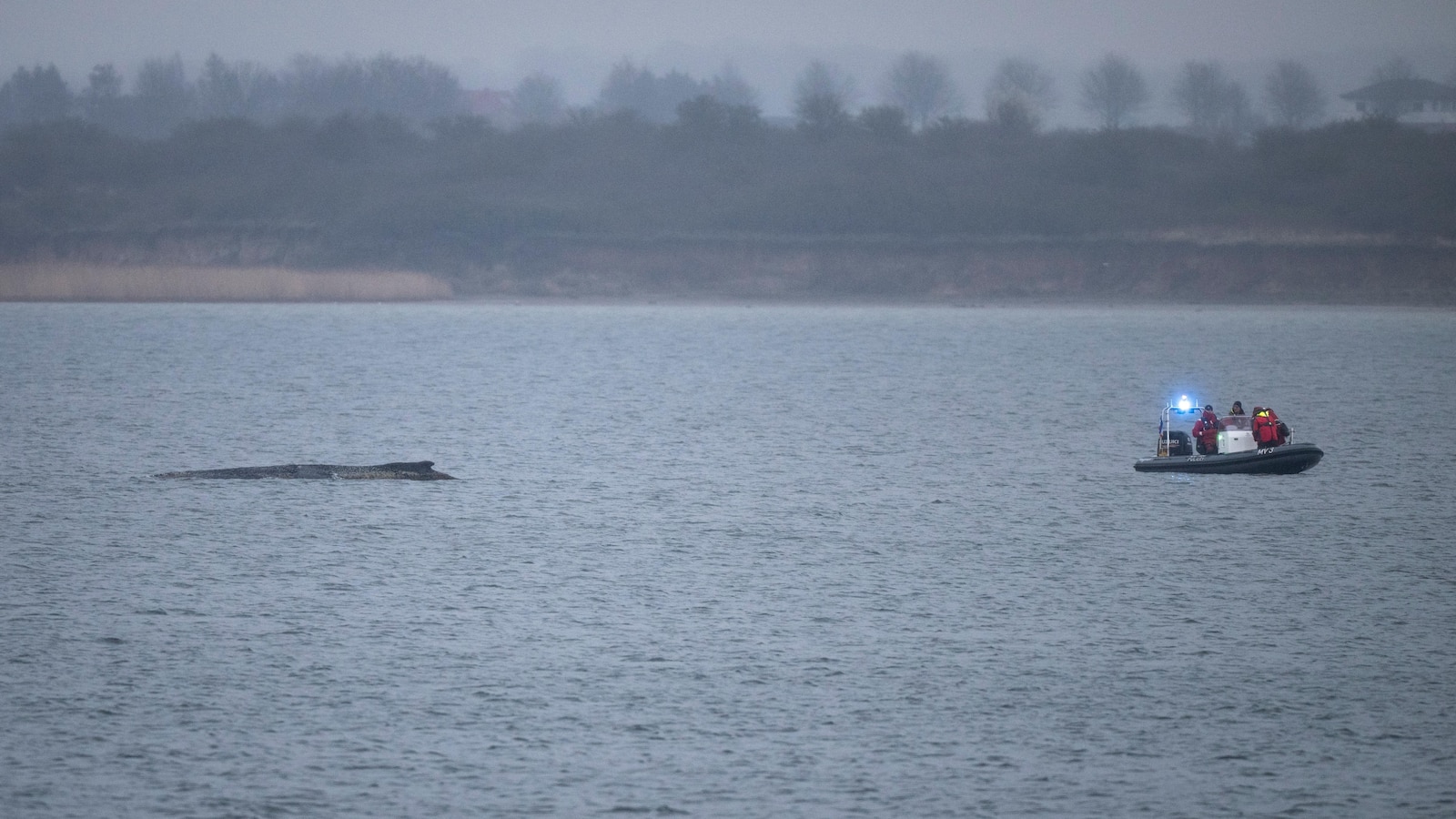
The coastal waters off Germany’s Baltic Sea have become the stage for a dramatic rescue effort as a large humpback whale continues to struggle finding its way back to open ocean. The magnificent creature, measuring between 12 and 15 meters (approximately 39 to 49 feet) in length, has captured the hearts of Germans nationwide as it repeatedly becomes stranded in shallow waters near the port city of Wismar. The whale’s predicament has intensified over recent days, with each temporary success in freeing the animal followed by renewed concerns as it becomes stuck once again. On Tuesday, less than 24 hours after swimming free from its previous location, the whale found itself stranded yet again, this time off an island with the ironically appropriate name of Walfisch—an old German word meaning “whale.” Despite these setbacks, rescue teams remain cautiously optimistic that the exhausted marine giant might still find its way to safety and eventually return to its natural habitat in the deeper waters of the Atlantic Ocean.
Coordinated Rescue Efforts and Ongoing Challenges
The rescue operation has involved a coordinated effort between local authorities, police, and the environmental organization Greenpeace, all working together to guide the distressed whale toward deeper waters. On Tuesday morning, after the whale had been spotted off Walfisch Island, both police and Greenpeace deployed rubber boats to escort the animal and hopefully direct it toward the open sea. Marine biologist Thilo Maack from Greenpeace, who has been closely involved in the rescue efforts, explained during a televised news conference that while rescuers managed to prevent the whale from swimming too far into a shallow inlet, the situation remains precarious. The whale had been swimming on a promising course that would have taken it out of Wismar Bay when it suddenly changed direction, heading instead toward an inlet where it became stranded once more. Fortunately, rescuers were able to intervene quickly enough to keep the whale in waters deep enough for it to potentially swim away under its own power, though it appears to lack the energy or orientation to do so consistently.
Previous Rescue Attempts and the Whale’s Journey
This isn’t the first time rescue teams have had to intervene to save this particular whale. Last week, an even more dramatic rescue took place at Timmendorfer Strand, a popular resort town located approximately 50 kilometers (over 30 miles) from the whale’s current position. There, the whale had become stuck on a shallow underwater sandbank, requiring the use of heavy machinery—an excavator—to help free it from its predicament. That rescue operation eventually succeeded, but the relief was short-lived. The apparently exhausted animal soon found itself in difficulty again, though fortunately in somewhat deeper water than before. The whale was first spotted in the region on March 3, marking the beginning of this ongoing saga that has kept rescue teams on alert for days. Each time the whale manages to swim free, hopes rise that it will find its way to safety, only to be dashed when it becomes stranded again, seemingly unable to navigate its way out of the relatively shallow and confined waters of the Baltic Sea.
The Mystery Behind the Whale’s Presence
The question of why this humpback whale ventured into the Baltic Sea in the first place remains unanswered, though experts have offered several theories. Some marine biologists suggest that the animal may have lost its way while pursuing a shoal of herring, becoming disoriented as it followed its prey into increasingly unsuitable waters. Another possibility is that the whale became confused during its migration route, perhaps due to environmental factors or health issues that affected its navigation abilities. What is clear is that the Baltic Sea is far from the ideal environment for a humpback whale. These magnificent creatures are adapted for the deep waters of the Atlantic Ocean, where they can dive to depths that simply don’t exist anywhere in the Baltic. The relatively shallow and confined nature of the Baltic Sea, combined with its lower salt concentration compared to the open ocean, creates challenging conditions for a whale accustomed to very different marine environments.
The Physical Toll and Uncertain Future
The extended stay in the Baltic Sea has already taken a visible toll on the whale’s health. Till Backhaus, the environment minister of Mecklenburg-Western Pomerania state, reported that a health check conducted on Monday revealed that while “it has potential,” the whale is clearly sick. The animal’s skin is in poor condition, damaged by prolonged exposure to the Baltic Sea’s relatively low salt concentration, which is significantly different from the salinity levels found in the Atlantic Ocean where humpback whales naturally thrive. This deterioration of the whale’s skin condition has prevented rescuers from attaching a tracking device, which would have helped them monitor its movements and condition more effectively. Backhaus candidly acknowledged that while the visible health problems are concerning, the team cannot know what other internal issues the whale might be suffering from, making the prognosis uncertain. Despite these concerns, he expressed continued hope for a positive outcome, saying he is “keeping my fingers crossed” for a good ending to this dramatic story.
The Long Road to Recovery and Home
Even if the whale manages to gather enough strength to swim away from its current location, the journey ahead remains daunting. The rescue team’s objective is clear but ambitious: guide the whale out of Wismar Bay into the broader Baltic Sea, then through Danish waters into the North Sea, and finally into the Atlantic Ocean where it belongs. This journey spans several hundred kilometers (hundreds of miles), an enormous distance for an already exhausted and sick animal. The rescue strategy currently focuses on giving the whale peace and quiet, allowing it to rest and hopefully gather enough strength to continue its journey. Rescuers are also prepared to carefully approach the animal with boats if necessary, using gentle motivation to encourage it to swim in the right direction without causing additional stress. The entire drama has captivated the German public, with media outlets providing detailed updates on every development in the whale’s progress. This widespread attention reflects not only the inherent fascination people have with these majestic marine mammals but also a collective hope that human intervention can help correct whatever circumstances led this whale so far from home. As the rescue effort continues, the world watches and waits, hoping that this lost giant of the ocean will find its way back to the deep Atlantic waters where it truly belongs.