


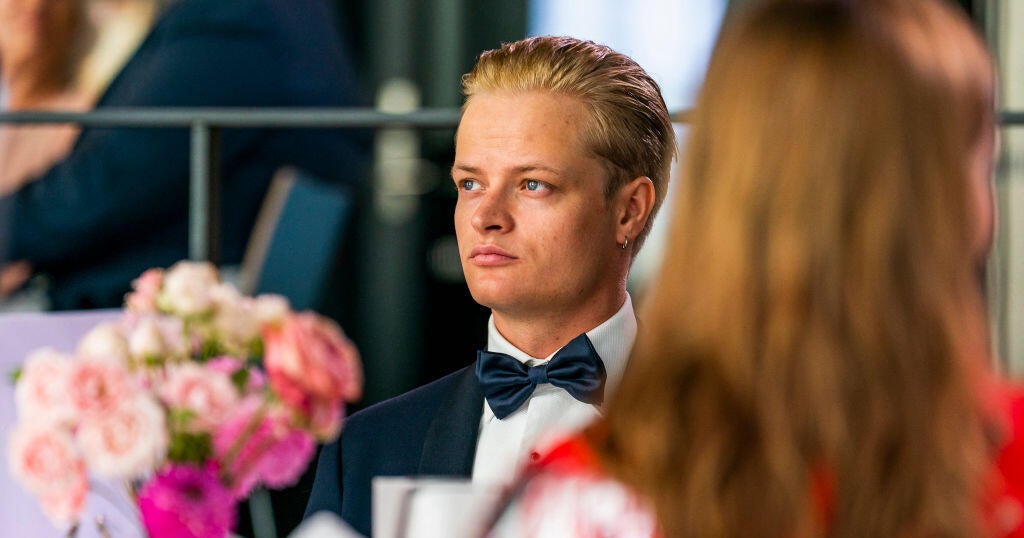

The Royal Scandal: Inside the Trial of Norway’s Crown Princess’s Son
A Mother’s Nightmare and a Nation’s Shock
The gleaming halls of Norway’s royal palace seem a world away from the stark courtroom in Oslo where Marius Borg Hoiby, the 29-year-old son of Crown Princess Mette-Marit, sits trembling as serious allegations unfold against him. This isn’t just another celebrity scandal—it’s a case that has shaken one of Europe’s most beloved royal families to its core. Hoiby faces 38 criminal charges, including accusations of raping four women and assaulting former girlfriends, with potential consequences of up to 16 years behind bars if convicted. The young man, who was raised within the royal household but never held an official title, now finds himself at the center of a trial that has captivated and horrified Norway in equal measure. His mother, Crown Princess Mette-Marit, who brought him into the royal family from a previous relationship before marrying Crown Prince Haakon in 2001, faces an impossible situation: torn between her maternal love and her role as a future queen of a nation demanding accountability and justice.
Disturbing Testimony from the Lofoten Islands
On Tuesday, the court heard harrowing testimony from a second alleged victim, a young woman who described what she called her “worst nightmare”—waking up to find Hoiby engaging in sexual relations with her without consent. The incident allegedly occurred on October 8, 2023, following an after-party in an apartment on Norway’s picturesque Lofoten Islands, where Hoiby and his stepfather had been enjoying a surfing trip. The woman, who had met Hoiby through the dating app Tinder, testified that after consensual sex earlier in the evening, she fell asleep, only to wake up to find him resuming sexual activity without her agreement. Her testimony painted a deeply disturbing picture: “I remember waking up when he was already underway. I thought, ‘I don’t understand how someone can have sex with someone who’s sleeping.'” She went on to describe the psychological trauma of the experience, explaining how she closed her eyes “so I wouldn’t have to take part in my own assault” and felt herself dissociating, leaving her own body. The physical pain she described—”my body wasn’t ready for it”—underscores the violation she experienced, transforming what should have been a beautiful island getaway into a scene of alleged assault.
Evidence from Technology: The Digital Trail
In an era where technology documents nearly every moment of our lives, prosecutors presented a chilling array of digital evidence to support the victim’s account. Most disturbingly, they submitted a five-second video that Hoiby allegedly filmed on his own phone during the alleged assault—footage that police later discovered when examining his device. According to prosecutor Sturla Henriksbo, the video clearly shows the young woman asleep at the time, contradicting any suggestion that she was conscious and consenting. The alleged victim expressed her distress at learning that she had been filmed without her knowledge, an additional violation for which Hoiby faces separate charges. But the technological evidence didn’t stop there. In a remarkable application of modern fitness technology to a criminal case, prosecutors also presented data from the woman’s fitness watch. This data, the prosecution argued, provided scientific proof that she was indeed asleep during the alleged assault. “According to the prosecution, the change in heart rate is the most decisive factor,” Henriksbo told the court, suggesting that the biometric data showed patterns consistent with sleep rather than conscious activity. This convergence of video and biometric evidence represents a new frontier in sexual assault cases, where personal technology can either incriminate or exonerate.
A Pattern of Allegations and Royal Embarrassment
The Lofoten Islands case represents just one thread in a much larger tapestry of allegations against Hoiby. The previous week, the court had heard testimony from another young woman who claimed that Hoiby raped her at an after-party in the basement of his parents’ royal estate outside Oslo in December 2018. The location of that alleged assault—within the very walls of royal property—adds another layer of shock to the case. Hoiby’s defense team has categorically rejected all rape accusations, characterizing the encounters as “perfectly normal and consensual sexual relations.” However, the prosecution’s case appears to be built on multiple testimonies from different women describing similar patterns of behavior. Making matters even more complicated, just days before the trial began, Hoiby was arrested on yet more charges, including assault, threats with a knife, and violation of a restraining order. As Hoiby took the stand on Tuesday—described as pale, with visibly trembling hands—the weight of these accusations seemed evident. The case has become a source of profound embarrassment for Norway’s royal family, particularly for Crown Princess Mette-Marit, who already faces her own health challenges, suffering from an incurable lung illness, and now must navigate the impossible terrain between being a supportive mother and a future queen whose family is supposed to embody the nation’s values.
The Royal Family’s Delicate Position
Crown Prince Haakon’s statement in late January carefully walking the tightrope of this impossible situation revealed the complexity of the royal family’s position. He announced that neither he nor Mette-Marit would attend the trial, a decision that speaks volumes about their attempt to respect the judicial process while protecting the institution of the monarchy. In his statement, Haakon emphasized Hoiby’s “autonomous” status, carefully noting that “Marius Borg Hoiby is not a member of the Royal House of Norway and is therefore autonomous.” This technical distinction—that Hoiby, despite being raised alongside his step-siblings, Princess Ingrid Alexandra and Prince Sverre Magnus, never held an official public role—provides the family with some legal and institutional distance from the case. Yet Haakon’s words also revealed the human dimension: “We care about him, and he is an important member of our family.” The prince went on to stress that Hoiby “is a citizen of Norway and, as such, has the same responsibilities as everyone else—as well as the same rights.” This statement attempted to balance family loyalty with the principle that no one, regardless of their connections to power, should be above the law. For Mette-Marit, the situation is particularly agonizing—watching her son face these serious allegations while she herself battles a chronic health condition, all while knowing that her every reaction will be scrutinized by a nation that has largely supported the royal family but now demands accountability.
What This Means for Modern Monarchy and Justice
The trial of Marius Borg Hoiby represents more than just the legal troubles of one individual—it poses fundamental questions about privilege, accountability, and the role of royal families in modern democratic societies. Norway, like other Scandinavian monarchies, has generally enjoyed widespread public support for its royal family, in part because they’ve been seen as accessible, down-to-earth, and subject to the same rules as ordinary citizens. This case tests that social contract. Can the justice system truly treat someone raised in a palace the same as any other citizen? The prosecution’s relentless pursuit of the case, complete with technological evidence and multiple witness testimonies, suggests that Norwegian authorities are determined to prove that the answer is yes. The case also highlights evolving understanding of consent and sexual assault, particularly regarding situations where victims are asleep or incapacitated. The alleged victims’ testimonies speak to experiences that many survivors will recognize—the trauma, the dissociation, the sense of violation that extends beyond the physical act. As the trial continues, it will undoubtedly serve as a watershed moment for Norway’s royal family and potentially for how sexual assault cases involving the powerful are prosecuted across Europe. Whether Hoiby is ultimately convicted or acquitted, the testimony heard in that Oslo courtroom has already changed the story of Norway’s modern monarchy, transforming it from a fairy tale of a commoner who became a princess into something far more complex, painful, and real—a reminder that behind palace walls, the same human darkness can exist as anywhere else.