

Behind the Curtain: The Complex Story of Shen Yun and Dragon Springs
A Hidden World in Upstate New York
Nestled deep within the forests of New York State, protected by security gates and shrouded in secrecy, sits an extraordinary 400-acre compound called Dragon Springs. This isn’t just any private estate—it’s a carefully constructed replica of ancient China, complete with traditional architecture and a community devoted to preserving what they believe China has lost. This compound serves as the creative and spiritual headquarters for Shen Yun, the spectacular theatrical production that tours internationally, presenting Chinese history, mythology, and contemporary political commentary through elaborate dance performances. According to Ying Chen, a vice president and conductor with Shen Yun, their mission is clear and confrontational: “We are putting on stage the tyranny of the CCP.” The Chinese Communist Party views this very differently, labeling the organization behind Shen Yun—a spiritual movement called Falun Gong—as an “evil cult.” This dramatic clash of perspectives sets the stage for a story that’s far more complicated than what audiences see during a typical Shen Yun performance.
Falun Gong emerged in 1992 when founder Li Hongzhi began teaching meditation exercises rooted in Buddhist traditions. The practice spread like wildfire throughout China, attracting millions of followers who embraced its spiritual teachings and physical exercises. However, this rapid growth alarmed Chinese authorities. In 1999, Beijing banned the movement entirely, declaring it “public enemy number one” for what they perceived as a challenge to communist authority. What followed was a brutal crackdown. Ying Chen speaks from personal experience about the consequences practitioners faced: her mother and brother were sent to labor camps, where her brother endured eighteen months of what she describes as daily torture, his survival nothing short of miraculous. Li Hongzhi eventually fled to the United States, and in 2006, he launched Shen Yun as both an artistic endeavor and a form of resistance—a way to preserve traditional Chinese culture while drawing international attention to the persecution his followers faced back home.
The Promise of Artistic Excellence and Spiritual Purpose
For families devoted to Falun Gong, being selected to train and perform with Shen Yun represented an extraordinary honor. Jeff Sun and Ashley Cheng, who both grew up in Falun Gong households, understood from an early age the significance of the opportunity. As Cheng explains, Li Hongzhi himself declared that “Shen Yun was the highest form of how practitioners can support the movement.” When their parents sent them to the boarding school at Dragon Springs in the late 2000s—Sun at fifteen, Cheng at just thirteen—the entire community celebrated. Cheng remembers feeling pride radiating from everyone around her: “They thought it was a great honor to live with Li Hongzhi in that compound.” Sun compared his selection to gaining admission to Harvard University, the pinnacle of achievement within their community. These young performers believed they were embarking on a journey that would combine artistic excellence with spiritual devotion, representing their faith on stages around the world while training alongside the movement’s founder himself.
The reality they describe, however, paints a starkly different picture from that initial promise. Sun and Cheng, now married and living in New Zealand, have joined a growing number of former Shen Yun dancers speaking out about their experiences. They describe Dragon Springs as an isolated world, nearly 9,000 miles from their families, where their primary existence revolved around constant dance training. Contact with the outside world was carefully controlled and monitored. When parents called, the children knew what was expected: “We had to tell that we were happy, that Master (which is Li Hongzhi) was taking great care of us,” Cheng recalls. Behind this carefully maintained facade, they claim, was a harsh reality of child labor and psychological manipulation. Cheng describes living in “survival mode,” obsessed with keeping her weight under 100 pounds, following instructions without question to avoid being singled out and publicly shamed. Sun remembers the profound isolation: “There’s no one we can talk to. The adults there who are your educators, [are] also your persecutors.” When they attempted to express their true feelings, they were told they were the problem, that their thinking diverged dangerously from the collective.
Physical Suffering and Denied Medical Care
Beyond the psychological pressure, both Sun and Cheng describe experiencing serious physical injuries during their training—injuries they say were dismissed, minimized, or blamed on their own spiritual failings. Sun recounts a particularly traumatic incident involving forced stretching: “Two kids kind of pushed my legs open in the side split, and it was the most amount of pain I’d ever experienced, ever. I had internal bleeding. My entire inside of my leg, both legs, was purple.” Despite this severe injury, he was required to continue the same painful training regimen every single day. Cheng suffered a shoulder injury from abnormal stretching that left her unable to feel her arm, affecting basic functions like showering and using the bathroom. When she reported her injuries to instructors, she was met with eye rolls and indifference. “I have not had or seen a single pill of medicine during my entire duration,” she states.
This alleged denial of medical care, Sun and Cheng explain, wasn’t simply neglect—it was rooted in Falun Gong’s spiritual teachings. According to their understanding of the doctrine, illness and injury were manifestations of spiritual shortcomings. “Any injury that you have, if you mention that you want to go the hospital, or if you wanted help, it will be denied,” Cheng explains. “And it will be quickly, very quickly associated to, ‘You got injured because you disobeyed Li Hongzhi… It is your fault.'” This framework created an environment where seeking medical attention became not just practically impossible, but spiritually problematic—a sign of weakness in faith rather than a legitimate physical need. In 2015, both Sun and Cheng were expelled from Shen Yun. Last spring, they filed a lawsuit, becoming part of two federal cases against the organization alleging forced labor. Reflecting on his experience, Sun’s pain remains palpable: “Every time I think about what happened to me, it kinda breaks me apart, you know? And nobody deserves this. I mean, we’re all kids, you know? We wanted to impress our parents. We wanted to do what we thought was right.”
Shen Yun’s Response and a Rare Look Inside
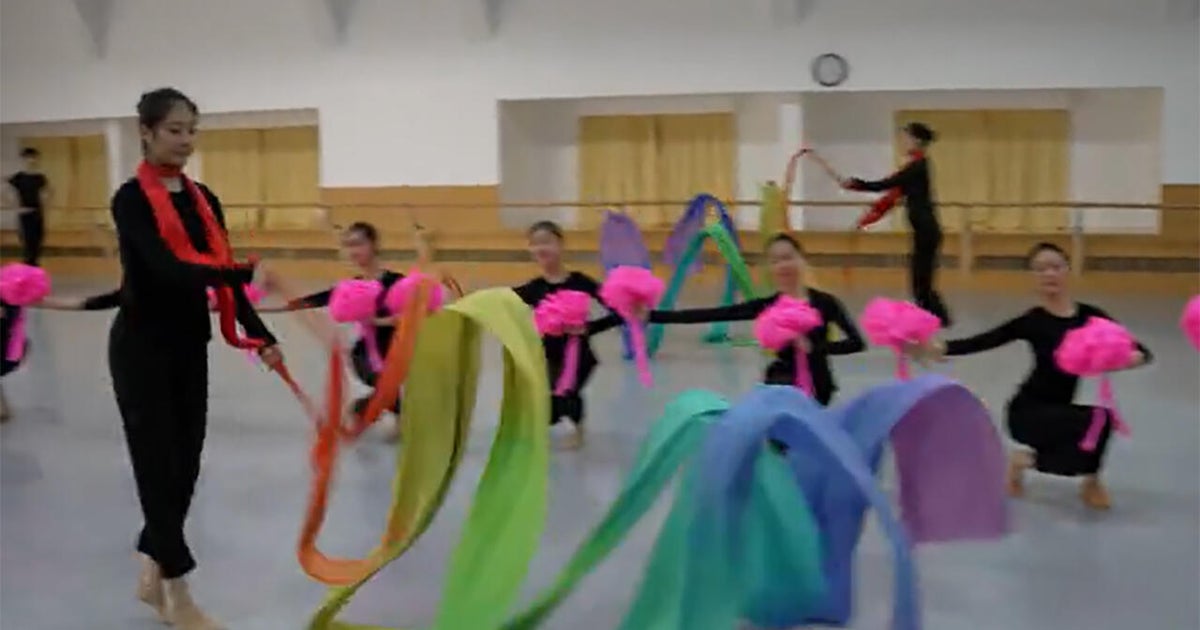
For the first time, Shen Yun opened the gates of Dragon Springs to media scrutiny, inviting reporters to see the facility and respond to the growing allegations. Spokeswoman Ying Chen conducted the tour, showing quiet young people engaged in meditation—men and women sitting separately, reflecting what Chen describes as “very conservative values in the school.” She characterized the atmosphere as resembling prayer: “We settle down our minds and try to purge distracting thoughts, and just stay really focused.” Chen presented Dragon Springs as “a place that provides top-level dance training, and also it’s a faith-based community,” acknowledging that the work is demanding but framing it as the natural requirement of excellence.
Regarding the specific allegations from Sun, Cheng, and others, Chen offered limited direct responses. “I cannot speak to what they went through,” she said about claims of denied medical attention, “But I just find it very shocking and very different from the practice here and our policies here.” Instead, Chen suggested a different narrative entirely—that the lawsuits might be part of a coordinated attack orchestrated by the Chinese government. “These lawsuits emerge at a time when Beijing escalated its global campaign against Shen Yun,” she noted. “It’s really hard to see it as a mere coincidence.” This theory gained some credence when, just this month, the Chinese Embassy publicly attacked Shen Yun as “a cult’s propaganda,” accusing the organization of using “culture as cover” to “deliver indoctrination.” For Shen Yun supporters, this statement reinforced their belief that they’re targets of a sophisticated persecution campaign extending far beyond China’s borders.
Contrasting Testimonies from Current Members
To counter the allegations, Shen Yun presented current company members who tell dramatically different stories. Regina Dong, Shindy Cai, and Piotr Huang—all also sent to Dragon Springs as teenagers—describe their experiences in positive terms. Dong frames the lawsuits within the broader context of Chinese government opposition: “The CCP has been trying to sabotage us since Day One. We’ve got death threats, bomb threats. And this tactic that they’re using now is very similar to what they were using to persecute Falun Gong.” Huang directly contradicts claims that young performers were pressured by their families, stating that his parents never forced him to come: “Not at all. Now, if they came and tried to drag me away, I wouldn’t go.”
On the critical question of medical care, Huang describes a completely different experience. When he experienced Achilles pain, his company manager connected him with a doctor, he received an MRI, and was given proper treatment instructions. Shindy Cai offers perhaps the most striking counterpoint—she claims she never gets sick at all, attributing this to her faith’s protective power: “I actually do think so, because I almost find it strange sometimes. I’m like, you know, usually I’m supposed to come down with, like, a flu, but never. And I think a lot of it has to do with the energy.” These testimonies create a puzzle: Are these fundamentally different experiences within the same organization, separated by time and policy changes? Are some voices being coached or controlled? Or do these divergent accounts reflect something more complex about belief, perception, and the subjective nature of experience within high-demand religious communities?
An Uncertain Future and Unresolved Questions
Today, Jeff Sun and Ashley Cheng have built a new life in New Zealand, having left Falun Gong entirely. When confronted with Shen Yun’s characterization of them as simply “disgruntled performers,” Cheng doesn’t deny the label but reframes it: “Yes, we are disgruntled. What happened to us was not our fault. We were children. And we’ve been living with the shame. And I don’t want to live with it for the rest of my life.” Their legal action, and that of others, has prompted New York’s Department of Labor to investigate Shen Yun’s working conditions and child labor practices—an inquiry that continues even as the organization launches its 20th touring season with a completely new show.
Yet regardless of how these investigations conclude, Shen Yun continues its work, performing for audiences around the world who may know nothing of these controversies. Each annual production is entirely new, but every show concludes with the same finale: a Chinese city teetering on the edge of destruction, saved at the last moment by a divine figure descending from the heavens—a being bearing a striking resemblance to Falun Gong founder Li Hongzhi himself. This ending encapsulates Shen Yun’s core message: a world in crisis, salvation through their specific spiritual path, and the cosmic significance of their founder. But as allegations of child labor, medical neglect, and psychological manipulation emerge from former members, the story of Shen Yun becomes far more complicated than the clear moral narratives presented on stage. The reality appears to be neither as simple as Shen Yun’s supporters believe, nor as sacred as their finale suggests—instead, it’s a deeply human story of faith, devotion, alleged exploitation, competing truths, and the complicated legacy of a movement caught between spiritual mission and earthly accountability.