


Inside Cambodia’s Abandoned Scam Center: A Disturbing Look at Industrial-Scale Fraud
The Discovery at O’Smach
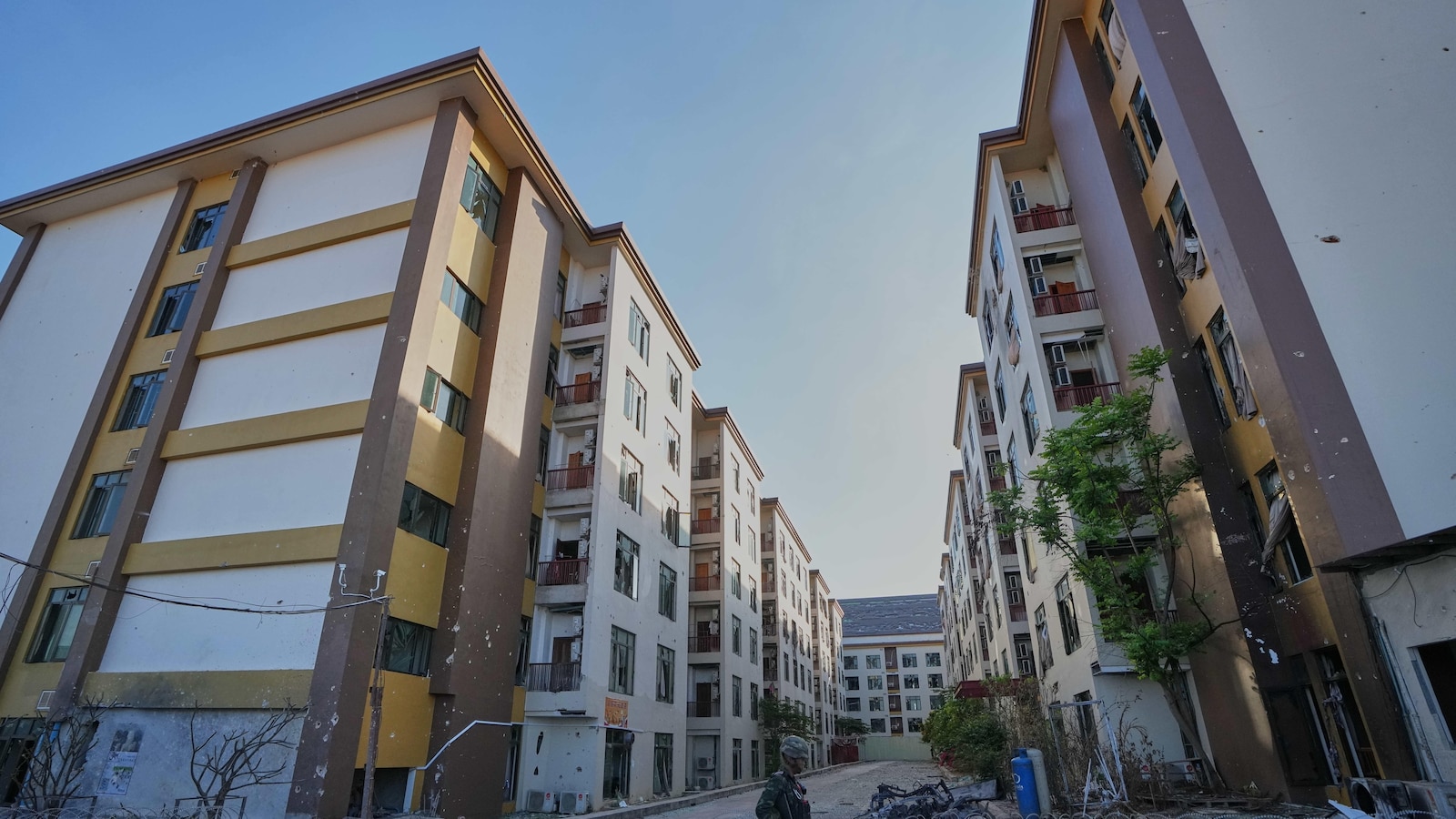
When Thai military forces secured an abandoned compound in O’Smach, a Cambodian town hugging the Thai border, they uncovered something far more sinister than a typical military target. What they found was a sophisticated scam center – a factory of deception that had been operating on an industrial scale. The six-story building complex, now littered with hastily abandoned documents, computer equipment, and personal belongings, tells the story of a massive criminal enterprise that was running full tilt until recent armed clashes forced its operators to flee. On Monday, Thai military officials organized a tour of the site for journalists and international observers, revealing the chilling infrastructure of modern fraud. The compound’s current state – scattered papers, empty hard drive brackets, and signs of sudden evacuation – paints a picture of criminals fleeing in panic as military forces closed in during December’s hostilities.
The Scale and Sophistication of the Operation
Lieutenant General Teeranan Nandhakwang, who directs the Thai army’s intelligence unit, couldn’t hide his surprise at what his forces had uncovered. His assessment was sobering: “They are well-organized. They have good infrastructure and systems, and also the workflow and many, many tactics and techniques to do the scams.” This wasn’t some amateur operation run from a basement with a handful of computers. What the evidence revealed was a meticulously planned, professionally executed criminal enterprise with systems and procedures that would rival legitimate businesses. The compound contained dozens of rooms, each equipped with wooden booths lined with foam for soundproofing – a detail that speaks to the scale of simultaneous operations and the need to prevent victims from hearing other scammers in the background. The presence of scripts written in multiple languages, extensive lists of names and phone numbers, and rows of computer monitors all point to an operation designed to cast a wide net across multiple countries and target victims speaking different languages. This was fraud as a business model, complete with infrastructure, training materials, and operational procedures.
The Theater of Deception: Fake Sets and Costumes
Perhaps the most disturbing aspect of the compound was its collection of elaborate props designed to deceive victims. Investigators found mock-up sets that resembled police stations, complete with uniforms from law enforcement agencies of at least seven different countries: China, Australia, India, Indonesia, Vietnam, Singapore, and Brazil. One room contained a complete replica of what appeared to be a Vietnamese bank branch, meticulously detailed with service counters, official-looking banners, and even a waiting area. These weren’t simple backdrops – they were carefully constructed stages designed to lend authenticity to video calls with victims. Imagine receiving a call from someone wearing what appears to be a police uniform, standing in what looks like a real police station, threatening you with arrest unless you follow their instructions. The psychological impact would be profound, and that’s exactly what these criminals were counting on. These theatrical elements were essential components of “authority impersonation” scams, where fraudsters pose as government officials, law enforcement officers, or bank representatives to intimidate victims into compliance.
The Global Impact and Human Cost
Experts tracking these operations estimate that scam centers in Cambodia and similar facilities across Southeast Asia have defrauded victims worldwide of billions of dollars. But the financial toll, staggering as it is, represents only part of the human cost. These centers have become notorious for another reason: they operate using what amounts to modern slavery. Workers from many countries have been tricked, trafficked, or kidnapped into working at these facilities under slave-like conditions. Victims of these labor trafficking operations often answer online job advertisements promising legitimate remote work in customer service or tech support, only to find themselves imprisoned in compounds like the one at O’Smach, forced to scam others under threat of violence. The very people making the fraudulent calls are often victims themselves, trapped in a cycle of exploitation and crime. The international community has increasingly recognized these scam centers as sites of serious human rights abuses, where forced labor, physical abuse, and human trafficking converge with large-scale financial fraud.
The Geopolitical Complications
The compound’s current status highlights the complex geopolitical situation in the region. Thai military forces secured the site during armed clashes in December, claiming that Cambodian forces had been using it as a military base. A ceasefire agreement reached in December stipulated that both sides would de-escalate tensions and maintain positions held at the time of the agreement. This means that despite being located on Cambodian soil, the compound remains occupied by Thai troops – at least for now. This unusual situation reflects the broader tensions between Thailand and Cambodia regarding border territories, disputes that have periodically flared into armed conflict over the years. The fact that a major scam center was apparently operating with impunity near an active border zone raises questions about oversight, corruption, and the challenges of law enforcement in border regions. It also demonstrates how criminal enterprises can exploit areas where jurisdiction is unclear or disputed, operating in the gaps between national authorities.
Looking Forward: Combating Transnational Scam Operations
The discovery at O’Smach offers valuable intelligence about how these scam operations function, but it also underscores the enormous challenge of combating them. These aren’t isolated criminal actors – they’re organized networks with significant resources, international reach, and the ability to quickly adapt and relocate. The sophistication of the O’Smach operation, with its multi-language capabilities, elaborate props, and professional infrastructure, suggests significant investment and criminal expertise. Shutting down one facility, while important, barely dents an industry that has proliferated across Cambodia, Myanmar, Laos, and other countries in the region. International cooperation is essential but complicated by issues of sovereignty, varying legal frameworks, and in some cases, alleged complicity by corrupt officials who profit from these operations. The scripts, equipment, and documents left behind at O’Smach will provide valuable evidence for investigators, potentially helping to identify victims, trace money flows, and understand the networks behind these operations. But until countries in the region commit to aggressive enforcement and address the governance gaps that allow these centers to operate, new facilities will likely spring up to replace those that are closed. For the millions of potential victims worldwide who answer phones not knowing whether the “police officer” or “bank representative” on the other end is real or a scammer in a soundproofed booth, the threat remains very real and growing.