


A Remarkable Discovery: Medieval Crusader Sword Found Off Israeli Coast
An Unexpected Find Beneath the Waves
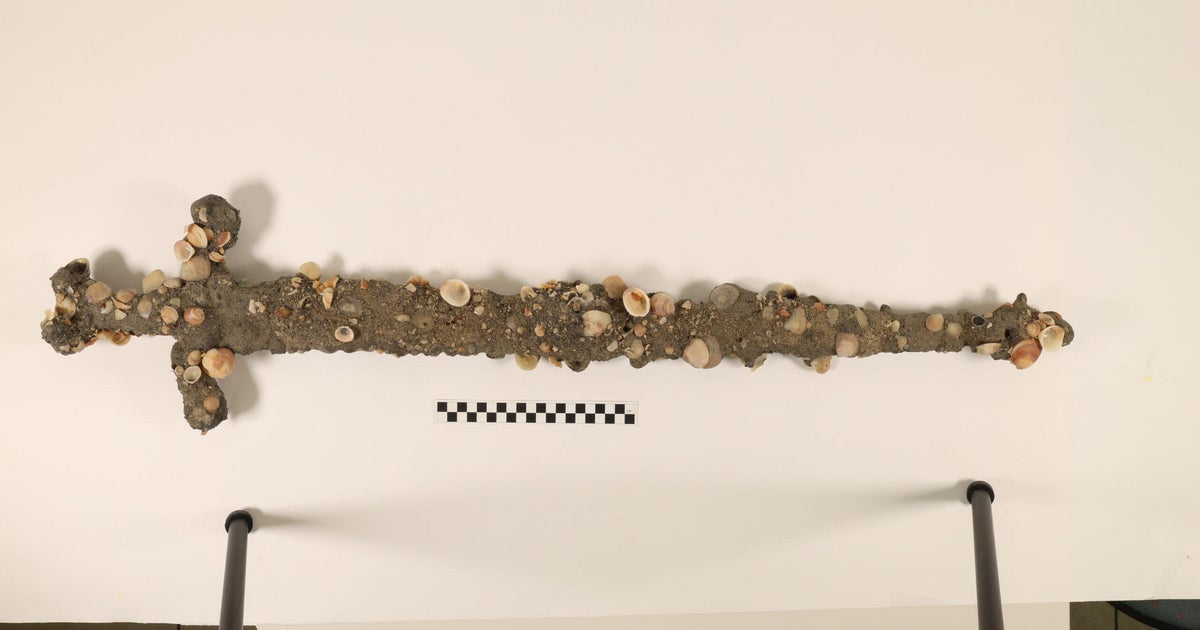
In a discovery that reads like something straight out of an adventure novel, a university student made an extraordinary find while enjoying a simple swim off the coast of Israel. Shlomi Katsin, who studies at the University of Haifa’s Department of Maritime Civilizations, was swimming near Dor Beach when he noticed something unusual—a group of divers equipped with metal detectors exploring the seafloor. His academic background immediately raised red flags, as he suspected these individuals might be antiquities thieves looking to plunder historical artifacts from the protected waters. Acting on instinct and a desire to protect potential historical treasures, Katsin managed to chase the suspicious divers away from the area. Little did he know that his protective actions would lead him to one of the most significant archaeological discoveries of recent years. After the divers left, something caught his eye protruding from the sandy seafloor—the unmistakable shape of an ancient sword, its blade partially buried beneath centuries of sediment and encrusted with marine life. This completely chance encounter would soon reveal a weapon that had rested on the Mediterranean seafloor for approximately 800 to 900 years, a silent witness to one of history’s most turbulent periods—the Crusades.
From Ocean Floor to Research Laboratory
Recognizing the potential historical significance of his discovery, Katsin didn’t attempt to retrieve the sword himself or keep his find secret. Instead, he demonstrated remarkable responsibility by immediately contacting Professor Debi Tsveikal from his own Department of Maritime Civilizations at the University of Haifa. Professor Tsveikal understood the gravity of the situation and quickly reached out to the Israel Antiquities Authority, the government body responsible for protecting and preserving the nation’s archaeological heritage. The authority responded swiftly, granting special permission for the sword to be carefully removed from its underwater resting place. This permission was crucial—normally, disturbing archaeological sites is strictly prohibited, but in this case, authorities recognized that leaving the sword exposed on the seafloor, especially after it had been discovered and its location potentially compromised, could result in theft or damage. The three-foot-long blade was carefully extracted from the water and transported to the conservation laboratory at the university’s Leon Recanati Institute of Maritime Studies, where experts could begin the delicate process of studying and preserving this remarkable piece of history.
Modern Technology Reveals Ancient Secrets
What happened next perfectly illustrates how contemporary medical technology can serve archaeological research in unexpected ways. The sword, heavily encrusted with seashells and covered in thick layers of marine sediment accumulated over centuries, was taken to Medica Elisha Hospital in Haifa. There, researchers employed a CT scanner—typically used to examine patients’ internal injuries or illnesses—to peer inside the ancient weapon without risking damage to its fragile, corroded structure. This non-invasive examination revealed fascinating details about the sword’s construction and condition. The scan showed that this was a single-handed weapon, designed to be wielded by a warrior using one hand while the other might hold a shield. The blade bore evidence of a fracture, possibly sustained in battle centuries ago, or perhaps resulting from the immense pressures of time and the sea. Most poignantly, the scan revealed that much of the iron that originally formed this formidable weapon had been slowly consumed by oxidation—the relentless ravages of time and saltwater had eaten away at the metal, transforming what was once a deadly instrument of war into a fragile archaeological treasure barely holding together after its long submersion in the Mediterranean.
A Window Into the Crusader Era
Dr. Sarah Lantos, a professor in the Department of Maritime Civilizations, emphasized the exceptional nature of this discovery. Finds like this are extraordinarily rare, she explained, and each one provides researchers with a unique opportunity to learn about the lives of European knights who traveled thousands of miles from their homelands to fight in the Holy Land during the medieval period. Professor Tsveikal, who first received Katsin’s report of the discovery, noted that only a handful of blades dating back to the Crusades have been found in Israel, making each discovery precious to historians and archaeologists trying to piece together a complete picture of this turbulent period. The sword’s discovery in the waters off Haifa is particularly significant because it contributes greatly to our understanding of how maritime anchorages were used during the Crusades and offers tangible evidence of the daily lives and equipment of the warriors who fought during this period. Unlike written accounts, which can be biased or incomplete, physical artifacts like this sword provide direct, unfiltered evidence of the craftsmanship, military technology, and material culture of the era.
The Historical Context of the Crusades
To fully appreciate the significance of this discovery, it’s important to understand the historical period from which this sword originated. The Crusades were a series of religious military campaigns that took place between 1095 and 1291, spanning nearly two centuries of conflict in the Mediterranean region. These campaigns were launched by Christian knights and soldiers from Western Europe with the stated goal of capturing and controlling areas along the eastern Mediterranean that were under Muslim control. The battles and sieges of the Crusades took place across territories that today include Israel, Turkey, Syria, and other Middle Eastern countries. The Crusaders weren’t merely raiders—they came as conquerors intending to stay. They constructed massive fortified castles and strongholds to protect and administer their newly conquered territories, many of which still stand today as testament to their engineering prowess and military ambitions. Over the nearly 200 years of the Crusades, control of these territories shifted back and forth between Christian and Muslim forces multiple times, with each side capturing and recapturing strategic locations. The era finally came to an end in 1291 when the last major Crusader stronghold fell, marking the conclusion of one of the most significant periods of conflict between Christian Europe and the Islamic world.
A Pattern of Discovery and the Importance of Protection
Interestingly, this isn’t the first time a Crusader-era sword has been discovered in the waters off Israel’s coast. In 2021, just a year before Katsin’s find, an amateur diver found another large sword dating back to the Crusades lying at the bottom of the Mediterranean Sea off the Israeli coast. This pattern of discoveries suggests that there may be many more artifacts resting on the seafloor, waiting to be found. The waters off the coast of Israel served as important routes for Crusader ships bringing supplies, reinforcements, and communication between Europe and the Crusader kingdoms in the Holy Land. Shipwrecks, battles at sea, and simple accidents could all have resulted in weapons and other artifacts ending up on the ocean floor. Katsin’s initial concern about antiquities thieves when he first spotted the divers with metal detectors highlights an ongoing challenge for archaeological preservation—the threat posed by looters who seek to profit from selling historical artifacts on the black market. Such theft doesn’t just deprive museums and researchers of valuable objects; it removes artifacts from their archaeological context, destroying information that scientists could have learned about how and when the objects were used. Katsin’s responsible decision to report his find to academic authorities rather than attempting to keep or sell the sword himself serves as an excellent example of how chance discoveries should be handled. His actions ensured that this remarkable piece of history will be preserved, studied, and eventually displayed for the public to appreciate, rather than disappearing into a private collection where its historical value would be lost to everyone except a single owner.