
A New Claim: Could a Roman Church Bust Be the Work of Michelangelo?
The Controversial Discovery
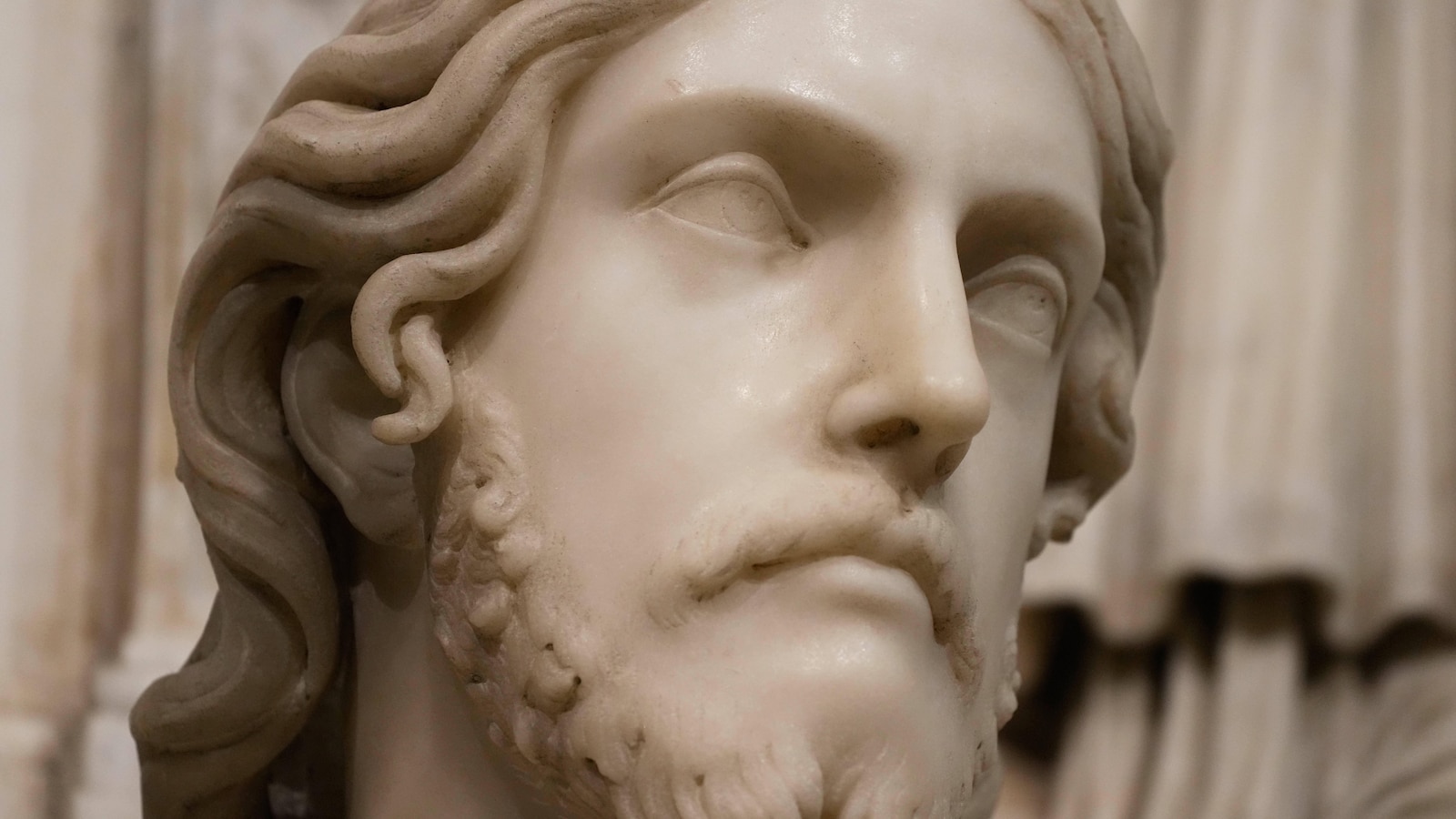
The art world is buzzing with excitement and skepticism following a bold new claim by independent researcher Valentina Salerno. On Wednesday, she announced that a marble bust of Christ housed in a Roman church might actually be the work of Michelangelo, one of history’s most celebrated Renaissance artists. This announcement comes at a particularly sensitive time for art historians and collectors alike, especially after a recently disputed sketch of a foot—claimed to be by Michelangelo but questioned by many experts as merely a copy—sold for an astounding $27.2 million at a Christie’s auction. The high stakes involved in attributing works to such a legendary master have made Renaissance scholars understandably cautious. Many leading experts have chosen to remain silent on Salerno’s claims rather than wade into what could become a contentious debate. Salerno presented her findings through the website academia.edu, a platform where academics share research but one that doesn’t employ the rigorous peer-review process that traditional academic journals require. She officially unveiled what she calls her first “rediscovery” at a press conference, timing her announcement strategically around the 550th anniversary of Michelangelo’s birth, a milestone being celebrated with numerous exhibitions, conferences, and commemorative events worldwide.
The Sculpture at the Center of Attention
The marble bust in question resides in the Basilica of Sant’Agnese fuori le mura in Rome, where it has sat for centuries. According to Italy’s culture ministry records, the work has long been classified as an anonymous piece from the Roman school of the 16th century—essentially an “artist unknown” designation that relegates it to obscurity among countless other works from that era. However, Salerno isn’t the first person to suggest this particular sculpture might be something special. Back in 1996, Michelangelo expert William Wallace wrote an article for ArtNews exploring the long, complicated history of incorrectly attributing works to the Renaissance master. In that piece, he quoted the 19th-century French writer Stendhal, who visited the Sant’Agnese church and wrote that “we noticed a head of the savior which I should swear is by Michelangelo.” Despite Stendhal’s confident assertion, Wallace noted that the sculpture had never been taken seriously by scholars and wouldn’t even merit inclusion in a catalog of rejected attributions in modern times. The church has taken the renewed attention seriously, though. According to Rev. Franco Bergamin, the abbot of the order managing the church, the Italian culture ministry was invited to Salerno’s press conference but declined to attend. The Carabinieri art squad, Italy’s specialized police unit for protecting cultural heritage, has also refused to comment on the statue’s authenticity but has ensured its protection. A laminated sign now warns visitors that the sculpture is under armed alarm protection.
The Evidence Behind the Attribution
Salerno’s conclusion that this bust is genuinely the work of Michelangelo rests on extensive documentary research rather than stylistic analysis or scientific testing. She claims that several historical documents from the first few centuries after Michelangelo’s death correctly identified the work as his, but that a 1984 scholarly assessment incorrectly debunked this attribution, causing it to be dismissed ever since. Her research involved tracing wills, inventories, and notarized documents held in church archives, state repositories, and the records of Roman confraternities to which Michelangelo and his students belonged. According to Salerno, the bust was modeled on Tomaso De’ Cavalieri, an intimate friend of Michelangelo’s, and was part of the artistic inheritance the master left to his friends and students upon his death in 1564. She believes she has uncovered evidence of a secret “pact of indissolubility” among some of Michelangelo’s students and their heirs to preserve and protect his works after he died. Most intriguingly, her research suggests the previously unknown existence of a special chamber whose locks could only be opened using three separate keys, each held by a different student—a dramatic detail that sounds almost like something from a historical thriller novel.
The Researcher’s Unconventional Background
What makes this story even more unusual is Salerno’s background. She is neither a trained art historian nor does she hold a college degree in any related field. By profession, she’s an actress and fiction author who stumbled into this research “by chance” about ten years ago when she decided to write a novel about Michelangelo. This unconventional path into serious art historical research has raised eyebrows in academic circles, where credentials and formal training typically carry significant weight. Despite—or perhaps because of—her outsider status, Salerno’s work caught the attention of Cardinal Mauro Gambetti, who oversees St. Peter’s Basilica. In 2025, he appointed both Salerno and her mentor to a scientific committee formed to discuss a possible Vatican exhibition commemorating the anniversary of Michelangelo’s birth. This committee includes some of the world’s leading Renaissance and Michelangelo scholars, including Barbara Jatta, director of the Vatican Museums; Hugo Chapman, curator of Italian and French drawings from 1400-1800 at the British Museum; and William Wallace, a professor of art history at Washington University in St. Louis. The inclusion of an uncredentialed researcher on such a prestigious committee has surprised many in the field. Nothing substantial has yet emerged from the committee’s work, and several members have either downplayed the significance of Salerno’s research, refused to discuss it, or distanced themselves from the committee altogether when contacted by journalists.
Expert Opinions and Academic Skepticism
The response from established scholars has been decidedly mixed, with most erring on the side of caution. When approached by The Associated Press, Barbara Jatta distanced herself from the Vatican committee, while the British Museum declined to make Hugo Chapman available for comment. Cardinal Gambetti’s office didn’t respond to requests for information, and other committee members simply declined to weigh in. William Wallace, however, did speak to the AP and offered a nuanced assessment. He acknowledged that Salerno’s research methodology was fundamentally sound and noted that Europe has a strong tradition of non-credentialed researchers producing valuable scholarly work. He agreed with her thesis that Michelangelo didn’t destroy his works in a fire—a belief commonly held in the past but already debunked by scholars years ago. Instead, he concurred with Salerno’s view that Michelangelo entrusted his remaining works to his students to complete his projects in his final years. However, Wallace disputes Salerno’s broader conclusion that a vast treasure trove of Michelangelo’s works was secretly hidden away and remains undiscovered. He points out that Michelangelo simply wasn’t producing that much artwork in his final years because he was primarily occupied with overseeing six major architectural projects in Rome. The drawings he did create during this period were mostly technical sketches to solve construction problems on worksites—”working drawings” that likely didn’t survive because they weren’t considered worth preserving. While Wallace acknowledged that the existence of a secret chamber requiring three keys is a genuinely new claim, he emphasized that proper academic scholarship would require Salerno to transcribe the original documents and submit them to peer review, allowing other experts to verify her interpretations.
The Pattern of “Rediscoveries” and What Comes Next
Italy has long been a hotbed for claims of newly discovered works by famous artists, with attributions, fakes, and frauds involving Modigliani and others regularly making headlines in art history circles. Wallace put Salerno’s claims in this broader context, noting that he counted 45 attributions to Michelangelo since the year 2000 alone. Each announcement arrived with breathless headlines proclaiming “the greatest discovery of the time” or predictions that it would “change everything we think about Michelangelo.” Yet five years later, Wallace observed, these discoveries are typically forgotten, having failed to withstand scholarly scrutiny. Whether Salerno’s claim about the Sant’Agnese bust will prove different remains to be seen. The sculpture continues to receive protection as an important cultural artifact regardless of its attribution, with Lieutenant Colonel Paolo Salvatori of the Carabinieri expressing hope that “this asset, which belongs to our cultural heritage regardless of whether it can be attributed to Michelangelo Buonarroti or not, is part of the national heritage that we are responsible for defending.” For now, the art world waits to see whether Salerno will make her documentary evidence available for peer review and whether stylistic or scientific analysis might support or contradict her archival findings. The 550th anniversary of Michelangelo’s birth has already sparked renewed interest in his genius and legacy, and Salerno’s claims—controversial as they may be—have certainly added another layer of intrigue to the celebrations. Whether this marble bust will ultimately join the ranks of authenticated Michelangelo masterpieces alongside the David, the Pietà, and the Sistine Chapel ceiling, or whether it will fade into the long list of rejected attributions, only time and rigorous scholarship will tell.