
The Cocoa Crisis: How West African Farmers Are Abandoning Their Heritage
A Generational Legacy Turns to Burden
For Manu Yaw Fofie, a 52-year-old farmer in Kona, Ghana, cocoa farming isn’t just a profession—it’s his birthright, passed down through generations as both a livelihood and a connection to his ancestral land. Yet what was once a source of pride and prosperity has transformed into an overwhelming burden. The dramatic collapse of cocoa prices over the past year has created a paradoxical situation: while chocolate manufacturers worldwide scramble to secure supplies and consumers continue their love affair with chocolate, cocoa beans are literally rotting in West African warehouses. This surreal disconnect between global demand and local reality has pushed Fofie to make a heartbreaking decision that would have been unthinkable to his ancestors. In a desperate bid for survival, he’s begun leasing portions of his inherited land to illegal sand miners—individuals who extract sand for the booming construction industry, where it’s used in concrete production. The cruel irony isn’t lost on Fofie: while this arrangement provides immediate income, the mining process renders the soil permanently infertile, destroying any possibility of future cocoa cultivation. His annual yields tell a devastating story of decline—from a prosperous 300 bags in years past to a mere 50 bags in 2025, a collapse driven by a perfect storm of climate change, market volatility, and systemic failures in agricultural support.
The Perfect Storm Devastating West Africa’s Cocoa Heartland
Fofie’s predicament isn’t an isolated case but rather a symptom of a crisis engulfing Ghana and Ivory Coast, the two nations that together produce nearly 70% of the world’s cocoa bean supply. These countries have built significant portions of their economies around this single commodity—Ivory Coast derives 40% of its total export revenue from cocoa beans, while Ghana depends on cocoa for nearly 15% of its export income. Hundreds of thousands of farming families across both nations have structured their entire lives around cocoa cultivation, creating communities where the rhythm of planting and harvest seasons dictates everything from school schedules to wedding dates. Now, this entire way of life teeters on the edge of collapse. The crisis reached a critical point when Ivory Coast, the world’s largest cocoa producer, was forced to purchase excess supply from farmers in January to prevent complete economic devastation, then this week slashed prices by more than half for 2026. Edward Karaweh, former general secretary of the General Agricultural Workers Union in Ghana, pointed to a fundamental failure in crisis preparedness, noting that while commodity markets naturally experience fluctuations, the scale of this particular disaster caught Ghanaian authorities completely unprepared. “Preparation allows you to mitigate the crisis. It is not that you prevent the crisis altogether,” Karaweh explained, highlighting how lack of foresight transformed a manageable market correction into an existential threat for farming communities.
How Market Manipulation Left Farmers Behind
The root of the current crisis lies in the complex interplay between government regulation, international futures markets, and the realities of agricultural production. Both Ghana and Ivory Coast operate systems where government regulators set a fixed price for cocoa beans at the beginning of each planting season, with the majority of beans sold through government-licensed intermediaries. This system was designed with good intentions—to protect farmers from the notorious volatility of international commodity markets and provide income stability. However, this protective mechanism became a trap when cocoa futures on international markets experienced an unprecedented surge in 2024, with prices reaching over $12,000 per metric ton—the highest levels seen in decades. Farmers, locked into their pre-season fixed prices, watched helplessly as their crop’s true market value skyrocketed beyond their reach, with all the windfall profits captured by traders and intermediaries rather than the people who actually cultivated the beans. Then came the crash. As supply eventually outstripped demand, prices plummeted to around $4,000 per metric ton, creating an impossible situation for global traders who had committed to purchasing cocoa at the previously set government prices. Faced with guaranteed losses, many traders simply stopped buying, leading to the surreal situation of cocoa beans rotting in warehouses while farmers who had already sold their stocks to government entities went unpaid for months, caught in a bureaucratic and financial limbo.
When Cocoa Can’t Compete with Gold and Sand
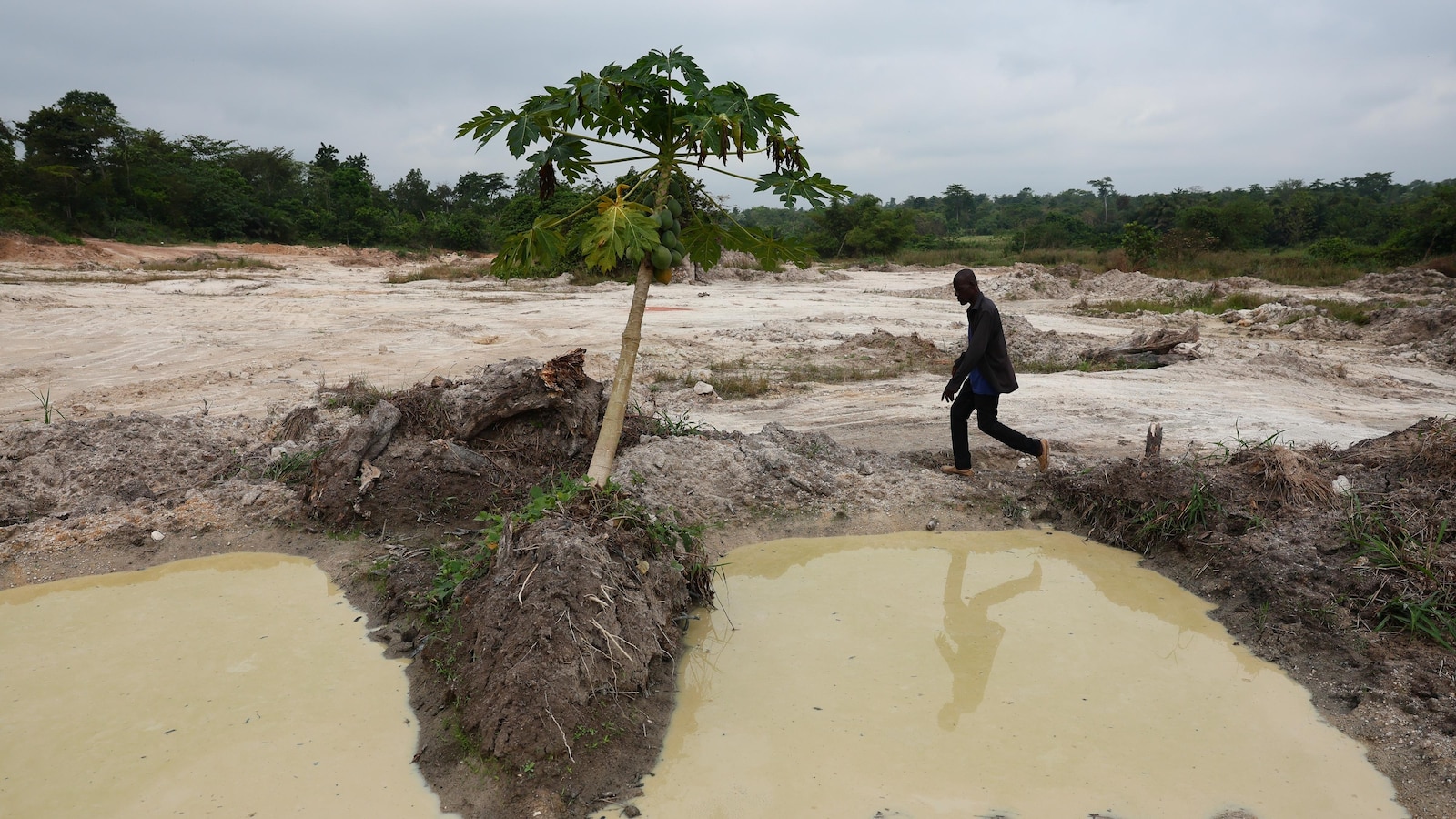
The cascading failures of the cocoa market have driven farmers to explore alternative uses for their land, even when those alternatives guarantee the permanent destruction of their agricultural heritage. In Ivory Coast, François N’Gbin walks through his cocoa plantation pointing out the visible signs of neglect and disease—blackened, dried-up pods damaged by pests and insufficient rainfall that goes untreated because investment no longer makes economic sense. Like Fofie in Ghana, N’Gbin has turned to illegal mining, initially leasing portions of his farm to gold miners for fees, then obtaining a mining license to protect himself from legal consequences. The mining operation on his property now covers at least 1,000 square meters, with murky, yellowish water filling the excavated areas—a visible scar on land that once produced cocoa. His calculation is brutally simple: “Today, gold is more profitable than cocoa. We get 1,500 CFA francs ($2.67) per gram of gold, and we’re about to negotiate an increase.” Moussa Koné, president of the Ivorian cocoa farmers’ union, confirms this trend is widespread, noting that desperation drives farmers’ decisions: “Cocoa is not selling, but farmers still need money to feed their families.” The immediate needs of survival—putting food on the table, paying for children’s education, covering medical expenses—override concerns about long-term land degradation when the traditional crop no longer provides subsistence income.
Government Interventions That May Be Too Late
Recognizing the crisis, both governments have attempted interventions, though farmers question whether these measures address the fundamental problems or simply shift the burden. In January, Ghana initiated efforts to loosen its rigid price control regulations, slashing the fixed price for cocoa beans by 28% to 41,392 cedis (approximately $3,881) per metric ton. The government’s rationale was straightforward—making beans more affordable to buyers would restart purchases and clear warehouse stockpiles. This week, Ivory Coast followed with even more drastic action, cutting the price paid to farmers by more than half to 1,200 CFA francs ($2.13) per kilogram, or roughly $0.97 per pound for the 2026 season. However, from the farmers’ perspective, these price cuts represent a betrayal rather than a solution. When they calculate their production costs—including fertilizers, pesticides, labor, equipment maintenance, and the basic expenses of running a farm—the new prices leave profit margins so slim that cocoa farming becomes economically irrational. Mercy Amponsah, a 50-year-old cocoa farmer in Ghana, was among those who traveled to the capital city of Accra in January to protest the price cuts, her participation driven by stark personal stakes: “Accepting the current price means my son will have to drop out of school.” Her statement captures the immediate human cost of these economic abstractions—children’s educations interrupted, medical care deferred, nutrition compromised, and futures foreclosed.
The Uncertain Future of West African Cocoa
While cocoa producers in South America and Asia have increased their output, West Africa still dominates global production, making the region’s crisis a matter of international concern for everyone from commodity traders to chocolate manufacturers to ordinary consumers. Yet for farmers like Fofie, these global considerations mean little compared to the immediate question of survival. His assessment of the situation is blunt and fatalistic: “If I keep this cocoa farm for the next 10 years, I would die a poor man.” This statement reflects not just economic calculation but a profound loss of hope in a system that seems fundamentally broken. The tragedy extends beyond individual farmers to entire communities built around cocoa cultivation, traditional knowledge developed over generations, and agricultural ecosystems carefully balanced over decades. As farms transition to mining operations or other uses, this accumulated wisdom and infrastructure faces extinction. The current crisis raises fundamental questions about the sustainability of commodity-dependent economies, the effectiveness of price controls in globalized markets, and the responsibility of wealthy consumer nations toward the farmers who supply their luxuries. Unless structural reforms address the power imbalances between growers and buyers, improve farmer access to value-added processing, and create genuine price stability rather than government-imposed fixes, West Africa’s cocoa farming communities face an existential threat. The rotting beans in warehouses serve as a powerful symbol—abundance without prosperity, productivity without reward, and a system that has somehow managed to create scarcity amidst plenty.