
A Shocking Discovery: When a Crocodile Turned Up 1,200 Miles from Home
A Mother’s Disbelief Turns to Alarm
When Stephanie Kirsop received a phone call from her 12-year-old son Lionel Saunders on a Saturday afternoon, claiming he’d spotted a crocodile swimming in a local creek, her first reaction was one of complete skepticism. Living in Newcastle, a temperate coastal city in Australia, the idea seemed absolutely absurd. After all, their home was situated a staggering 1,200 miles south of Australia’s tropical northern regions where crocodiles naturally inhabit. The coastal climate of Newcastle is far too cool to support crocodile populations, making Lionel’s claim seem like nothing more than an overactive imagination or perhaps an elaborate prank concocted by him and his friends.
Despite her doubts, Lionel was insistent. He and his friends had clearly seen something in Ironbark Creek that afternoon, and he was determined to convince his mother it wasn’t just a misidentified log or piece of debris. Understanding his mother’s natural disbelief, the resourceful young boy took videos of the creature as evidence, sending them to her phone in an attempt to prove he wasn’t making up stories. Even with the video evidence in hand, Stephanie remained unconvinced, reasoning that what appeared to be a crocodile in the footage was probably just a log floating in the water. When Lionel called back with even greater urgency, pleading with his mother to come see for herself, she reluctantly agreed, fully expecting to arrive at the creek only to be met with laughter from a group of kids who’d successfully pulled off an elaborate joke.
The Shocking Reality
The entire drive to Ironbark Creek, Stephanie braced herself for embarrassment, convinced she was falling for a trick that would leave her as the punchline. However, when she arrived at the location her son had described, all her skepticism evaporated in an instant. There, swimming casually in the creek waters where local children regularly fished and occasionally swam, was unmistakably a crocodile—small, but undeniably real. The shock of seeing such a creature in such an unexpected location immediately shifted her concern from whether her son was telling the truth to the potential danger this reptile posed to the community, especially the children who frequented the area for recreational activities.
Recognizing the urgency of the situation, Stephanie immediately contacted a wildlife rescue service, only to be met with the same skepticism she had initially shown her son. The rescue service informed her that crocodiles simply don’t live in that area of Australia, dismissing her concern based on geographic impossibility. Not one to give up easily, and now armed with her own photographic and video evidence, Stephanie sent her documentation to the wildlife service as proof. This persistent approach eventually led her to the Australian Reptile Park, a facility experienced in handling such exotic creatures and maintaining crocodiles in carefully controlled, temperature-regulated environments suitable for these tropical animals.
From Skepticism to Action
Billy Collett, the manager of the Australian Reptile Park, initially shared the same doubts that had plagued everyone else in this unusual chain of events. In an age where artificial intelligence can create incredibly convincing fake images and videos, Collett’s first suspicion was that the photos and videos might be digitally manipulated or AI-generated fakes. The park regularly receives calls about exotic animal sightings, and in the modern digital era, distinguishing genuine wildlife emergencies from elaborate hoaxes or honest misidentifications has become increasingly challenging. However, when local police confirmed that there was indeed a crocodile in Ironbark Creek, Collett knew immediate action was required.
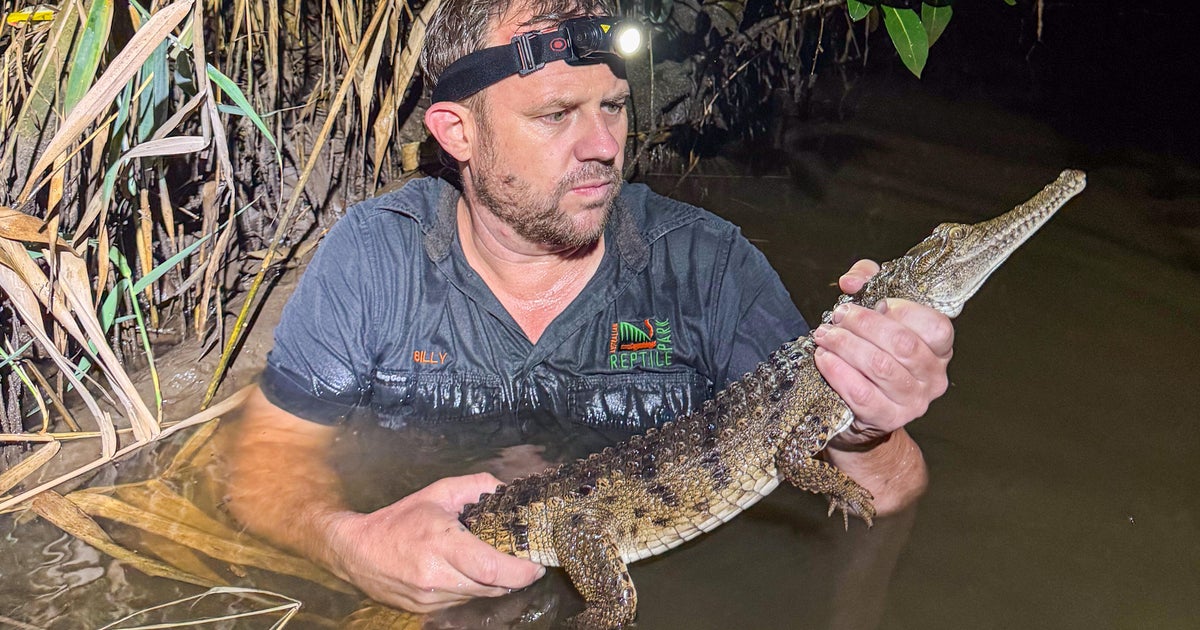
Upon examining the evidence more closely, Collett was able to identify the species as an Australian freshwater crocodile, scientifically known as crocodylus johnstoni. This identification was actually somewhat fortunate news, as freshwater crocodiles are considerably smaller and less dangerous than their saltwater cousins, which can grow to terrifying lengths of over 20 feet, weigh more than a ton, and possess bite forces powerful enough to crush a human skull. However, Collett was quick to point out that “less dangerous” doesn’t mean harmless—freshwater crocodiles are still perfectly capable of inflicting serious injuries on humans, particularly children, and the presence of any crocodile species in a recreational area frequented by kids was completely unacceptable from a safety standpoint.
The Successful Capture
Collett and his experienced team mobilized quickly, launching a careful operation to capture the wayward reptile. By Sunday night, approximately a day and a half after Lionel’s initial sighting, they successfully caught the juvenile meter-long crocodile about 2 miles downstream from where it had first been spotted. The capture operation required both expertise and caution, as even smaller crocodiles can be surprisingly aggressive and difficult to handle when threatened or cornered. Collett’s primary motivation for acting so quickly wasn’t just public safety, though that was certainly paramount—he was also concerned about the crocodile’s own survival prospects. With autumn currently underway in the Southern Hemisphere and winter approaching, the temperate climate of Newcastle would soon become fatally cold for a tropical reptile. “I just wanted to get him out of there because he would’ve perished in winter,” Collett explained, highlighting the dual emergency of both public safety and animal welfare.
Following the successful capture, the crocodile underwent a health assessment and was found to be in good condition despite its geographic displacement. The reptile is currently being housed at the Australian Reptile Park, where staff can provide appropriate care while authorities determine the best permanent placement for the animal. Since crocodiles are protected under Australian law, the decision about the animal’s future cannot be made lightly and must balance conservation concerns with practical considerations. Collett’s professional opinion is that this crocodile was almost certainly someone’s pet that had been released into the wild—a sadly common scenario when exotic pets grow too large for their enclosures or too dangerous for their owners to safely manage. What might start as a tiny hatchling in a fish tank can quickly become an unmanageable predator, leading irresponsible owners to make the dangerous and illegal decision to release these animals into environments where they don’t belong.
The Broader Context of Crocodile Encounters
This unusual incident in Newcastle serves as a reminder of the very real dangers that crocodiles pose in their natural habitats throughout northern Australia. Statistical data paints a sobering picture: between December 1985 and April 2024, wild saltwater crocodiles in Queensland were responsible for 34 non-fatal attacks and 14 fatal attacks on humans. These numbers represent not just statistics but individual tragedies, families torn apart, and communities impacted by encounters with these apex predators. Recent incidents have been particularly heartbreaking—in August 2024, police discovered human remains inside a large crocodile suspected of killing a tourist, a grim confirmation of the fatal encounter. Just a month prior to that tragic event, a 12-year-old girl was snatched by a crocodile while swimming with her family in a creek in the Northern Territory. Despite extensive search efforts, only her remains were later recovered, and wildlife rangers were forced to destroy a 14-foot crocodile believed responsible for the attack.
These incidents underscore why the discovery of a crocodile in Newcastle, even a smaller freshwater species, generated such serious concern among authorities and wildlife experts. While crocodiles are magnificent creatures that play important roles in their native ecosystems, they are also powerful predators with instincts honed over millions of years of evolution. They have no place in areas where children play, families swim, and communities gather for recreation. The quick thinking of young Lionel Saunders, the persistent advocacy of his mother Stephanie Kirsop, and the professional response of Billy Collett and his team at the Australian Reptile Park likely prevented what could have become another tragic statistic in Australia’s complex relationship with these ancient reptiles. This story, while ultimately having a positive resolution, serves as both a warning about the dangers of keeping exotic pets and a reminder to remain vigilant about wildlife safety, even in areas where dangerous animals aren’t supposed to exist.