
Tragic Military Plane Crash in Bolivia Claims 22 Lives While Carrying Currency Shipment
Devastating Accident Near La Paz Airport
A catastrophic military plane crash near Bolivia’s capital city has left 22 people dead and 29 others injured in what has become one of the country’s most tragic aviation disasters in recent memory. The incident occurred when a Hercules C-130 military aircraft, transporting 18 tons of newly printed Bolivian banknotes, crashed in El Alto—a city situated adjacent to La Paz where the international airport is located. The massive aircraft veered off the runway during what should have been a routine landing, ultimately ending up in a nearby field and wreaking havoc on the surrounding area. The crash damaged approximately fifteen vehicles, many of them public transportation buses carrying unsuspecting passengers, and resulted in a scene of utter devastation with debris, destroyed automobiles, and casualties scattered across the roadway. Firefighters worked tirelessly to extinguish the flames that had completely engulfed the aircraft, while emergency responders rushed to provide aid to the injured and recover those who had perished in the accident.
Victims and Emergency Response Efforts
The human toll of this disaster has been heartbreaking, with police commander Mirko Sokol confirming that among the 22 deceased are twelve men (including one crew member from the aircraft), six women, and four children—a stark reminder that this tragedy impacted entire families and innocent bystanders who were simply going about their daily lives. The 29 injured survivors were quickly transported to medical facilities in El Alto for treatment, with many suffering from serious injuries sustained when the aircraft plowed into their vehicles. Forensic investigators continued their grim work throughout Saturday, carefully recovering human remains from the wreckage in a process that required both technical expertise and tremendous emotional resilience. The fact that so many victims were passengers on public transportation underscores the random cruelty of this disaster—people who had no connection to the military operation became casualties simply because they happened to be traveling on roads near the airport at the wrong moment. Emergency services, including firefighters, police, and medical personnel, worked in coordinated efforts to manage the crisis, treat the wounded, and secure the crash site while dealing with the additional complication of scattered currency that attracted unwanted attention from the public.
Details of the Fatal Flight and Crash Circumstances
Defense Minister Marcelo Salinas provided official details about the ill-fated flight, explaining that the Hercules C-130 aircraft had been transporting newly printed Bolivian currency from the eastern city of Santa Cruz to La Paz when disaster struck. According to Salinas, the plane “landed and veered off the runway” at the El Alto airport, though the exact cause of why the aircraft lost control during what appeared to be the landing phase remains under investigation. The Hercules C-130 is a well-known military transport aircraft with a long history of reliable service across numerous countries, making this crash all the more perplexing and tragic. The plane was carrying an enormous payload—18 tons of fresh banknotes that had recently arrived in Santa Cruz from abroad, representing a significant monetary shipment intended to enter Bolivia’s financial system. When the aircraft crashed and broke apart, these newly printed bills were scattered across the crash site, creating an additional complication for authorities who were already dealing with the immediate emergency of saving lives and recovering the deceased. The images that emerged from the scene on social media painted a picture of absolute chaos: twisted metal from the aircraft, burned and crushed vehicles, emergency responders working frantically, and, incongruously, paper currency littering the ground around the site of such terrible loss of life.
Chaos and Looting at the Crash Site
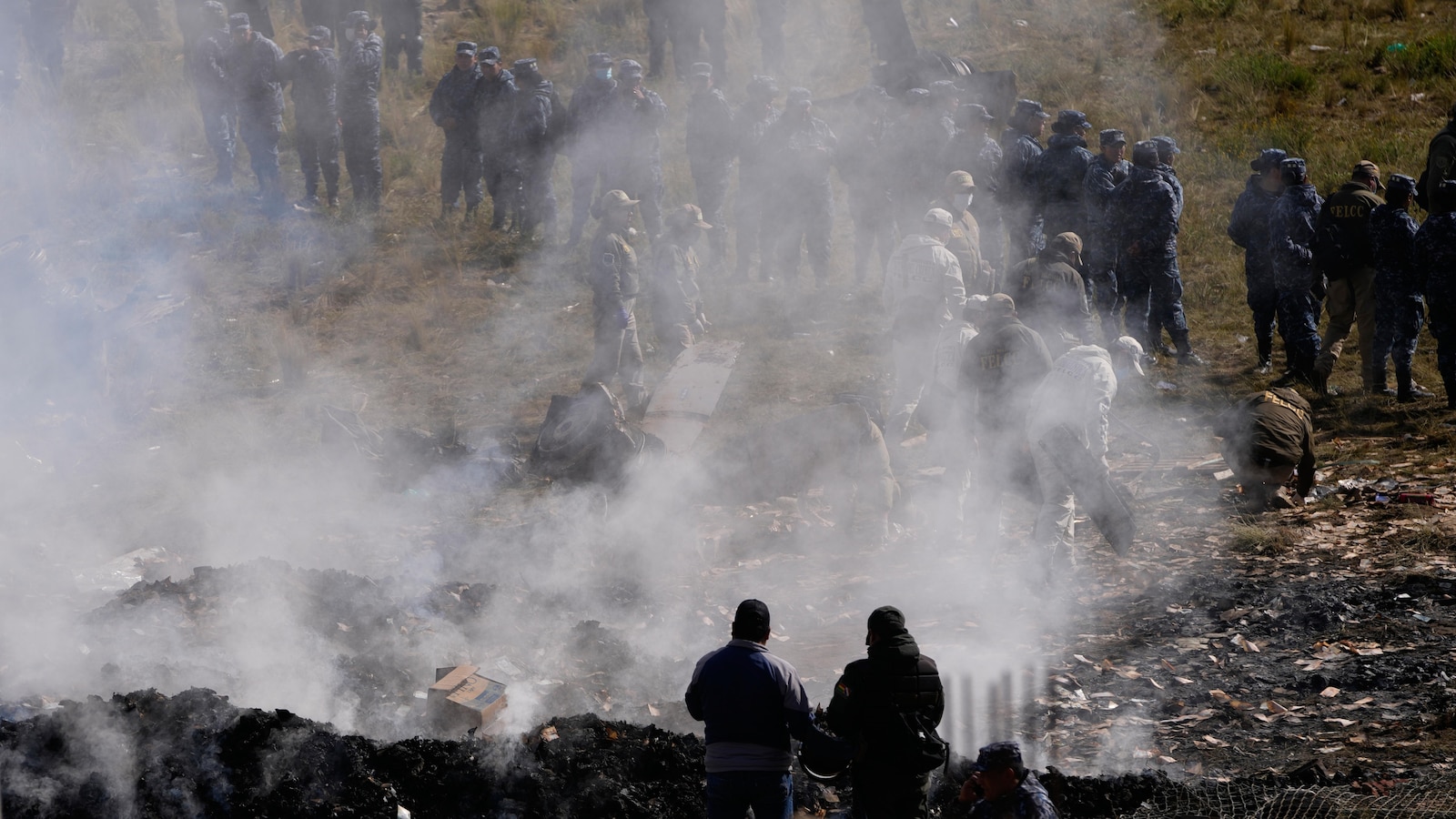
In the aftermath of the crash, authorities faced an unexpected challenge that compounded the tragedy: members of the public began rushing to the scene to collect the scattered banknotes, apparently viewing the disaster as an opportunity for personal gain despite the obvious suffering and death surrounding them. Fire chief Pavel Tovar reported that at least fifteen vehicles had been damaged in the crash, but the scene quickly became even more complicated as people swarmed the area to gather the money scattered across the field and roadway. Recognizing the potential for further chaos and the need to maintain dignity at what was essentially a mass casualty site, Bolivian authorities deployed more than 500 soldiers and 100 police officers to the crash location with the specific mission of dispersing the crowds attempting to loot the currency. The response required significant law enforcement resources that might otherwise have been dedicated entirely to rescue and recovery operations. This phenomenon—people rushing to collect money from a disaster scene—speaks to complex social and economic realities, though it also demonstrated a troubling disregard for the sanctity of a site where so many had just lost their lives. The situation highlighted the challenges authorities face during major emergencies when they must simultaneously manage rescue operations, secure evidence, recover remains, and maintain public order in circumstances that can bring out both the best and worst in human behavior.
Official Response to the Scattered Currency
To address the looting problem and prevent the illicit money from entering circulation, authorities took the dramatic step of burning the cash boxes at the crash site in the presence of Central Bank President David Espinoza. This decision to destroy the currency was both practical and symbolic—practical because it eliminated any incentive for continued looting, and symbolic because it demonstrated that human life and dignity took precedence over monetary concerns. President Espinoza made a point of clarifying that the scattered banknotes “have no legal value because they never entered circulation,” though the statement left some ambiguity about the technical status of the currency and whether any bills collected by looters could potentially be used. Espinoza declined to specify the exact monetary amount being transported on the doomed flight, maintaining some confidentiality around the financial details of the operation, but he did confirm that the banknotes had recently arrived in Santa Cruz from a foreign printing facility—a common practice for countries that outsource the production of their physical currency to specialized international printing companies. The decision to burn money that might otherwise have entered the economy represents a significant financial loss for Bolivia, but authorities apparently determined that allowing the currency to be dispersed through looting would create even greater problems for the integrity of the financial system and would reward those who had shown such disrespect at a tragedy site.
Investigation and Broader Implications
As Bolivia mourns the loss of 22 lives and hopes for the recovery of the 29 injured survivors, investigators will now turn their attention to determining exactly what caused this military aircraft to veer off the runway during landing. Several questions demand answers: Was there a mechanical failure with the aircraft itself? Did weather conditions play a role in the crash? Were there errors in pilot judgment or communication with air traffic control? Was the massive 18-ton cargo of currency properly secured and balanced within the aircraft? The Hercules C-130 has a generally strong safety record, suggesting that specific circumstances rather than inherent design flaws likely contributed to this disaster. The investigation will require careful examination of flight data recorders (if the aircraft was equipped with them), interviews with any surviving crew members and airport personnel, analysis of weather data, and forensic examination of the aircraft wreckage itself. Beyond the technical investigation, this tragedy raises broader questions about protocols for transporting large currency shipments, the security measures in place for such operations, and whether military aircraft are the most appropriate means for such transportation given the potential risks. For the families of the victims—particularly those children who lost their lives simply because they were traveling near the airport—no investigation can undo the harm or restore what was taken. This crash serves as a sobering reminder that aviation disasters, while statistically rare, can have devastating consequences that ripple far beyond those aboard the aircraft, affecting innocent people on the ground and entire communities. As Bolivia works through the grief and seeks answers, the focus remains on honoring those who died, supporting those who survived, and ensuring that lessons learned from this tragedy might prevent similar disasters in the future.