
Ecuador and U.S. Join Forces: Major Narco-Submarine Bust Near Colombian Border
A Strategic Strike Against Drug Trafficking Networks
In a significant blow to international drug trafficking operations, Ecuadorian military forces have successfully located and neutralized a sophisticated “narco-submarine” hidden deep within the country’s northern mangrove forests. This major discovery came as Ecuador and the United States launched coordinated military operations aimed at dismantling the powerful organized crime networks that have plagued the South American nation for years. The joint effort, which began on Tuesday according to the U.S. Southern Command, represents a renewed commitment by both nations to confront the violence, corruption, and terror that drug cartels have inflicted upon communities throughout the Western Hemisphere. While the full scope of this collaborative operation remains somewhat unclear, the immediate results demonstrate the determination of both countries to tackle the deeply entrenched criminal organizations that have turned Ecuador into a critical battleground in the war against narco-terrorism. The discovery of this elaborate trafficking operation underscores the sophisticated methods employed by modern drug smuggling networks and the lengths they will go to transport their illegal products across international waters.
The Discovery: A Fully Equipped Trafficking Operation
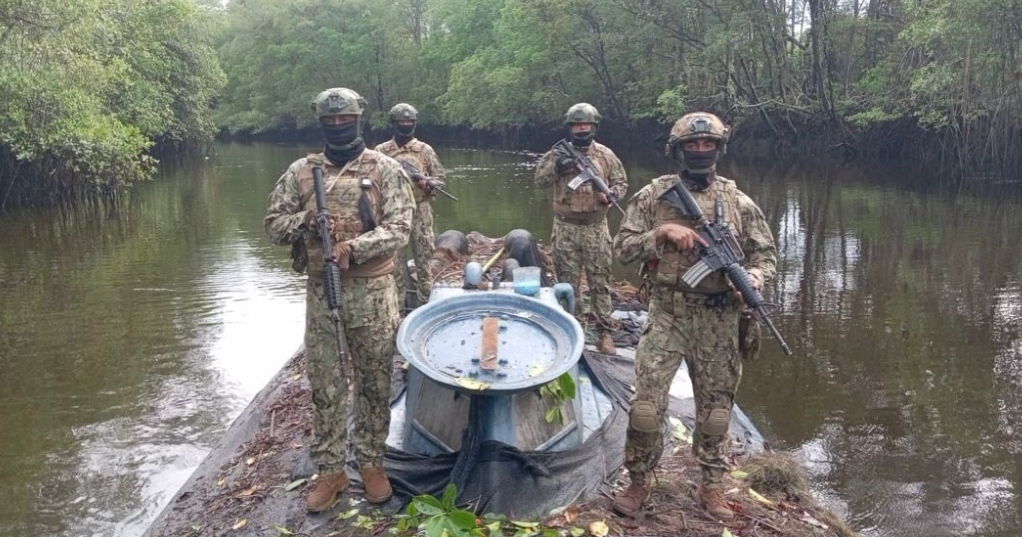
The breakthrough came during a military operation conducted in the remote Cayapas-Mataje mangrove forest reserve, a strategic location situated near Ecuador’s border with Colombia along the Pacific Coast. Ecuador’s Defense Ministry announced on Wednesday that military personnel had stumbled upon not just a vessel, but an entire clandestine camp designed to support large-scale drug trafficking operations. The centerpiece of this discovery was an impressive narco-submersible measuring approximately 115 feet in length, camouflaged with plant debris and positioned for what officials described as a “prolonged voyage” dedicated to illicit activities. The vessel was in ready condition, suggesting that a major trafficking operation was imminent before military forces intervened. Photos released by the Defense Ministry show multiple uniformed personnel standing atop the partially submerged craft, which had been cleverly concealed within the dense mangrove ecosystem—one of the most challenging terrains to navigate and monitor. The location was no accident; the Cayapas-Mataje reserve contains some of the tallest mangroves in the world according to National Geographic, creating a natural fortress that traffickers had exploited to hide their operations from aerial surveillance and ground patrols.
A Complete Logistics Network Uncovered
Beyond the submarine itself, what truly revealed the scale of this operation was the extensive support infrastructure discovered at the site. Military forces uncovered a treasure trove of equipment and supplies that painted a picture of a well-organized, well-funded trafficking operation prepared for sustained activity. The inventory was staggering: six speedboats that likely served as support vessels for loading operations and quick escapes, seven outboard motors for powering these craft, and a fuel cache that would make any naval operation envious. Specifically, authorities found 25 tanks containing a combined 1,375 gallons of diesel, an additional 6,000 gallons of fuel stored separately, and 120 empty fuel tanks presumably waiting to be filled for future operations. The presence of sophisticated navigation equipment indicated these weren’t amateur smugglers but professionals operating with military-grade precision. Even a shotgun was recovered, suggesting the camp’s occupants were prepared to defend their valuable assets. According to Ecuador’s Defense Ministry, this collection of materials clearly demonstrated “the existence of a logistical structure intended to sustain illicit activities in this strategic area.” The sheer volume of supplies suggests this wasn’t a one-time operation but rather a permanent or semi-permanent base designed to support multiple trafficking runs over an extended period.
Violence Erupts During the Operation
The discovery didn’t come without danger. According to the Defense Ministry’s statement, military personnel came under fire after discovering the clandestine site, forcing them to return fire in what became a tense armed confrontation in the dense mangrove terrain. The exchange of gunfire highlights the violent nature of the drug trade and the risks faced by military and law enforcement personnel working to dismantle these criminal networks. Unfortunately, officials did not disclose whether there were any casualties—either among the military personnel conducting the operation or among those who were manning the camp when it was discovered. This lack of information leaves many questions unanswered about the human cost of the operation and whether any suspects were apprehended or escaped into the surrounding forest. The willingness of the camp’s occupants to engage in a firefight with military forces demonstrates the high stakes involved and the desperation of traffickers to protect their multi-million-dollar investments in vessels, equipment, and likely drugs that may have been stored at the location.
Ecuador’s Escalating Battle Against Organized Crime
This operation comes at a critical moment for Ecuador, a nation that has experienced a dramatic surge in violence linked to drug trafficking and illegal mining in recent years. President Daniel Noboa announced earlier this week that his government was implementing a new strategy in the fight against organized crime, one that emphasized international collaboration and joint operations with allied nations. The partnership with the United States is not new—Ecuador and the U.S. have a long history of cooperation on security issues—but the intensity and coordination of these latest efforts suggest a renewed urgency in confronting the crisis. The U.S. Southern Command’s involvement brings sophisticated surveillance technology, intelligence capabilities, and operational expertise to complement Ecuador’s local knowledge and ground forces. In a statement accompanying video footage of a helicopter flying over a group of men (though officials didn’t specify where the footage was taken), the U.S. Southern Command emphasized the mission’s importance: “We are taking decisive action to confront narco-terrorists who have long inflicted terror, violence, and corruption on citizens throughout the hemisphere.” This language—referring to drug traffickers as “narco-terrorists”—signals a shift in how these criminal organizations are perceived, acknowledging that their impact extends far beyond simple drug smuggling to encompass widespread violence, political corruption, and the destabilization of entire communities and nations.
The Narco-Submarine Phenomenon and Future Challenges
Narco-submarines, more accurately described as semi-submersibles since they cannot operate fully underwater like military submarines, have become increasingly popular tools among international drug trafficking organizations precisely because of their ability to evade detection. These vessels typically ride very low in the water with only a small portion visible above the surface, making them extremely difficult to spot by radar, aircraft, or surface vessels. They represent a significant investment by criminal organizations—costing hundreds of thousands of dollars to construct—but can transport multiple tons of cocaine in a single voyage, making them economically viable despite the risks. The vessels are typically built in remote jungle locations in Colombia and other South American countries, constructed from fiberglass or wood, and designed for one-way trips where they’re abandoned after successfully delivering their cargo. The discovery of this particular vessel “ready to begin” its voyage suggests authorities may have disrupted a major shipment, potentially preventing tons of drugs from reaching markets in Central America, Mexico, and ultimately the United States. However, this single success, while significant, represents just one battle in a much larger war. As long as demand for illegal drugs remains high and the profits astronomical, trafficking organizations will continue to innovate, building new vessels, establishing new routes, and finding new ways to evade detection. The challenge for Ecuador, the United States, and other nations committed to disrupting these networks is maintaining the pressure, sustaining international cooperation, and addressing not just the symptoms but the underlying economic and social conditions that make drug trafficking so attractive and so difficult to eliminate completely.