


Ukraine’s Frontline Reality: Four Years of War Through Soldiers’ Eyes
The Memorial of Sacrifice in Maidan Square
Maidan Square in central Kyiv, once the beating heart of Ukraine’s 2014 pro-Western revolution that ousted President Viktor Yanukovych, has transformed into a solemn memorial of the country’s ongoing sacrifice. Where protesters once camped on grass banks demanding change and Western integration, there now stand countless flags planted in snow-covered soil. Each flag represents a Ukrainian soldier or foreign volunteer who gave their life defending the nation across four brutal years of full-scale war with Russia. President Volodymyr Zelenskyy recently acknowledged that 55,000 Ukrainian soldiers are confirmed killed since Russia’s 2022 invasion, though the true toll may never be fully known. Both sides have reasons to obscure or manipulate casualty figures, and many people remain listed as missing. These fallen heroes join Ukraine’s growing pantheon of military dead, a list that has expanded gradually since 2014 but exploded after the full-scale invasion began. With approximately 980,000 Ukrainians in uniform as of January 2025, the country continues its desperate fight for survival, with soldiers scattered across the hottest portions of the front line facing exhaustion, danger, and an enemy that seems relentless in its determination.
The Grinding Battle for Pokrovsk
The situation around Pokrovsk represents one of the war’s most intense and devastating battlefields. Kuper, a rock musician and journalist turned soldier who joined the 14th Chervona Kalyna Brigade in 2023, describes the reality there as “really hard.” Russia has been fighting for this single city since the summer of 2024, paying an enormous price in human lives. The fields and forests surrounding Pokrovsk and nearby cities are reportedly covered with Russian bodies, as their forces are known for not retrieving fallen comrades. Kuper, who uses only his call sign for security, has witnessed the transformation from Ukraine’s failed 2023 counteroffensive in Zaporizhzhia to the desperate defense of Pokrovsk and Myrnohrad. Despite the immense toll on both sides, Ukrainian soldiers remain driven by a fundamental truth: they have nowhere else to go. This is their home, and Russian victory would mean the complete destruction of their country. The exhaustion is universal among Ukrainian defenders, but so is their resolve.
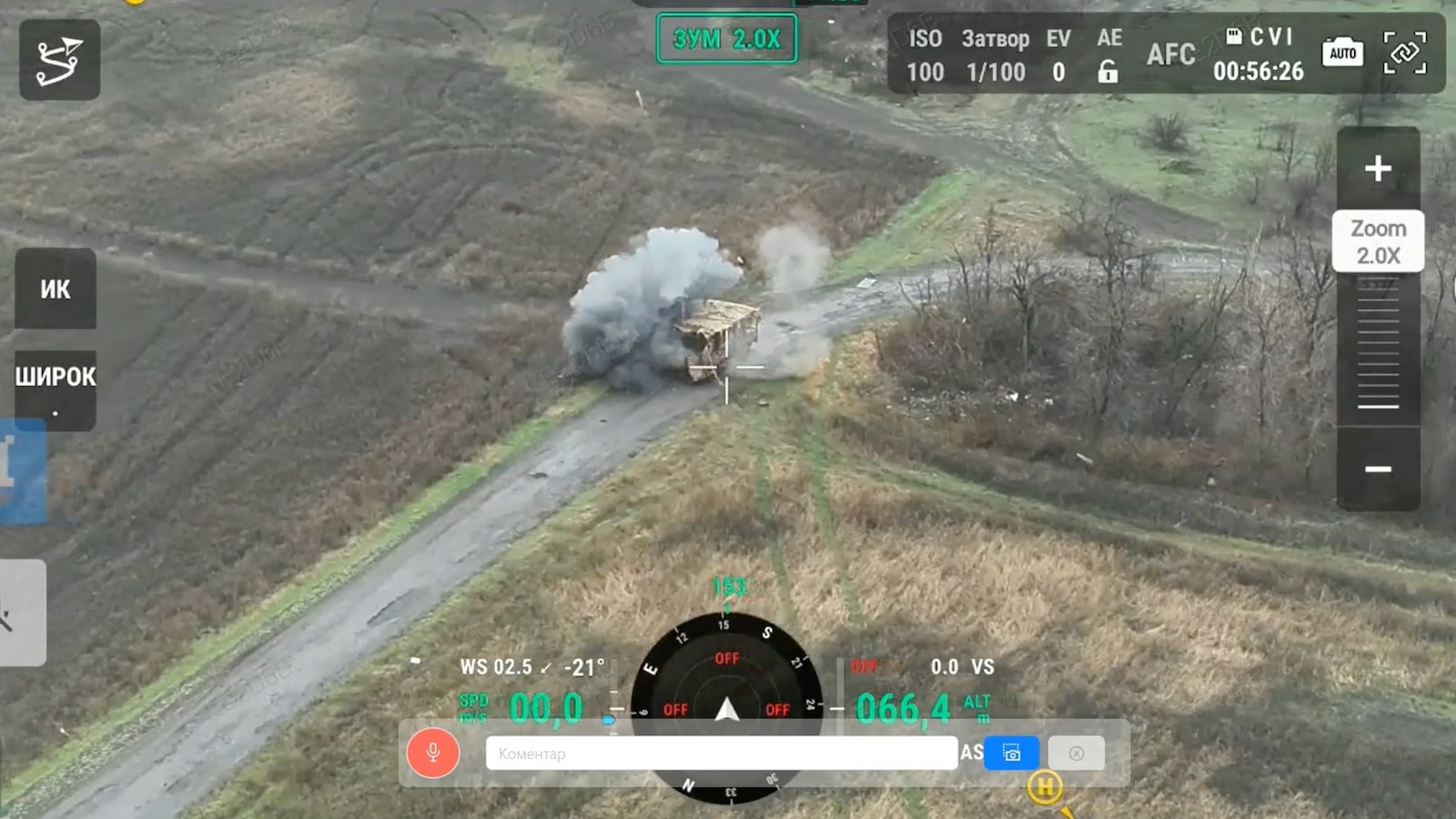
Twenty-three-year-old Sergeant Naruto, also serving with the 14th Chervona Kalyna Brigade in an intelligence and reconnaissance role, describes his daily routine with stark simplicity: wake up, smoke a cigarette, put on armor and helmet, then conduct surveillance to prevent enemy breakthroughs. Before the war, he ran a car service business; now he faces the heavy emotional toll of constant combat stress. Drones dominate modern warfare on both sides—for supply, reconnaissance, and direct attacks. Russian guided bombs destroy Ukrainian shelters and fortifications, followed by FPV drones moving in for close combat. The Russian forces, while suffering tremendous casualties, maintain certain specialized capabilities, particularly their feared “Rubicon” unit that strikes supply routes and positions deep behind Ukrainian lines. Kuper describes the Russian army as resembling “a salad”—a patchwork of units with varying capabilities, with poorly prepared infantry but well-equipped, skilled drone specialists who avoid the suicidal frontal assaults that characterize much of Russia’s approach.
The High Cost of Holding the Line
The Donetsk “fortress belt” of interconnected fortified cities has contained Russian advances since 2014, and Ukrainian commanders refuse to surrender these positions despite Moscow’s demands that Kyiv withdraw troops from the partially occupied region as part of potential peace negotiations. The industrial landscape, dotted with urban centers, hills, and valleys, offers Ukrainian defenders potent defensive positions, but holding them requires constant sacrifice. Major Bohdan Yanush (call sign Fritz) of the 79th Air Assault Brigade, fighting in nearby Myrnohrad, emphasizes that while everyone wants peace, surrendering territory is unacceptable. “This is our land, we are fighting for it,” he states plainly. The Russians engage Ukrainian positions around the clock, bombarding supply routes with various munitions. The main challenge facing troops in Myrnohrad is maintaining resupply and reinforcement under constant threat, forcing Ukrainian forces to increasingly rely on heavy-lift drones like the “Vampire” hexacopter.
Major Myroslav Kryvoruchko of the 38th Marine Brigade, also fighting around Myrnohrad, describes the urban battlefield as remarkably fluid, with control shifting block by block or even building by building, making accurate mapping nearly impossible. Russian soldiers constantly attempt to infiltrate the city’s ruins in small groups, exploiting poor weather, darkness, or limited visibility. Ukrainian defenders hold their positions until their cover is destroyed, then move to new defensive locations, while Russians claim destroyed areas as captured territory—though in reality, these are just ruined buildings without strategic value. The Russian attacks continue despite numerous setbacks, including the sudden widespread disconnection from the Starlink network that caused “panic on their radios” and temporarily halted assault operations. However, these pauses rarely last more than a few days before the attacks resume, sustained by a constant influx of replacements. Naruto’s view of the enemy is uncompromising: “I can’t even call them soldiers. They are wild beasts who have never seen anything in this world. They came here to rob, kill, and rape us.”
The Southern Front and Zaporizhzhia Threat
The southern theater presents different challenges but equally dangerous threats. The Russian drive toward Zaporizhzhia, a city with a pre-war population exceeding 710,000 that serves as the gateway to much of the southern front, represents one of the war’s most concerning developments. Since September, Russian forces have advanced up to six miles in the farmlands east of the city, prompting the deployment of units like the 225th Separate Assault Regiment around the small city of Huliaipole. The relatively flat, sparsely populated landscape of southern Ukraine contrasts sharply with the hilly, industrial Donetsk region, but the fighting remains similarly brutal. Major Oleh Shyriaiev of the 225th describes how Russian forces have “hit some barriers” in their attempts to penetrate deeper toward Zaporizhzhia, desperately trying to infiltrate infantry between Ukrainian positions. Despite unchanged tactics, Russian casualties continue mounting, with Shyriaiev estimating that two complete regiments have been lost in the Huliaipole direction alone, replaced by two new brigades.
Shyriaiev reports that his unit faces the Russian 5th Combined Arms Army, whose infantry personnel were completely wiped out and replaced with improperly reconstituted brigades that Moscow nevertheless continues pushing forward. The Russian forces face serious equipment problems, increasingly using unarmored civilian cars, and in some cases even horses and motorcycles, to move personnel. According to Shyriaiev, 90% of armored vehicles approaching the front lines are destroyed by Ukrainian defenders. This equipment shortage reflects the broader degradation of Russian military capabilities, which Kuper compared to a sports team cycling through multiple squads—an A team, B team, C team, and so on, with Russia now “at least in the middle of the alphabet.” Yet despite these losses and limitations, the Russian Defense Ministry continues its daily announcements of small settlements captured, framing its attritional advance as inevitable. The grinding nature of this warfare takes an enormous toll on both sides, but particularly on the Ukrainian defenders who must hold against numerically superior forces backed by a population many times larger than their own.
Personal Toll and Fleeting Moments of Peace
The human cost of this war extends far beyond casualty statistics. Major Shyriaiev is on his third stint in the Ukrainian military, having completed mandatory service in 2008, fought against Russian forces and separatists after 2014, and rejoined in the opening days of the 2022 invasion. When asked about his post-war plans, he candidly admits he doesn’t believe the war will end anytime soon. If it does, however, he intends to remain in the military to pass on his experience, stating, “I do not see any other future for myself, because this is the only thing that I know how to do—fighting in a war.” This sentiment reflects the profound transformation the war has imposed on an entire generation of Ukrainians, whose lives have been irrevocably altered by years of combat. For Kuper, the endless news cycle about U.S.-led peace negotiations has become “white noise,” yet within his unit, discussions about post-war possibilities remain a favorite topic. Everyone has plans, dreams of lives they hope to reclaim or build anew.
Kuper acknowledges that his pre-war life is gone, its routines and relationships broken and scattered by four years of war. He hopes to return to playing music and plans to leave the military eventually, but in the meantime, he snatches moments of rest however he can—video games and his guitar offer escape, though sometimes when truly exhausted, the best relaxation is simply silence, to “feel the calm.” Naruto occasionally manages to meet his wife in Dnipro, less than 100 miles from the front, for brief holidays where “for two to three days, we live only for each other.” These precious moments of normalcy stand in stark contrast to the daily reality of surveillance, drone strikes, and the constant threat of death. Yet even these brief respites are shadowed by the knowledge that return to the front is inevitable. Naruto sees little prospect of the fighting ending anytime soon, expressing frustration that while talk of security guarantees “sounds great, nobody follows agreements.” Support with weapons and intelligence helps, he acknowledges, but the requests to “close the sky” and stop the suffering of women and children go unheard, with no one seeming to react to civilian and child casualties.
An Uncertain Future and Unwavering Resolve
As the war approaches its fourth anniversary since the full-scale invasion, the soldiers defending Ukraine face an uncertain future with unwavering resolve. The battlefield reality they describe—of constant drone warfare, devastating artillery strikes, waves of poorly trained Russian infantry supported by specialized units, and the grinding attrition of urban combat—paints a picture far removed from strategic maps and diplomatic negotiations. These are men who have sacrificed years of their lives, watching friends die, enduring physical and psychological trauma, all while knowing that defeat would mean the end of their nation as they know it. The Russian demand that Ukraine withdraw from partially occupied territories represents an impossible ask for these defenders who have paid such a high price for every meter of ground. Their determination stems not from abstract patriotism but from the concrete understanding that Russia seeks not just territorial conquest but the complete erasure of Ukrainian independence and identity.
The stories from Pokrovsk, Myrnohrad, Huliaipole, and countless other contested positions reveal the true nature of this war—not as a distant conflict reported in headlines, but as a daily struggle for survival fought by ordinary people thrust into extraordinary circumstances. A musician, a car service owner, career soldiers, and volunteers from many backgrounds now share the same trenches, the same dangers, the same hope that their sacrifice will preserve Ukraine’s freedom. The flags in Maidan Square multiply, each representing a life cut short, a family shattered, a future unrealized. Yet for every fallen defender, others step forward, exhausted but resolute, finding moments of peace in silence or brief reunions with loved ones, all while knowing they must return to the front. As diplomatic efforts continue and the international community debates security guarantees and peace frameworks, these soldiers remain focused on the immediate reality: holding the line against an enemy that shows no sign of relenting, defending a homeland they refuse to surrender, and enduring until victory or death settles the question that has consumed their lives for four long years.