
The Ultimate Test of Love: Inside Britain’s Quirky Wife Carrying Race
A Uniquely British Take on a Finnish Tradition
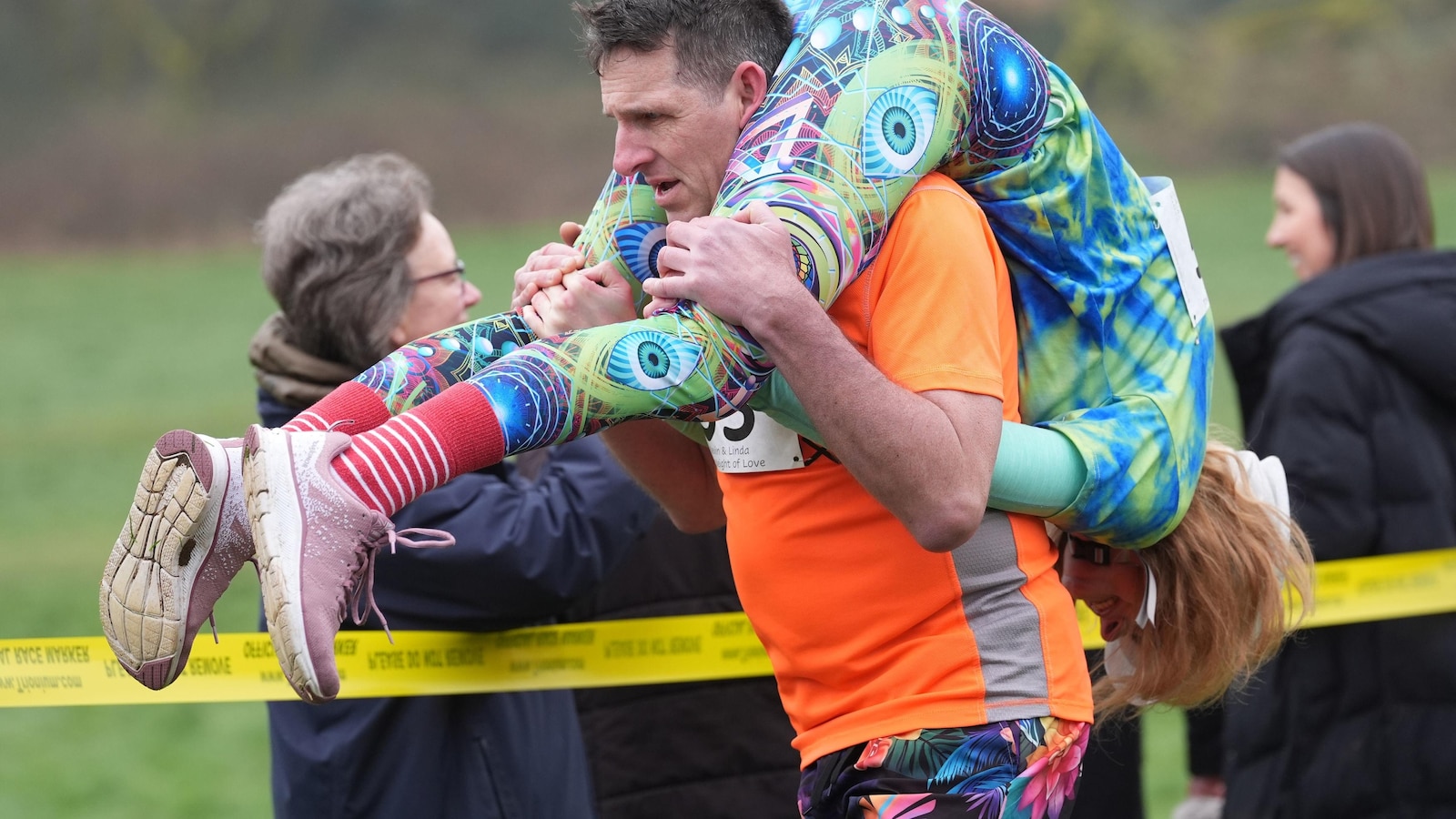
In the rolling hills of southern England, approximately two dozen couples recently participated in one of the United Kingdom’s most unusual and entertaining sporting events—the U.K. Wife Carrying Race. This peculiar competition, held in Dorking, Surrey, transforms the traditional wedding vow of “to have and to hold” into a literal physical challenge that tests both strength and partnership. As wives and girlfriends clung desperately to their partners, competitors navigated a challenging hillside course that pushed their endurance, balance, and teamwork to the limit. What might seem like an absurd spectacle to outsiders has become a beloved annual tradition that celebrates both athletic prowess and good-humored fun, drawing participants and spectators who appreciate the lighter side of competitive sports.
The event’s charm lies in its perfect blend of athletic challenge and comedic entertainment. Unlike traditional sporting competitions that take themselves seriously, the Wife Carrying Race embraces silliness while still demanding genuine physical fitness and coordination from its participants. The sight of determined competitors hauling their partners up and down a grassy slope, navigating obstacles, and dodging buckets of water creates an atmosphere of joy and laughter that’s increasingly rare in today’s competitive sports landscape. This particular Sunday event proved once again why this quirky competition has captured the imagination of people both in Britain and around the world, offering a refreshing alternative to conventional athletic contests.
Finnish Champions Take the Crown and the Barrel
The 2024 competition crowned Teemu Touvinen and Jatta Leinonen from Finland as champions, with the duo completing the demanding course in an impressive 1 minute and 45 seconds. Their victory wasn’t entirely surprising, given that the sport originated in their home country and wife carrying remains particularly popular throughout Scandinavia. The Finnish couple demonstrated the technique, endurance, and coordination that have made Scandinavian competitors dominant forces in this sport worldwide. Their reward for this remarkable achievement? A barrel of local English ale—a prize that perfectly captures the event’s emphasis on fun and community celebration over commercial sponsorship or substantial monetary rewards.
The choice of prize reflects the event’s core philosophy: this isn’t about professional athletics or serious competition, but rather about community, tradition, and shared laughter. A barrel of ale represents conviviality, celebration, and the kind of informal gathering where stories of the day’s exploits can be shared among friends. While modern sporting events often feature massive cash prizes or expensive trophies, the Wife Carrying Race maintains its grassroots character by offering rewards that encourage celebration and camaraderie. For Touvinen and Leinonen, the real prize likely wasn’t the ale itself but the honor of winning a competition rooted in their own cultural heritage, albeit thousands of miles from home on an English hillside.
The Legend Behind the Laughter
The wife carrying competition traces its origins to a 19th-century Finnish legend about a gang of raiders who would pillage villages and carry off the women. This rather dark historical tale—whether based in fact or folklore—has been transformed into something entirely different in the modern era. Today’s wife carrying events strip away any sinister undertones and instead celebrate partnership, physical fitness, and the ability to laugh at ourselves. The evolution from a story about theft and violence to a lighthearted sporting event demonstrates how cultural practices can be reimagined and repurposed for contemporary values that emphasize consent, fun, and equality.
Modern organizers have thoughtfully adapted the rules to reflect 21st-century sensibilities and inclusivity. Participants need not be married or even romantically involved—the “wives” being carried can be girlfriends, boyfriends, friends, siblings, or essentially anyone over 18 who meets the minimum weight requirement of 50 kilograms (110 pounds). This flexibility opens the competition to a wider range of participants and removes any outdated assumptions about relationships and gender roles. Organizers even note with tongue-in-cheek humor that “you do not have to carry your own wife. It could be someone else’s”—a joke that highlights the event’s playful nature. Those whose partners fall below the minimum weight requirement must wear rucksacks filled with flour or water to reach the threshold, ensuring fairness while adding another element of challenge and comedy to the proceedings.
Technique, Obstacles, and Getting Thoroughly Soaked
The physical challenge of the race extends well beyond simply carrying another person across flat ground. The 380-meter (416-yard) course—described by organizers as “a long way under the circumstances”—features a gently sloping hillside that competitors must ascend and then descend while maintaining their grip on their partners. This elevation change significantly increases the difficulty, as carriers must manage their partner’s shifting weight while maintaining balance on uneven terrain. The course also includes deliberate obstacles such as low rows of hay bales that competitors must clear, requiring coordination between carrier and carried to avoid tumbling into an undignified heap.
Adding to the challenge and entertainment value, volunteers throw buckets of water at competitors as they navigate the course, creating slippery conditions and testing everyone’s determination and good humor. Most contestants favor what’s known as the “Estonian Hold,” a technique where the person being carried hangs upside-down on their partner’s back with legs crossed in front of the carrier’s face. While this position might seem uncomfortable or undignified, it actually provides an efficient weight distribution and allows the carrier to maintain better balance and mobility. Other carrying techniques are permitted, allowing couples to choose the method that best suits their particular strengths and body types, though the Estonian Hold has proven most effective in competition settings worldwide.
A Growing Global Phenomenon
While wife carrying might seem like the definition of a niche sport, it has developed a dedicated international following since its modern revival. The U.K. race, which first launched in 2008, is part of a broader network of competitions held in countries including the United States, Australia, Poland, and throughout Scandinavia. What began as a peculiarly Finnish pastime has crossed cultural boundaries to appeal to people who appreciate unconventional sports and aren’t afraid to look silly in pursuit of fun and community connection. The sport’s growth reflects a broader trend toward alternative athletic events that prioritize enjoyment and accessibility over elite performance and exclusive participation.
The pinnacle of the wife carrying world is the World Wife Carrying Championships, held annually in Finland, where the sport’s legendary origins began. This year, the fastest British couple—Edward Nash and Kathryn Knight—earned the right to represent the United Kingdom at this prestigious international competition in July. The British pair finished just four seconds behind the Finnish winners, a remarkably close margin that demonstrates the improving competitiveness of U.K. participants. Their upcoming journey to Finland creates a perfect narrative circle, taking a sport born in Finnish legend, adapted and celebrated in England, and returning to its homeland with British representatives who will carry not just their partners but also their nation’s hopes for international wife-carrying glory. The existence of national representation and world championships elevates what could be dismissed as mere novelty into something more significant—a legitimate sport with developing techniques, dedicated practitioners, and international competition that brings diverse communities together through shared laughter and surprising athletic demands.