
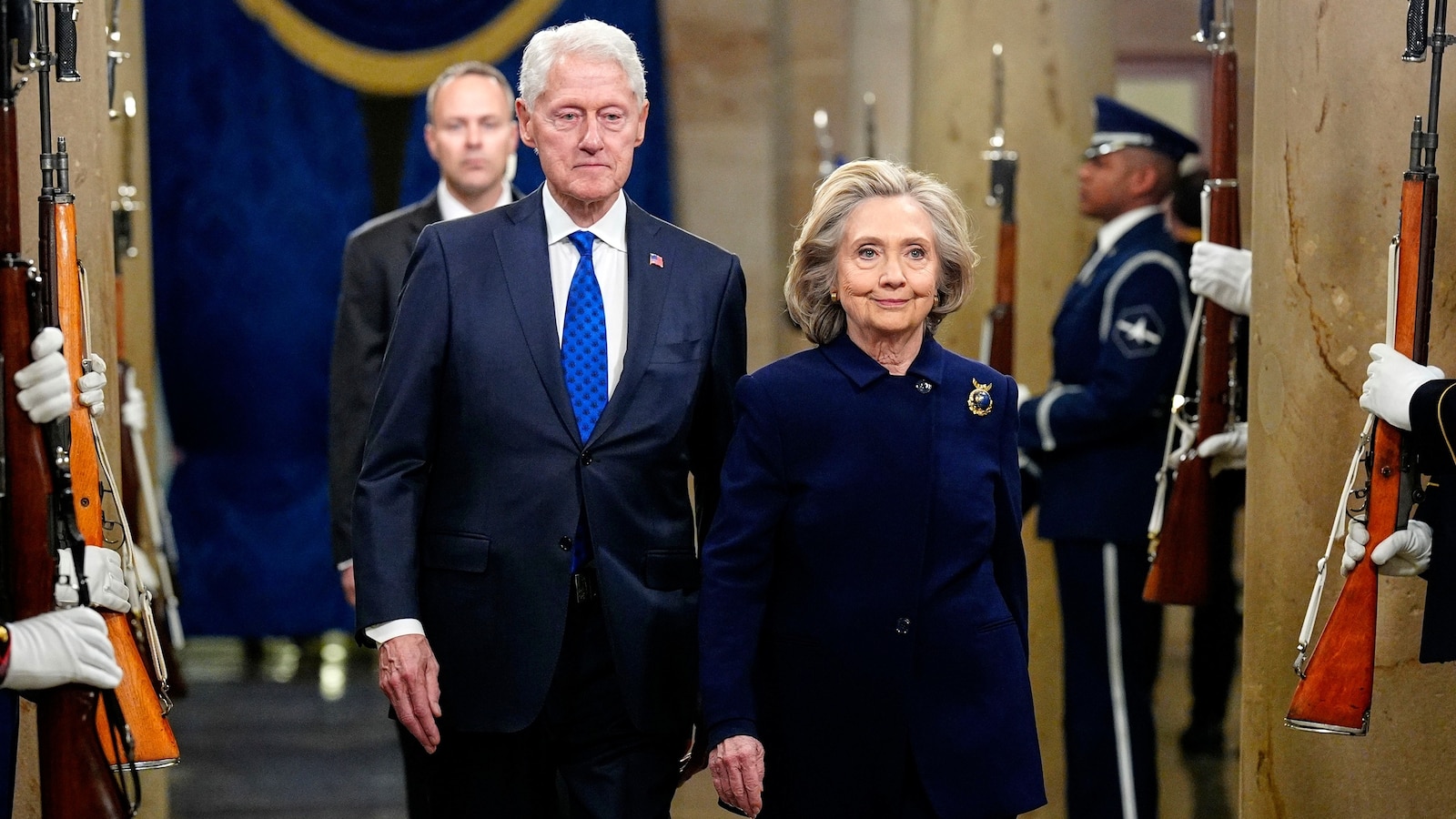

The Clintons at the 2025 Presidential Inauguration: A Moment of Political History and Personal Reflection
A Return to the Capitol’s Grandeur
On January 20, 2025, the historic Rotunda of the United States Capitol once again became the backdrop for one of America’s most cherished democratic traditions—the presidential inauguration. Among the distinguished guests who arrived to witness the 60th Presidential Inauguration were two figures who have been deeply intertwined with American political life for decades: former President Bill Clinton and former Secretary of State Hillary Clinton. As they entered the ornate chamber, their presence served as a powerful reminder of the cyclical nature of American democracy and the enduring legacy of those who have served at the highest levels of government. The photograph captured by Melina Mara of The Washington Post shows the couple arriving with the dignity and composure that comes from years of public service, though one can only imagine the complex emotions and memories that must have flooded their minds as they prepared to witness yet another peaceful transfer of power in the building where so much of their own political history unfolded.
The Clintons’ attendance at this inauguration represents more than just a customary appearance by former leaders; it symbolizes the continuity of American democratic institutions and the respect for tradition that transcends party lines and personal political battles. Having experienced their own inauguration ceremonies—Bill Clinton’s in 1993 and 1997—and having been intimately involved in numerous other inaugurations as participants, candidates, and witnesses, the couple brings a unique perspective to such events. For Hillary Clinton, the occasion likely carried particular poignancy, having come tantalizingly close to her own inauguration in 2017, only to experience one of the most stunning electoral defeats in modern American history. Yet there she was, fulfilling the unwritten but crucial expectation that former presidents and their families set aside personal disappointments and partisan differences to honor the democratic process itself.
Decades of Service and Sacrifice
The journey that brought Bill and Hillary Clinton to that moment in the Capitol Rotunda spans more than five decades of public service, political achievement, personal scandal, and ultimately, a form of redemption through continued civic engagement. Bill Clinton’s rise from humble beginnings in Hope, Arkansas, to become the 42nd President of the United States is the stuff of American legend—a story of extraordinary intelligence, political acumen, and personal charisma that captivated a nation. His presidency, which spanned from 1993 to 2001, saw significant economic prosperity, the expansion of international free trade agreements, and efforts toward healthcare reform, though it was also marred by personal scandal and impeachment proceedings that tested the nation’s constitutional framework. Through it all, Hillary Clinton evolved from being a traditional First Lady into a political force in her own right, championing healthcare reform, children’s issues, and women’s rights on the global stage.
Hillary Clinton’s own political career blossomed after leaving the White House, as she became the first former First Lady to hold elected office, serving as a U.S. Senator from New York from 2001 to 2009. Her tenure in the Senate was marked by serious legislative work, particularly on issues affecting her adopted home state after the September 11 attacks, and she earned respect from colleagues on both sides of the aisle for her preparation and dedication. When she joined the Obama administration as Secretary of State, she traveled more than any of her predecessors, championing what she called “smart power”—a combination of diplomatic, economic, and military tools to advance American interests. Her “glass ceiling” moment came in 2016 when she became the first woman to be nominated for president by a major political party, winning the popular vote but losing the Electoral College in a result that shocked many observers and has been endlessly analyzed in the years since. These experiences—the victories and defeats, the honors and humiliations—all informed the perspective the Clintons brought to the 2025 inauguration.
The Weight of History and Memory
As the Clintons took their seats for the 60th Presidential Inauguration, they were surrounded by the physical manifestations of American history—the soaring dome above them, the paintings depicting foundational moments in the nation’s story, and the gathering of current and former leaders who have all played their parts in this ongoing democratic experiment. For Bill Clinton, who at this point would be in his late seventies, the occasion must have prompted reflection on his own inaugurations, when he stood as a young, vigorous leader promising a “New Covenant” with the American people and later celebrating the economic prosperity of his second term. The passage of time, visible in the gray hair and the more measured pace, serves as a reminder that the torch inevitably passes to new generations, yet the principles and institutions endure beyond any individual leader.
For Hillary Clinton, the emotional landscape of attending another presidential inauguration—particularly if it involved a candidate from the opposing party—would be considerably more complex. The 2017 inauguration, which she attended with grace despite her recent loss, was widely described as one of the most difficult public appearances of her life. By 2025, some of that acute sting may have faded, replaced perhaps by a more philosophical acceptance of her place in history as a pioneering figure who opened doors for future women candidates, even if she herself did not walk through the final one. The Clintons have both spoken in various forums about the importance of resilience, of picking oneself up after defeat, and of continuing to serve the causes and country they love despite setbacks. Their presence at inaugurations, regardless of which party or individual is being sworn in, demonstrates a commitment to these principles that speaks more eloquently than any speech could about the character they have developed through decades of public life.
Symbols of Democratic Continuity
The tradition of former presidents and other dignitaries attending inaugurations regardless of party affiliation is one of the understated yet powerful norms that help maintain the stability of American democracy. In an era of increasing political polarization, where partisan rhetoric often reaches fever pitch and compromise seems increasingly elusive, the image of political rivals gathering together to witness the peaceful transfer of power serves as a crucial reminder that what unites Americans is ultimately more important than what divides them. The Clintons’ attendance at the 2025 inauguration, alongside other former presidents and leaders from both parties, reinforces this essential norm. It sends a message to the American people and to the world that democracy is not about any single individual or party, but about a system of government that continues regardless of who holds power at any given moment.
The symbolism extends beyond mere attendance. The very act of former political competitors standing together, shaking hands, and exchanging pleasantries—however brief or perfunctory—demonstrates a commitment to the idea that political opponents are not enemies, but fellow citizens with different visions for the country’s future. In recent years, this norm has been tested by presidents who broke with tradition in various ways, but the continued participation of figures like the Clintons helps to preserve it for future generations. Their example suggests that even after the most bruising political battles, there is still room for civility, respect for institutions, and recognition that the American experiment is larger than any individual ambition or disappointment. This is particularly important for younger Americans and future leaders who look to these moments to understand how democracy is supposed to function, even—or especially—during times of transition and political tension.
The Personal Behind the Political
Behind the formal attire, the measured smiles, and the careful public demeanor, Bill and Hillary Clinton are human beings with the full range of emotions, memories, and relationships that all people carry with them. Their marriage has been one of the most scrutinized in American history, tested by very public infidelities, political pressures, and the relentless demands of life at the highest levels of power. Yet they have remained partners through it all, suggesting a bond that, whatever its exact nature, has proven resilient in the face of challenges that would have destroyed many relationships. As they sat together at the inauguration, one can imagine they might have exchanged knowing glances, remembering their own inaugurations, the times they stood where others now stood, and the hopes and dreams they had for their time in power and for the country they served.
The photograph of their arrival, captured by a pool photographer and distributed to news organizations worldwide, represents just a fleeting moment in time, yet it contains multitudes. It shows two people who have experienced the highest highs and lowest lows of American political life, who have been both celebrated and vilified, who have made mistakes and achieved remarkable successes, and who continue to participate in the democratic process despite having every reason to retreat from public view. Their daughter Chelsea and their grandchildren represent the future they are investing in, the legacy they hope to leave beyond the headlines and history books. As they age and gradually step back from the most intense forms of political engagement, their appearances at events like inaugurations become increasingly meaningful, marking the transition from active political players to elder statespeople whose very presence lends weight and historical perspective to proceedings. The Clinton legacy, like that of all former presidents and major political figures, will be debated and reassessed by historians for generations, but their commitment to showing up, to participating in the rituals of democracy, and to modeling civic engagement even after personal defeat is already an important part of that legacy, captured in images like the one from January 20, 2025.