
Lightning the Robot Makes History: A New Era in Robotics Begins on Beijing’s Streets
A Historic Race That Changed Everything
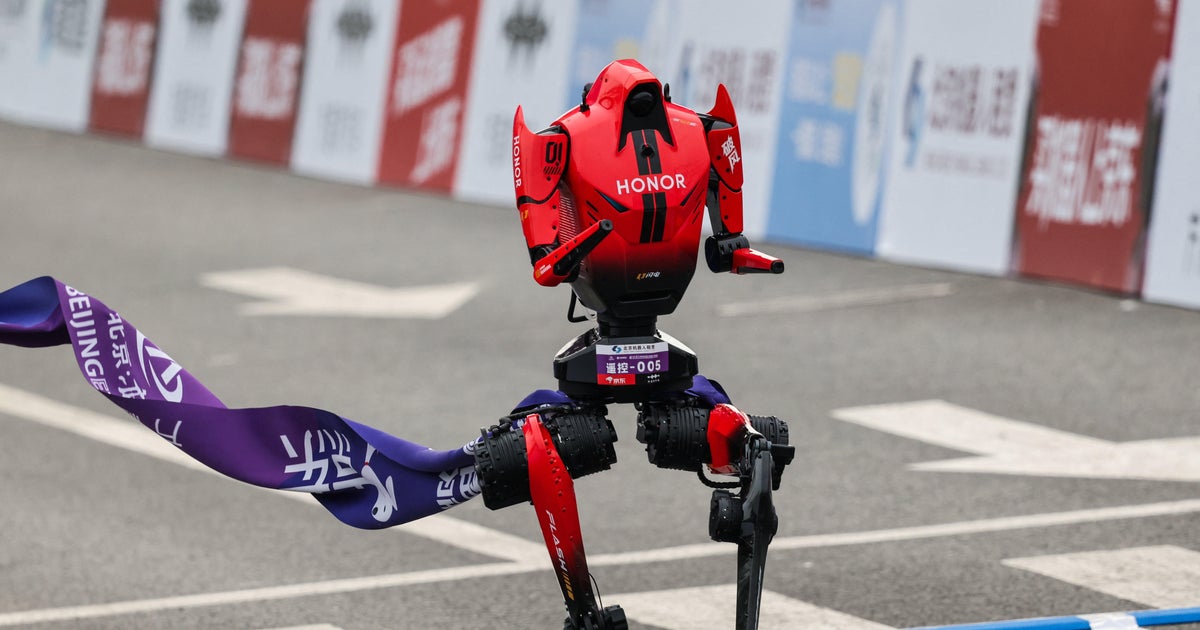
Something extraordinary happened on the streets of Beijing last Sunday that has people talking about the future in ways we’ve never quite done before. A humanoid robot named Lightning—a name that would prove prophetic—didn’t just participate in a half-marathon. It shattered expectations by completing the grueling 13-mile course in just over 50 minutes, beating the human world record by a remarkable seven minutes. This wasn’t some isolated experiment in a controlled laboratory environment. This was dozens of robots lining up alongside each other, competing in the Beijing E-Town Robot Half Marathon, running on a parallel course to human athletes who were tackling the same distance. Developed by Honor, the Chinese smartphone company that’s been making waves in consumer technology, Lightning represents something bigger than just a fast-running machine. It’s a glimpse into a future where the boundaries between what humans can do and what machines can accomplish are becoming increasingly blurred, and that future arrived faster than most of us expected.
The Technology Behind the Achievement
Lightning’s impressive performance didn’t happen by accident—it’s the result of sophisticated engineering and countless hours of development. Du Xiaodi, one of the development engineers at Honor who helped create Lightning, couldn’t contain his excitement after the race. He drew parallels to another industry that evolved through competition: automotive racing. “Looking ahead, some of these technologies might be transferred to other areas,” Du explained, his enthusiasm evident. “It’s similar to how the automotive industry initially developed through competitions.” This comparison is more apt than it might first appear. Just as Formula One racing has given us innovations like disc brakes, semi-automatic transmissions, and advanced aerodynamics that eventually found their way into everyday vehicles, the technologies being developed for these humanoid racing robots could revolutionize multiple industries. The event itself served as a rigorous real-world testing ground, pushing these machines to their limits in ways that laboratory conditions simply cannot replicate. The robots had to demonstrate not just speed, but balance, endurance, and navigation capabilities—all while adapting to unpredictable conditions like weather, terrain variations, and the need to stay on course for over 50 minutes of continuous operation.
When Technology Stumbles: The Reality of Innovation
Despite Lightning’s record-breaking performance, the race wasn’t without its dramatic moments that reminded everyone watching that we’re still in the early stages of this technology. Not every robot crossed the finish line in glory. Some stumbled awkwardly, their sophisticated balance systems overwhelmed by unexpected challenges. Others veered off course, their navigation systems confused or malfunctioning. In perhaps the most striking image of the day, one robot suffered a catastrophic failure during a fall, breaking into pieces and requiring staff members to carry it away on a stretcher—a surreal moment that seemed borrowed from a science fiction movie. These failures, while initially appearing as setbacks, actually highlight how remarkable the successful runs were. The robots competing in Beijing weren’t running on perfectly flat treadmills in climate-controlled rooms. They were navigating real streets with real imperfections, dealing with weather conditions, and operating continuously for nearly an hour. Some ran completely autonomously, making split-second decisions about balance and navigation without any human intervention, while others were controlled remotely by operators who had to react in real-time to keep their machines on track. The fact that any of them finished—let alone that one broke records—speaks volumes about how far this technology has come in an incredibly short time.
Public Reaction: Excitement Mixed With Wonder
The spectators who lined the streets of Beijing to watch this unprecedented race had reactions that ranged from amazement to disbelief. Sun Zhigang, one of the onlookers, captured the surreal nature of what everyone was witnessing: “I’m very excited. First of all, it’s the first time robots have surpassed humans, and that’s something I never imagined.” His words reflected a sentiment that many in the crowd seemed to share—this was one of those moments where science fiction becomes science fact, where something you’ve seen in movies suddenly appears on your city streets. Another spectator, Jiang Liangzhi, was particularly impressed by the technical capabilities on display. “Their performance is quite impressive,” he observed. “I didn’t expect the speeds to be this fast already, and they’re all very stable.” This stability—the ability of these humanoid robots to maintain their balance and pace over such a long distance—is perhaps even more impressive than the raw speed. After all, building a wheeled robot that can move quickly is relatively straightforward, but creating a two-legged humanoid that can maintain a running motion for 50 minutes without falling requires solving incredibly complex problems in real-time balance, energy management, and coordinated movement.
Beyond the Finish Line: The Bigger Picture
While Lightning’s record-breaking time grabbed headlines and sparked conversations around the world, the organizers of the Beijing E-Town Robot Half Marathon were quick to point out that the event’s true purpose goes far deeper than simply seeing which robot could run fastest. According to the organizers, this marathon serves as a proving ground for robotics technology, pushing it beyond the controlled confines of research laboratories and into real-world applications where conditions are unpredictable and challenges are constant. The technologies being developed and tested in these races have potential applications that could transform multiple industries. In manufacturing, robots with the kind of balance, endurance, and adaptive capabilities demonstrated in this race could work alongside humans more effectively, handling physically demanding tasks without the fatigue that limits human workers. In logistics, these humanoid robots could navigate warehouses, loading docks, and delivery routes with unprecedented efficiency. Perhaps most importantly, in emergency response situations—from natural disasters to industrial accidents—robots that can traverse difficult terrain, maintain balance on unstable surfaces, and operate continuously for extended periods could reach victims and deliver aid in situations where it might be too dangerous to immediately send human first responders.
Racing Toward Tomorrow: What This Means for Our Future
The Beijing robot half-marathon represents more than just an interesting sporting event or a technological curiosity—it’s a tangible demonstration of how rapidly artificial intelligence and robotics are advancing from theoretical concepts to practical realities. Chinese companies, backed by significant government support and investment, are pushing aggressively into robotics development for both civilian and military applications. What we witnessed in Beijing is just the beginning. The remarkable progress from last year’s race, where most robots struggled even to finish the course, to this year’s record-breaking performance by Lightning shows a pace of advancement that few predicted. This trajectory suggests that within just a few years, we may see humanoid robots becoming increasingly common in various aspects of daily life. The future that science fiction writers have been imagining for decades—where robots work alongside humans in factories, deliver packages to our doors, assist in hospitals, and respond to emergencies—is moving from the pages of novels and movie screens into our streets and workplaces. Lightning’s victory lap in Beijing wasn’t just a robot crossing a finish line; it was humanity crossing a threshold into a new era where the question is no longer whether robots can match human physical capabilities, but rather how quickly they’ll surpass them and what we’ll choose to do with these powerful new tools.