
The Death and Burial of Mexico’s Most Powerful Cartel Leader
A Golden Casket and Military Presence Mark El Mencho’s Final Journey
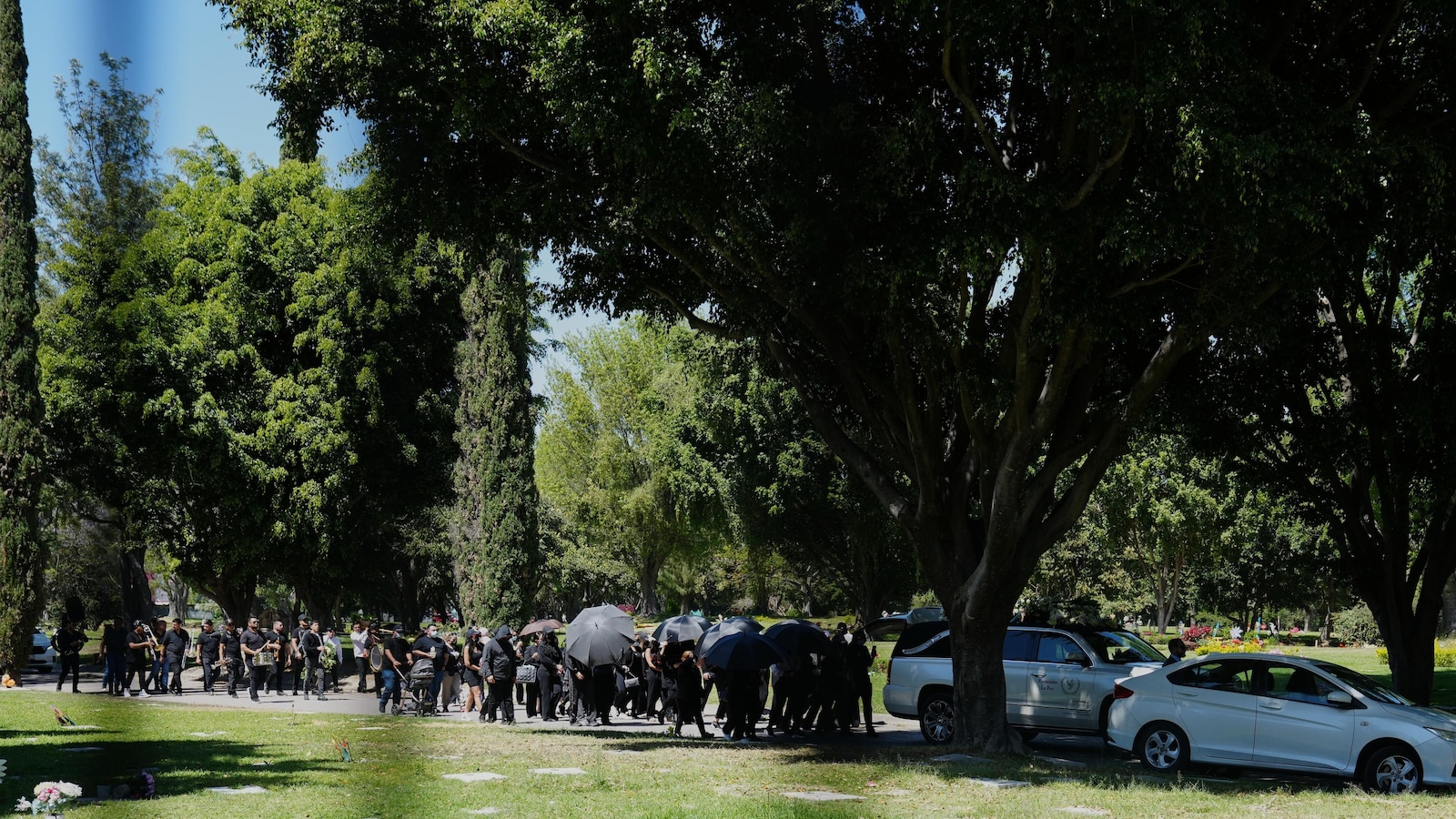
The streets of Zapopan, a suburb nestled within Mexico’s second-largest city of Guadalajara, witnessed an extraordinary spectacle this Monday. Nemesio Oseguera Cervantes, known throughout Mexico by his fearsome alias “El Mencho,” was laid to rest in a gleaming golden casket that seemed to capture the audacious spirit of the man who had led the Jalisco New Generation Cartel to become one of the most powerful criminal organizations in Mexico. The funeral procession was nothing short of remarkable—dozens of mourners walked alongside the casket, many holding black umbrellas against the bright sunshine in what appeared to be a coordinated show of respect. A banda group, playing the distinctive Mexican regional music that pulses through the country’s heartland, accompanied the procession through the cemetery. The entire scene unfolded under the watchful eyes of a substantial military presence, a stark reminder of both the man’s significance and the dangerous world he inhabited. Federal officials confirmed the burial location, though the Attorney General’s Office refused to publicly acknowledge where El Mencho was buried, citing “security reasons” that would soon prove to be well-founded concerns rather than mere bureaucratic caution.
The Violent End of a Criminal Empire’s Leader
Just over a week before his burial, Oseguera Cervantes met his end in circumstances that were almost inevitable for a man who had spent decades evading Mexican authorities. The Mexican army had attempted to capture him alive, but the operation ended in a fierce gunfight that left the cartel leader mortally wounded. According to the death certificate obtained by The Associated Press, Oseguera Cervantes died from multiple bullet wounds—a clinical description that barely captures the violence of his final moments. Defense Secretary Ricardo Trevilla provided additional details about the operation, explaining that El Mencho and two of his bodyguards had been badly wounded during a confrontation with soldiers outside a home in Tapalpa, Jalisco—the very state that gave his cartel its name. The three men never made it to the hospital alive, succumbing to their injuries during transport. The death certificate painted a grim picture, noting bullet wounds to his chest, abdomen, and legs. Following his death, his body was transported to Mexico City where an autopsy was performed with the thoroughness reserved for cases of national significance. On Saturday, after the medical examination was complete, authorities released the body to his family, setting in motion the funeral preparations that would culminate in Monday’s elaborate burial ceremony.
A Nation Erupts in Violence and Retaliation
The killing of El Mencho didn’t bring peace to Mexico—instead, it unleashed a wave of violence that swept across the country like a destructive storm. The Jalisco New Generation Cartel responded to their leader’s death with coordinated attacks spanning approximately 20 states, demonstrating both the organization’s vast reach and its capacity for brutal retaliation. In the chaotic days following the military operation, more than 70 people lost their lives in the violence that engulfed communities across Mexico. These weren’t just numbers on a casualty report; they represented real people caught in the crossfire of a criminal organization’s rage and the government’s determination to maintain control. The Mexican government, anticipating further violence, continued security operations targeting other high-ranking members of the cartel, hoping to prevent the organization from regrouping under new leadership. The authorities’ decision to keep El Mencho’s burial location secret wasn’t paranoia—it was a practical response to very real threats. Since Sunday, security had been dramatically increased around a funeral home where massive flower wreaths began arriving, conspicuously without names attached. Some of these elaborate floral arrangements featured the image of a rooster crafted in flowers, a subtle reference to Oseguera Cervantes’ nickname “Lord of the Roosters,” allowing those in the know to understand exactly whose funeral was being prepared while maintaining a thin veneer of deniability.
The Mythology and Mystery Surrounding Drug Lord Deaths
In Mexico, the deaths and burials of major cartel figures have become woven into a strange tapestry of fact, fiction, and folklore that blurs the lines between reality and legend. It’s almost customary for an air of mystery to envelope these events, something that the supporters and admirers of these criminals eagerly exploit to elevate their fallen leaders to almost mythical status. Within hours of El Mencho’s death being confirmed, songwriters had already composed narcocorridos—ballads that romanticize the lives and deaths of drug traffickers—immortalizing his killing in music that would be played in bars and at parties across Mexico. This phenomenon isn’t unique to El Mencho; it’s part of a darker aspect of Mexican culture where some view these violent criminals as folk heroes rather than the murderers and drug dealers they truly were. In Culiacán, located in neighboring Sinaloa state and home to the infamous Sinaloa Cartel, there exists a cemetery that has become something of a tourist attraction for its luxury crypts and elaborate mausoleums housing former drug kingpins. Here lie men like Ignacio Coronel, an old associate of El Mencho, and Arturo Beltrán Leyva, their final resting places more opulent than most living Mexicans could ever afford.
When Death Becomes Uncertain: The Strange Cases of Mexico’s Cartel Leaders
The history of cartel leader deaths in Mexico reads like something from a surrealist novel, filled with bizarre twists that would seem unbelievable if they weren’t documented fact. Perhaps most famously, there was Nazario Moreno, the leader of the violent and pseudo-religious Knights Templar cartel, who authorities claimed to have killed in 2010. For years, his followers insisted he was still alive, and remarkably, they were right—Moreno didn’t actually die until 2014 when authorities killed him “for real” in a second operation. Then there’s the case of Heriberto Lazcano, leader of the fearsome Zetas cartel, whose body was stolen from a funeral home in 2012, never to be recovered. The theft raised endless questions: Was he really dead? Did his organization take the body to give him a proper burial? Or was the entire death staged? Nobody knows for certain. Perhaps the strangest death of all belonged to Amado Carrillo Fuentes, known as the “Lord of the Skies” for his fleet of aircraft used to transport drugs. Carrillo Fuentes died in 1997 during a botched plastic surgery procedure, apparently attempting to change his appearance to evade authorities. The doctors who performed the surgery were later found murdered, their bodies stuffed in concrete-filled barrels, taking whatever secrets they knew about that operating room to their graves.
The Legacy of Violence and the Path Forward
The death certificate for Oseguera Cervantes specifically noted that his body was to be buried rather than cremated—a standard practice in cases of violent deaths that allows authorities to gather additional forensic evidence if needed in the future. This detail speaks to the ongoing nature of investigations into cartel activities and the possibility that El Mencho’s body might need to be exhumed someday to answer questions that haven’t even been asked yet. As his golden casket was lowered into the ground in Zapopan, it marked the end of one chapter in Mexico’s long, painful struggle with drug cartels, but certainly not the end of the story itself. The Jalisco New Generation Cartel remains operational, and history has shown that killing a cartel leader rarely destroys the organization—it often just creates a power vacuum that leads to even more violence as lieutenants fight for control. For the families of the more than 70 people who died in the violence following El Mencho’s death, there were no golden caskets, no banda music, no elaborate flower wreaths shaped like roosters. There were only grief, unanswered questions about why their loved ones had to die, and the grim reality that in Mexico’s drug war, the innocent often suffer most. The Mexican government faces an enormous challenge ahead: dismantling what remains of the Jalisco New Generation Cartel while preventing the power struggle that inevitably follows from claiming even more lives. As El Mencho’s funeral demonstrated, these cartels have deep roots in their communities, with supporters who view them through a distorted lens that ignores the devastation they cause. Breaking this cycle requires not just military operations, but addressing the poverty, corruption, and lack of opportunity that allows these organizations to recruit and maintain power in the first place.