



NASA’s Bold New Vision: Building Humanity’s First Permanent Moon Base
A $20 Billion Commitment to Lunar Exploration
NASA has unveiled an extraordinarily ambitious plan that sounds like something straight out of science fiction, yet it’s very much grounded in reality. The space agency announced this week that it intends to spend $20 billion over the next seven years to establish a permanent base on the Moon, specifically near the lunar south pole. This isn’t just about planting flags and taking photos—it’s about creating a genuine human presence on another world, complete with livable habitats, vehicles designed to traverse the harsh lunar landscape, and even nuclear power systems to keep everything running. The timing of this announcement is particularly significant, coming just days before NASA’s planned launch of Artemis II, which will send astronauts around the Moon for the first time in over half a century. NASA Administrator Jared Isaacman made it crystal clear that this mission represents a fundamental shift in how America approaches space exploration: instead of brief visits that capture headlines and then fade from memory, the goal is to establish a sustained human presence that will serve as both a research outpost and a training ground for the even more challenging journey to Mars.
From Occasional Visits to Permanent Residence
What makes this plan truly revolutionary is the frequency and sustainability NASA envisions. Rather than celebrating a single moon landing as the ultimate achievement, Isaacman outlined a vision where NASA would launch two moon landing missions every single year. Think about that for a moment—in the Apollo era, landing on the Moon was a monumental event that happened just a handful of times between 1969 and 1972. Now, NASA is proposing to make it routine, almost commonplace. This approach reflects a completely different philosophy: treating the Moon not as a destination for brief expeditions, but as a place where humans will work, live, and conduct groundbreaking research on a semi-permanent basis. Isaacman drew parallels to the Apollo program of the 1960s, when NASA accomplished what seemed impossible, but he emphasized a crucial difference. “This time, the goal is not flags and footprints,” he stated emphatically. “This time, the goal is to stay.” The administrator also made clear that this would involve working with multiple launch providers, ensuring that no single company or system becomes a bottleneck, and creating opportunities for new players to enter the field. His declaration carried unmistakable determination: “America will never again give up the moon.”
Redesigning the Journey: Scrapping Gateway for Direct Access
One of the most significant aspects of the revised plan involves a major architectural change to how astronauts will actually get to the lunar surface. The original Artemis plan included building a space station called Gateway that would orbit the Moon, serving as a pit stop where astronauts traveling in NASA’s Orion spacecraft would meet up with lunar landers before descending to the surface. However, NASA has now decided to bypass Gateway entirely, at least in its originally conceived form. Instead, astronauts will transfer directly from their Orion spacecraft to lunar landers without the intermediate stop. This streamlines the entire process and allows NASA to redirect resources that would have gone into building and maintaining an orbital station toward developing the actual moon base instead. The hardware and modules that were being developed for Gateway won’t go to waste, though—they’ll be repurposed to serve as components of the surface base. This pragmatic approach reflects a willingness to adapt and change course when the original plan doesn’t serve the ultimate objective as efficiently as possible. Isaacman acknowledged that “it should not really surprise anyone that we are pausing Gateway in its current form,” emphasizing that the focus needs to be on “infrastructure that supports sustained operations on the lunar surface” rather than an orbital waystation.
Decades of Shifting Priorities and Astronomical Costs
To understand the significance of this announcement, it’s important to recognize the long and sometimes frustrating journey that led to this point. According to The Planetary Society, a respected space advocacy organization co-founded by the legendary astronomer Carl Sagan, NASA will have spent approximately $107 billion on various return-to-the-moon initiatives by 2026 when adjusted for inflation. That staggering figure reflects two decades of constantly changing priorities as different presidential administrations each put their own stamp on America’s space program. After the tragic Columbia shuttle disaster in 2003, President George W. Bush initiated the Constellation program, which aimed to retire the space shuttle fleet and return astronauts to the Moon by 2020. When President Obama took office, his administration determined that program wasn’t financially sustainable and redirected NASA toward a mission to a nearby asteroid instead. Then President Trump, during his first term, shifted the focus back to the Moon with the Artemis program, setting an ambitious 2024 landing target. The Biden administration largely continued supporting Artemis, though the timeline slipped due to the COVID-19 pandemic, budget constraints, and various technical challenges. Now, under Administrator Isaacman with clear backing from President Trump’s current administration, the program has been redesigned yet again—hopefully for the last time. Isaacman didn’t shy away from acknowledging past failures: “The programs we left behind in this effort were not success stories,” he admitted, with NASA taking ownership of shortcomings while recognizing that “contributing billions more and time that we do not have was not a pathway to success.”
Building the Moon Base in Three Carefully Planned Phases
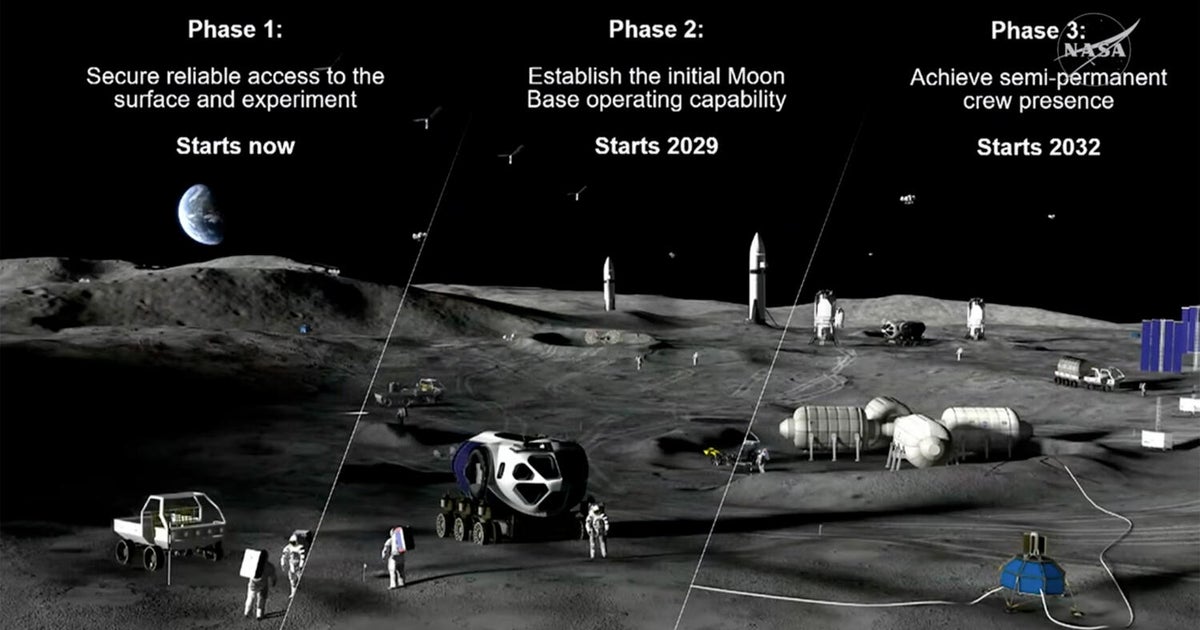
The construction of the lunar base won’t happen overnight—it’s envisioned as a methodical, three-phase process that builds capability incrementally. Phase 1 focuses on transitioning from rare, once-a-year missions to a much more frequent cadence that Isaacman described as “a templated approach that will generate significant learning through experimentation.” This initial phase will dramatically expand the number of lunar landings, delivering essential equipment like rovers, scientific instruments, and technology payloads that will test everything from mobility and power systems to communications, navigation, and surface operations. Phase 2 represents the next major step: developing actual habitats and the supporting infrastructure necessary for “regular astronaut operations on the surface.” This is when the Moon stops being just a place people visit briefly and starts becoming a place where they can stay for extended periods. Finally, Phase 3 will establish “the permanent infrastructure necessary to sustain a human presence”—the point at which the base truly becomes self-sustaining and capable of supporting continuous occupation. This permanent infrastructure includes both nuclear and solar power systems (recognizing that the lunar night lasts about two weeks, making solar power alone insufficient), crewed and uncrewed rovers for exploration and construction, a communications network similar to cell phone systems on Earth, a lunar equivalent of GPS for navigation, and constellations of satellites orbiting the Moon to facilitate observation and relay communications back to Earth. It’s an incredibly comprehensive vision that addresses not just getting people to the Moon, but enabling them to thrive there.
High Stakes and Higher Expectations: A Race Against China
Throughout his announcement, Administrator Isaacman made abundantly clear that this isn’t merely a scientific endeavor or a demonstration of technological prowess—it’s a competition with profound geopolitical implications, particularly concerning China’s own ambitious lunar program. His language left no room for ambiguity about what’s at stake or what will be tolerated going forward. “Should we fail, and should we look on as our rivals achieve their lunar goals ahead of our own, we are not going to celebrate our adherence to excess requirements, policy or bureaucratic process,” Isaacman declared. He made it clear that NASA would take “uncomfortable action if that is what it takes” to keep the program on schedule and within budget, because “the public has invested over $100 billion and has been very patient with respect to America’s return to the moon.” Those expectations, he noted, are “rightfully very high.” Beyond the lunar base itself, NASA also plans to maintain its other major initiatives, including accelerating the development of commercial space stations in low-Earth orbit to replace the International Space Station when it’s eventually retired, and continuing ambitious planetary science missions like sending multiple small helicopters to Mars. But make no mistake—the Moon is now NASA’s primary focus, serving as what Isaacman called a “proving ground for future Mars initiatives.” This isn’t just about winning a new space race; it’s about establishing the technological capabilities, operational experience, and international leadership that will define humanity’s expansion beyond Earth for generations to come.