
North Korea Offers Rare Glimpse of Kim Jong Un as Family Man Amid Global Tensions
A Dictator’s Dual Image: Military Might and Family Moments
In an unusual display of contrasting imagery, North Korea has recently provided the world with a rare and humanized portrait of its notoriously secretive leader, Kim Jong Un. While the United States finds itself entangled in escalating military tensions with Iran, and following dramatic international events including strikes that killed Iran’s supreme leader and the capture of Venezuela’s former president Nicolas Maduro, North Korea’s state media has been busy projecting a carefully curated dual image of their leader. On one hand, Kim was shown Thursday inspecting the naval destroyer Choe Hyon and its sophisticated weapons systems, boldly declaring his intention to build “the strongest navy” in the nation’s history. This military posturing seemed designed to demonstrate strength and relevance on the global stage at a particularly volatile moment in international relations. However, in a surprising departure from the typical propaganda playbook, separate footage emerged showing Kim in an entirely different light—as a devoted father, loving husband, and surprisingly gentle animal enthusiast, spending a relaxed afternoon with his family and playing with puppies at a newly constructed residential complex in Pyongyang.
The Carefully Orchestrated Family Portrait
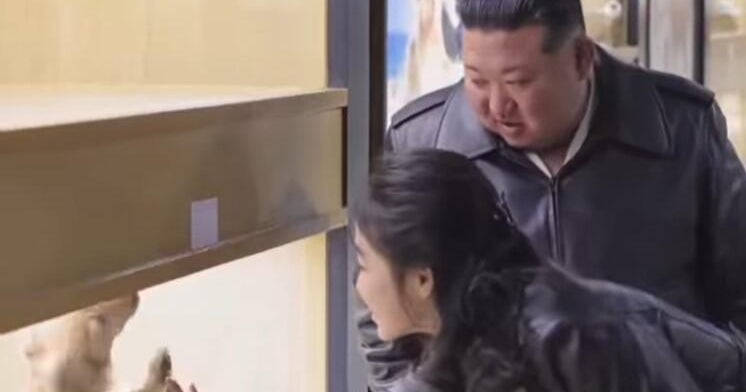
The softer side of Kim Jong Un was revealed through video footage that surfaced with remarkably little fanfare from the regime in Pyongyang, showing the dictator enjoying quality time with his 13-year-old daughter Ju Ae, his wife Ri Sol Ju, and his influential sister Kim Yo Jong. The intimate family scenes, which South Korean analysts believe were initially broadcast internally before reaching international audiences, depicted the Kim family visiting new facilities in Pyongyang as part of what state media described as a “fourth-stage construction project” designed to provide welfare and sports services for residents. The images and video, some of which were shared via an Instagram account identified as belonging to a North Korean “government official,” showed Kim and his daughter dressed in coordinating black coats as they toured various establishments including what appeared to be a pet shop and a musical instrument store. In these candid moments, viewers witnessed a side of the North Korean leader rarely, if ever, seen before—a smiling, engaged father who appeared genuinely relaxed and affectionate with his daughter, a stark contrast to the stern military commander typically depicted inspecting missiles or delivering fiery denunciations of the United States at elaborate military parades.
Ju Ae: The Likely Successor to the Kim Dynasty
The prominence of Kim’s daughter Ju Ae in these recent images carries significant political weight beyond simple family portraiture. North Korean state media consistently describes her as Kim’s “beloved child,” and South Korea’s National Intelligence Service has made the assessment that she has likely been chosen to succeed her father, thereby continuing the Kim family’s ruling dynasty into yet another generation. This marks a notable development in North Korean leadership succession planning, as it suggests the regime is comfortable publicly grooming a young female heir, breaking from traditional expectations. The carefully orchestrated public appearances of Ju Ae alongside her father serve multiple purposes: they humanize the dictator, they provide the North Korean people with a glimpse of continuity and stability for the future, and they signal to the international community that the Kim family’s grip on power remains unchallenged and will extend well into the future. The images of father and daughter visiting shops together, examining musical instruments, and playing with puppies create a narrative of normalcy and familial warmth that stands in deliberate contrast to the regime’s reputation for brutality and repression.
Puppy Love and Potential Diplomatic Signals
Among the most striking elements of the released footage were the scenes showing Kim and his family interacting with various dogs at the pet shop within the residential complex. JuAe was seen admiring several dogs, including a traditional Korean Pungsan breed, while her father engaged playfully with the animals in a manner that seemed genuinely affectionate rather than staged. In one particularly humanizing moment captured on video, Ri Sol Ju, Kim’s wife, appears to gently scold their daughter for some minor transgression while Kim watches on with a broad, indulgent smile—the kind of everyday family interaction that occurs in households around the world. His sister, Kim Yo Jong, who wields considerable power within the regime, can be seen nearby, also smiling as the family moment unfolds. However, keen observers of North Korean propaganda noted what may have been a small but symbolically significant detail embedded within the seemingly innocent pet shop visit: Kim was shown passing by a Shiba Inu, a distinctly Japanese breed, without any apparent interest, before lavishing attention on a Shih Tzu, a breed with historical origins in the royal palaces of China. While this could have been purely coincidental, specialists in decoding North Korean messaging suggested it might represent a subtle diplomatic signal about the current state of relations between North Korea, Japan, and China—showing preference for the Chinese connection while disregarding the Japanese one, reflecting the complex geopolitical realities of the region.
Strategic Messaging in Uncertain Times
The timing and nature of these contrasting images—military strength on one hand and domestic tranquility on the other—appear to be carefully calculated to serve North Korea’s strategic interests during a period of significant global instability. As the United States directs considerable military and diplomatic resources toward confronting Iran following deadly strikes and managing the fallout from Venezuela’s political upheaval, North Korea seems intent on reminding the world of its continued relevance while simultaneously presenting a more complete, humanized portrait of its leadership. The inspection of the destroyer Choe Hyon and Kim’s bold declaration about building the strongest navy in the country’s history serves the traditional propaganda purpose of projecting military might and deterring potential adversaries. Meanwhile, the family-oriented footage accomplishes something quite different but equally important for the regime: it makes Kim Jong Un relatable, shows him as a man with a family and simple pleasures, and potentially softens international perceptions of a leader more commonly associated with nuclear threats, human rights abuses, and totalitarian control. This dual approach allows North Korea to maintain its threatening posture while opening slight cracks in the monolithic image of its leadership, potentially creating openings for diplomatic engagement while never appearing weak or desperate for international approval.
The Evolving Face of North Korean Propaganda
What makes this recent release of personal footage particularly noteworthy is the departure it represents from North Korea’s traditional propaganda methods. Historically, images of North Korean leaders have been rigidly controlled, presenting them almost exclusively in contexts of power, authority, and ideological purity—reviewing troops, visiting factories, or delivering speeches before adoring crowds. Personal or family moments have been exceedingly rare, and when they have appeared, they’ve typically been formal and stiff rather than genuinely candid. The fact that this recent video and photographic material shows Kim in casual clothing, smiling naturally, interacting playfully with animals, and experiencing what appears to be a genuine family outing represents a subtle but significant evolution in how the regime chooses to present its supreme leader. This approach may reflect a recognition that in the age of global social media and instant information sharing, maintaining an entirely two-dimensional image of leadership has become less effective, particularly when trying to communicate with younger generations both domestically and internationally. By allowing glimpses of Kim as a father who dotes on his daughter, enjoys watching her interact with puppies, and shares tender family moments, the regime creates a more complex portrait that may resonate more effectively with contemporary audiences while still maintaining the essential narrative of the Kim family’s right to rule. Whether this represents a genuine shift in North Korean messaging strategy or simply a temporary tactical adjustment remains to be seen, but it undoubtedly provides fascinating insight into how one of the world’s most secretive and authoritarian regimes adapts its propaganda techniques to changing global communication landscapes.