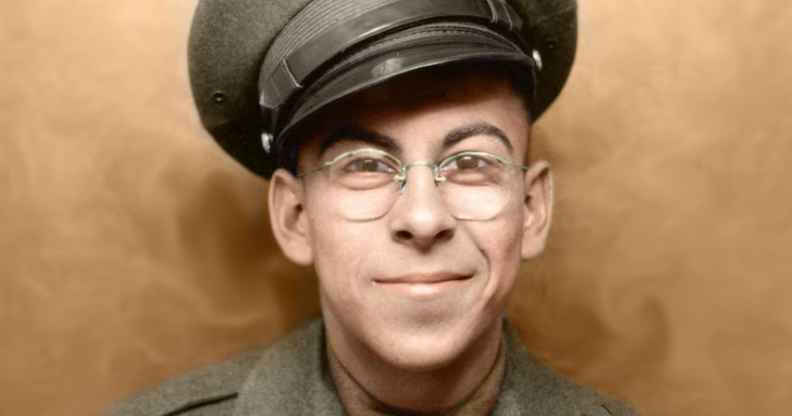

A Hero Returns Home: The Story of Sgt. Celestino Chavez
A Young Soldier’s Journey to War
The story of U.S. Army Sergeant Celestino Chavez is one that speaks to the heart of sacrifice, courage, and the enduring promise that no fallen soldier will be forgotten. In 1949, when he was just 17 years old, Celestino Chavez made a life-changing decision that would shape not only his own destiny but also leave a lasting mark on his family and community in Gallup, New Mexico. Like many young men of his generation, Chavez answered the call to serve his country by enlisting in the United States Army. Within a year, he would find himself on the other side of the world, assigned to D Battery in the 15th Anti-Aircraft Artillery of the Automatic Weapons Battalion in the 7th Infantry Division. He was thrust into one of the most brutal conflicts of the 20th century—the Korean War. Before leaving for combat, Chavez wrote to his mother, Lupita, in what would be their final communication. The letter, dated November 27, 1950, contained words that no mother wants to hear but that reveal the courage and maturity of this young soldier: “If anything happens to me, please mother, no tears.” Little did anyone know that these words would echo through the decades, as his family waited more than 70 years to bring him home.
The Battle That Changed Everything
Just three days after sending that heartbreaking letter to his mother, on November 30, 1950, Sergeant Chavez found himself in the middle of one of the Korean War’s most ferocious battles near the Chosin Reservoir in what is now North Korea. This wasn’t just any military engagement—it was one of the most brutal confrontations between United Nations forces and Chinese Communist troops during the entire war. The numbers alone paint a picture of the overwhelming odds these soldiers faced: approximately 30,000 United Nations soldiers and Marines were surrounded by a staggering 120,000 enemy troops. For several grueling weeks between late November and mid-December 1950, these forces clashed in freezing temperatures and harsh terrain. The battle would claim the lives of over 1,000 U.S. service members, with thousands more wounded in the fighting. During this intense combat, Sergeant Chavez displayed extraordinary valor that would later earn him the Silver Star, one of the military’s highest honors. When he was struck and seriously wounded during an enemy attack, Chavez made a decision that defines true heroism—he refused evacuation because there was no one available to replace him at his critical defensive position. Despite his wounds and the life-threatening danger, he stayed at his post and kept his weapon firing, providing accurate and intense fire that helped break up the enemy attack. Only after the immediate threat had been neutralized did his body finally give out; weakened by blood loss, he collapsed unconscious and fell from his M-19 gun carriage to the ground.
Lost But Never Forgotten
After his heroic stand, Chavez was eventually evacuated to an aid station for medical treatment. However, the chaos and brutality of war had more tragedy in store. On December 2, 1950, just days after his extraordinary act of courage, Chavez was reported missing in action when his convoy was ambushed by opposing forces. The harsh winter conditions and the retreat of U.N. forces from the Chosin Reservoir region meant that hundreds of servicemembers, including Chavez, could not be immediately recovered. There were no records indicating he had been taken as a prisoner of war, and on December 31, 1953, he was officially declared presumed dead. For the people of Gallup, New Mexico, this loss hit particularly hard. Chavez was the only person from his hometown to remain unaccounted for from the Korean War. His name was memorialized at the Courts of the Missing at the National Memorial Cemetery in the Pacific, a solemn tribute to those whose remains had not been recovered. For his family—his mother Lupita, his step-siblings, and the community that knew him—the absence of closure must have been agonizing. They knew he had given everything for his country, but without his remains, a part of their grief remained unresolved, suspended in the painful limbo of not knowing exactly what had happened to their beloved Celestino.
Decades of Determination to Bring Them Home
The story of Sergeant Chavez is not just about loss; it’s also about persistence and the unwavering commitment of the United States to account for every service member who made the ultimate sacrifice. The Defense POW/MIA Accounting Agency (DPAA) has worked tirelessly for decades to recover and identify the remains of fallen soldiers from conflicts around the world. The Korean War presents particular challenges—approximately 7,500 U.S. troops remain unaccounted for from that conflict. The harsh conditions at sites like the Chosin Reservoir, combined with the passage of time and the political complexities of working in North Korea, have made recovery efforts extraordinarily difficult. Yet the work continues. In 2018, a significant breakthrough occurred when North Korea turned over 55 boxes believed to contain the remains of American service members who had died during the war. This transfer represented a rare moment of cooperation in an otherwise tense international relationship, and it gave new hope to families who had waited decades for answers. The DPAA immediately began the painstaking process of analyzing these remains, using every tool modern science could provide. Through anthropological analysis, examination of circumstantial and material evidence, and multiple forms of DNA and genome testing, investigators worked to match these remains with the identities of missing soldiers. It’s a process that requires patience, precision, and respect for both the fallen and their families.
The Moment of Identification
After years of meticulous work, the breakthrough finally came. On April 15, 2024, exactly one year before the public announcement, the DPAA was able to positively identify a set of remains as belonging to Sergeant Celestino Chavez. Through the miracle of modern science and the dedication of countless professionals, a 19-year-old soldier who had been missing for more than seven decades could finally be brought home. The identification represented closure not just for Chavez’s family but for an entire community that had never forgotten their hometown hero. The journey to bring Chavez home was treated with the utmost dignity and respect. His remains were carefully transported to New Mexico, where members of the New Mexico National Guard Funeral Honors Team received his casket in Albuquerque. One Guard member captured the solemnity and significance of the moment perfectly: “We’re here to make sure he is received with dignity. It’s an honorable duty.” These simple words reflect a profound truth—that the debt owed to those who serve is eternal, transcending the boundaries of time. Sergeant Chavez received a military burial with full honors in his hometown of Gallup, finally resting in the soil of the place where his story began. In addition to the Silver Star he had been awarded posthumously for his heroic actions at the Chosin Reservoir, Chavez was also honored with a Purple Heart and the Korean Service Medal with two Bronze Service Stars, recognition of his sacrifice and service. His name has been removed from the Courts of the Missing, a bittersweet moment that acknowledges both loss and recovery.
A Legacy That Lives On
The story of Sergeant Celestino Chavez resonates today because it reminds us of the very real human cost of war and the importance of remembering those who serve. He was just 17 when he enlisted, barely more than a child, yet he displayed courage and selflessness that most of us can hardly imagine. His final letter to his mother—asking her not to cry if something happened to him—shows a young man trying to spare his loved ones pain even as he faced unimaginable danger. For more than 70 years, his family lived with the uncertainty of not knowing exactly what had happened to him or where he was. Now, thanks to the determined efforts of the DPAA and advances in forensic science, that chapter of uncertainty has closed. While the pain of loss never fully disappears, there is comfort in knowing that Celestino Chavez is finally home, honored as the hero he was. His story also highlights an important ongoing mission. With approximately 7,500 U.S. troops still unaccounted for from the Korean War alone—and thousands more from other conflicts—the work of identifying and repatriating fallen service members continues. Each identification represents not just a set of remains but a person with a name, a story, a family, and a community that has never stopped waiting for them to come home. Sergeant Celestino Chavez’s journey from a teenager in New Mexico to a fallen hero and finally to a properly honored veteran spans more than seven decades, but his legacy is timeless. He represents all those who answer the call to serve, who face danger with courage, and who sacrifice everything for their fellow soldiers and their country. His homecoming reminds us that America keeps its promise to leave no one behind, no matter how long it takes.