



The Rise of Healthcare Robots: How Automation is Transforming Medical Care
Meeting Moxi: The Robot Nurse Assistant Revolutionizing Hospital Work
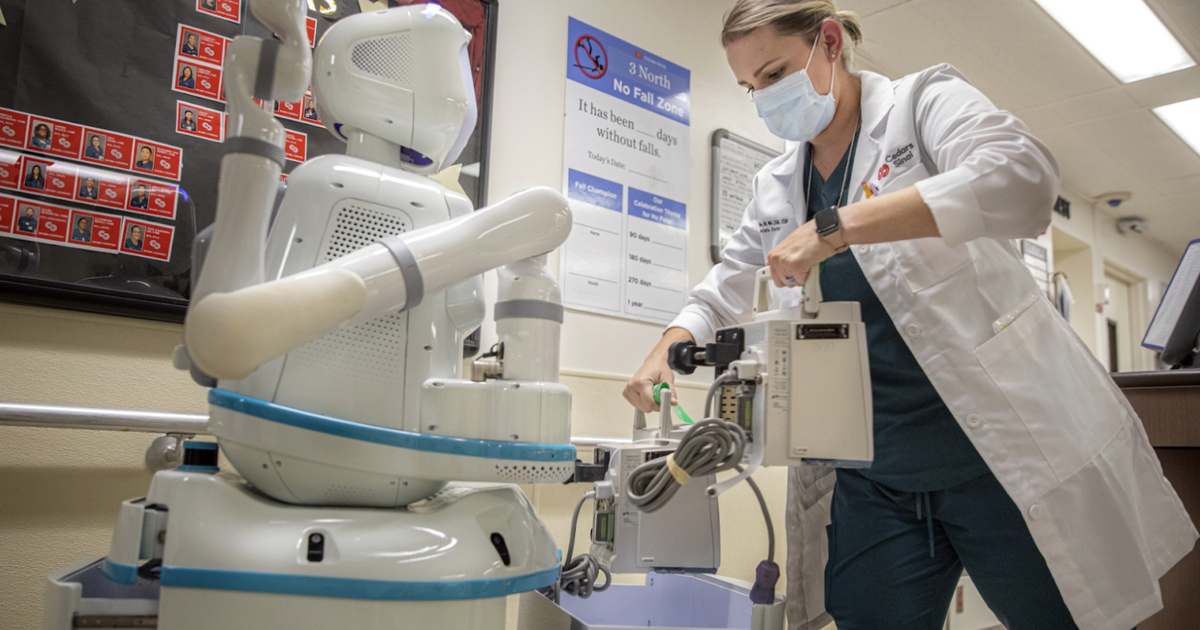
In the bustling hallways of Cedars-Sinai Medical Center in Los Angeles, an unusual staff member makes its rounds with quiet efficiency. Moxi, a robot nurse assistant, glides through the hospital corridors picking up lab samples, delivering toiletries, and completing various backend tasks that once consumed hours of human nurses’ time. With pixelated blue eyes that flash heart symbols when tasks are completed, Moxi represents a significant shift in how hospitals manage their daily operations. The robot autonomously summons elevators and navigates to supply rooms, freeing up valuable time for nursing staff to focus on what matters most—direct patient care. Melanie Barone, an associate director at Cedars-Sinai, perfectly captures the relief this technology brings: “I don’t have to go take my 10,000 steps down into the belly of the hospital to go find things and get it for my patient.” As Barclays analyst Zornitsa Todorova noted at the recent World Economic Forum in Davos, Switzerland, “Robots are no longer so sci-fi.” They’re here, they’re working, and they’re making a tangible difference in healthcare delivery across America.
Practical Applications and Growing Adoption Across American Hospitals
Developed by Diligent Robotics, an Austin, Texas-based company, Moxi has found a home in approximately 25 hospitals nationwide, demonstrating that this technology has moved well beyond the experimental phase. Cedars-Sinai Medical Center began its partnership with Moxi two years ago, initially deploying the robots for backend operations such as transporting linens, retrieving medications, and collecting patient belongings. The success of this pilot program led the 900-bed facility to expand its robotic workforce to three Moxis. The impact has been remarkably positive, extending beyond simple operational efficiency. David Marshall, the chief nursing executive at Cedars-Sinai, describes emotional responses from patients, staff, visitors, and children that have been overwhelmingly positive. In one touching example, a patient specifically requested that Moxi return to greet her after her surgery, showing how these machines can provide comfort and familiarity in stressful hospital environments. Meanwhile, Rochester Regional Health in Rochester, New York, has emerged as an early adopter and enthusiastic advocate for the technology. The 528-bed hospital introduced Moxi in 2023 and has since scaled up to operate eight robots. Casey Wilbert, vice president of Rochester Regional Health, highlights the practical benefits with refreshing candor: “One of the great things about the robots is you’re not paying overtime, they don’t take sick days.” He views this implementation as just the beginning, stating, “This is the beginning of how we integrate robotics into health care.”
The Human Touch: Understanding the Limitations of Robot Care
Despite the impressive capabilities and growing adoption of robots like Moxi, healthcare leaders are quick to emphasize the irreplaceable value of human caregivers. David Marshall of Cedars-Sinai offers a poignant reminder of what distinguishes human nurses from their robotic counterparts: “Robots touch things and people touch people. They could never hold a patient’s hand or wipe their brow or help them brush their teeth.” This fundamental limitation defines the current and likely future role of robots in healthcare settings. Rather than replacing nurses and medical staff, robots are designed to complement and support them by handling time-consuming logistical tasks. This division of labor allows human caregivers to dedicate more energy and attention to the emotional, psychological, and complex medical needs of patients—aspects of care that require empathy, judgment, and the irreplaceable human connection that forms the foundation of healing. The success of healthcare robotics depends not on replacing the human element but on enhancing it by removing burdensome tasks that keep caregivers away from bedsides. This balanced approach recognizes that while technology can deliver supplies and transport materials with impressive efficiency, the art of healing requires human compassion, intuition, and the ability to provide comfort during vulnerable moments that no machine can replicate.
The Next Frontier: Humanoid Robots and Their Expanding Capabilities
While Moxi represents the current state of hospital robotics, the industry is rapidly advancing toward more sophisticated humanoid robots capable of performing increasingly complex tasks. Jeff Cardenas, CEO of humanoid robot developer Apptronik, explains the strategic advantage of giving robots a human form: “They have the same footprint as a person does. They can use the same tools. You don’t have to change everything for the robot.” This design philosophy allows humanoid robots to seamlessly integrate into existing environments—whether hospitals, homes, or workplaces—without requiring extensive infrastructure modifications. The market potential is staggering. Barclays analyst Zornitsa Todorova projects the humanoid robotics segment will explode from approximately $2 billion today to $40 billion over the next decade, with potential growth reaching as high as $200 billion. This expansion is expected to fill critical labor gaps across multiple sectors including defense, agriculture, manufacturing, and healthcare. Manufacturing expert Darrell West from Brown University believes autonomous robots will deploy much faster than most people anticipate, drawing parallels to historical technological revolutions: “Similar to how industrialization changed the world a hundred years ago, all these digital tools are going to have the same large-scale impact now.” However, he emphasizes the importance of managing this transition thoughtfully so that workers don’t feel left behind or demoralized by machines assuming parts of their roles.
Vision and Innovation: From Elon Musk to Personal Care Robots
The race to develop functional humanoid robots has attracted some of the world’s most ambitious entrepreneurs and innovators. Elon Musk, the world’s richest person, is actively pushing to accelerate the introduction of humanoid machines into both workplaces and homes through Tesla’s Optimus robot project. At the recent World Economic Forum in Davos, Musk made bold predictions about the timeline: “By the end of this year, I think they will be doing more complex tasks, and probably by the end of next year, I think we’d be selling humanoid robots to the public.” He envisions a future where these robots achieve such high reliability that people can “basically ask it to do anything you like.” Meanwhile, Apptronik’s Jeff Cardenas brings a deeply personal motivation to his work developing the Apollo humanoid robot. Watching his grandparents age with dementia profoundly shaped his vision for this technology. He recalls his grandfather’s final years, when a fall resulted in vision loss and necessitated 24-hour caretakers: “My dream was to build a robot, to build a tool that would help them do all the things that they didn’t—that they couldn’t—do anymore so that they could age more gracefully and with dignity.” This human-centered approach to robotics development highlights how these technologies could address one of society’s most pressing challenges—caring for an aging population while preserving independence and dignity for elderly individuals who want to remain in their homes.
Surgical Robots and the Future of Medical Automation
Looking further into the future, researchers are developing robots capable of assisting with and eventually performing surgical procedures. Michael Yip, an associate professor of electrical and computer engineering at UC San Diego, heads a laboratory dedicated to creating surgical robots with increasing autonomy. He predicts that “surgeon assistants are going to be there in 10 years,” noting that current technology already has “the capacity to perform autonomously in lower-stakes applications, like soft tissue cutting.” Yip specifically believes humanoid robots will thrive in healthcare environments because these settings are fundamentally people-centered: “In home care, where you have to navigate a home environment, and especially in hospitals where you have to navigate the hospital environment, a human form factor is actually kind of necessary.” This observation reinforces why companies are investing heavily in humanoid designs rather than specialized machines—versatility and adaptability to human spaces make these robots far more practical for real-world deployment. As these technologies continue to evolve, the healthcare industry faces both tremendous opportunities and significant challenges. The question is no longer whether robots will play a role in medical care, but rather how quickly they’ll be adopted and how effectively we’ll manage the transition to ensure that technological advancement enhances rather than diminishes the quality of patient care and the dignity of both patients and healthcare workers.