


U.S. Secretary of State Marco Rubio Strongly Backs Hungary’s Viktor Orbán Ahead of Crucial Elections
A “Golden Age” in U.S.-Hungary Relations
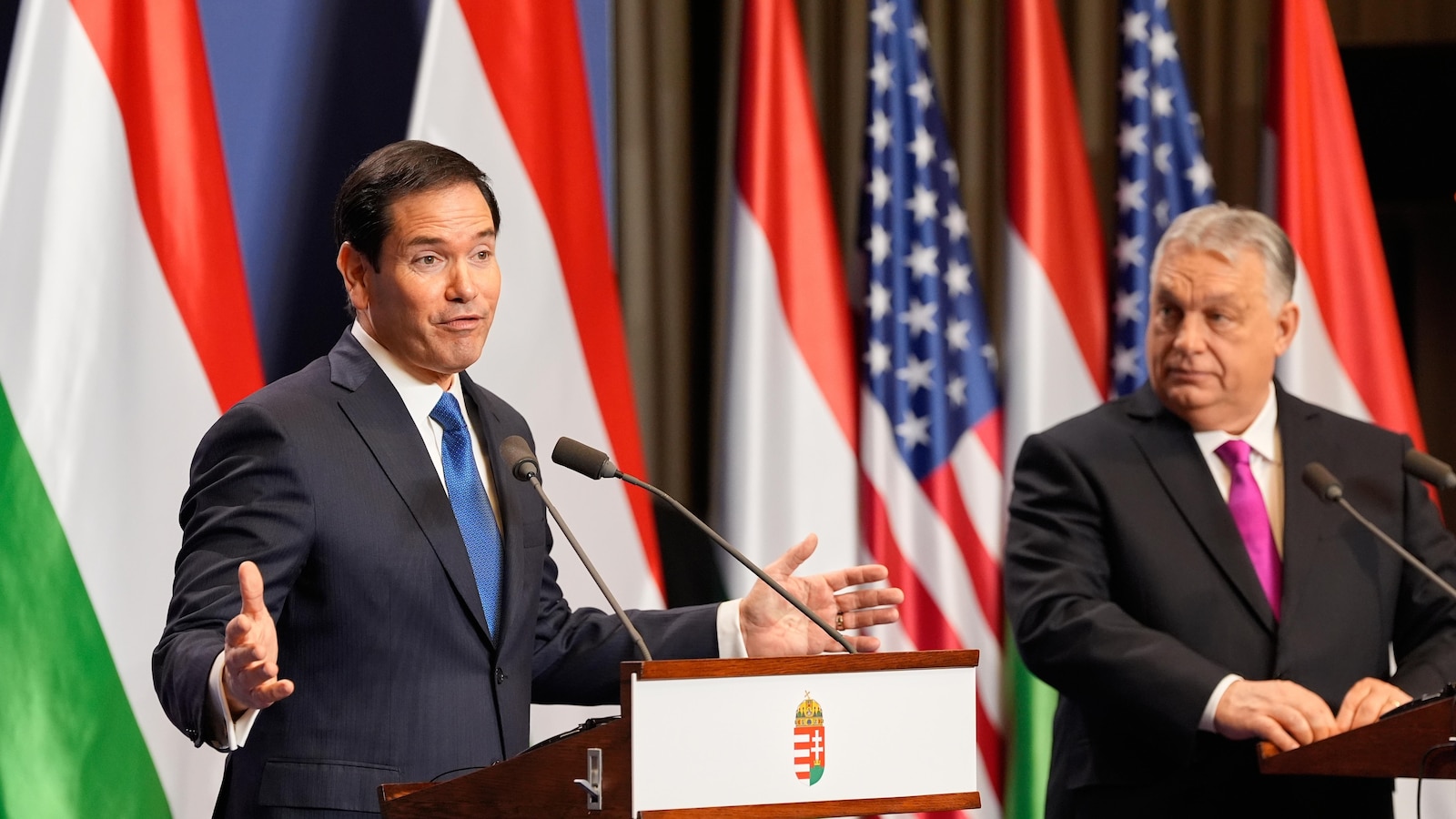
During a highly publicized visit to Budapest on Monday, U.S. Secretary of State Marco Rubio threw his full support behind Hungarian Prime Minister Viktor Orbán’s campaign for a fifth consecutive term in the upcoming April elections. Rubio’s endorsement wasn’t couched in diplomatic language or subtle political maneuvering—instead, he was remarkably direct about the close bond between Orbán and President Donald Trump. Speaking at a news conference in the Hungarian capital, Rubio emphasized that the relationship between the two leaders transcends typical diplomatic cooperation, describing what both he and Orbán characterized as a “golden age” in U.S.-Hungary relations under the Trump administration. Rubio’s visit included meetings with Orbán and other Hungarian government officials, during which they signed an agreement on civilian nuclear cooperation. This deal potentially involves Hungary purchasing small modular reactors (SMRs) from the United States, along with U.S.-supplied nuclear fuel and spent fuel storage technology—a significant economic and strategic arrangement between the two nations.
The Trump-Orbán Connection and Its Political Implications
Rubio didn’t hold back in describing the depth of the relationship between Trump and Orbán, stating bluntly that “the prime minister and the president have a very, very close personal relationship and working relationship.” He went further, directly telling Orbán that “that person-to-person connection that you’ve established with the president has made all the difference in the world in building this relationship.” Perhaps most significantly, Rubio declared that “President Trump is deeply committed to your success because your success is our success”—a remarkably explicit endorsement of a foreign leader during an election campaign. This level of support is particularly notable given that Orbán, who has led Hungary since 2010, is facing what many consider the toughest electoral challenge of his 16-year tenure in power. The timing of Rubio’s visit and his enthusiastic backing of Orbán are clearly designed to provide a boost to the Hungarian leader’s campaign ahead of the April 12 vote, demonstrating how personal relationships in the Trump administration can translate into concrete political support.
Strategic Partnerships in Central Europe
Rubio’s stop in Hungary was part of a broader Central European tour that included a visit to Slovakia on Sunday, following his attendance at the Munich Security Conference in Germany. Both Slovakia and Hungary represent friendly territory for the Trump administration’s diplomatic efforts, as both countries are led by euroskeptic populist governments that oppose support for Ukraine and vocally back Trump’s policies. The focus on these two nations reflects a strategic push by the U.S. to shore up energy agreements with Central European countries that share the administration’s political outlook. During his time in Budapest, Orbán told Rubio that Hungary is ready to host a potential trilateral peace summit between the United States, Russia, and Ukraine, extending an “open invitation” to Trump to visit Budapest. Such a visit before the elections would be an enormous political boost for Orbán, who is trailing in most polls, and his government has been actively working to entice Trump to make the trip. The possibility of a high-profile Trump visit to Hungary demonstrates how Orbán is leveraging his relationship with the U.S. president to bolster his domestic political standing.
The Complicated Question of Russian Energy
One of the most contentious aspects of Hungary’s foreign policy under Orbán has been his steadfast commitment to maintaining economic ties with Russia, even as the European Union has worked to reduce its dependence on Russian energy supplies. Widely regarded as Russian President Vladimir Putin’s most reliable advocate within the EU, Orbán has maintained warm relations with the Kremlin despite Russia’s ongoing war against Ukraine. Hungary has remained firmly committed to purchasing Russian energy, and following a November meeting at the White House between Orbán and Trump, Hungary received an exemption from U.S. sanctions on Russian energy. During Monday’s press conference, Rubio declined to specify how long that exemption would last, particularly as the EU plans to completely phase out Russian fossil fuels by the end of 2027. This delicate balancing act—supporting Hungary while the EU pushes for energy independence from Russia—highlights the complex geopolitical considerations at play in the relationship between the Trump administration and Orbán’s government.
Hungary’s Controversial Domestic Policies and Conservative Appeal
Many conservatives in the United States and the broader MAGA movement view Hungary as a shining example of successful conservative nationalism, despite widespread criticism of the erosion of democratic institutions under Orbán’s leadership and Hungary’s status as one of the European Union’s poorest countries. Orbán has cleverly adapted Trump’s popular campaign slogan, declaring that he and his movement seek to “Make Europe Great Again,” creating an explicit parallel between their political visions. Trump has publicly praised Orbán’s firm stance against immigration, particularly the fence that the Hungarian government erected on the country’s southern border in 2015 during the refugee crisis, when hundreds of thousands of people fled Syria and other countries in the Middle East and Africa. Beyond immigration policy, many U.S. conservatives admire Orbán’s hostility toward LGBTQ+ rights. The Hungarian government has implemented increasingly restrictive policies in recent years, including banning the popular Budapest Pride celebration last year and allowing facial recognition technology to identify participants despite the prohibition. Additionally, Hungary has effectively banned same-sex adoption and marriage, and has prevented transgender individuals from changing their sex in official documents—policies that resonate with certain segments of the American conservative movement.
Election Interference Allegations and the Road Ahead
As the April elections approach, Orbán has made allegations that Ukraine and President Volodymyr Zelenskyy are attempting to interfere in Hungary’s domestic politics by criticizing his opposition to providing weapons or financial aid to Kyiv and his threats to block Ukraine’s eventual membership in the European Union. These accusations add another layer of complexity to the already tense relationship between Hungary and Ukraine, particularly given Orbán’s close ties with Russia. The connection between American conservatives and Orbán’s Hungary has been formalized through events like the Conservative Political Action Conference (CPAC), which has held several annual iterations in Budapest. Notably, another CPAC event was hastily rescheduled for March of this year—conveniently just before Hungary’s elections—in what appears to be a coordinated effort to provide additional momentum to Orbán’s campaign. As the April 12 vote approaches, all eyes will be on whether the strong backing from Trump and his administration, exemplified by Rubio’s enthusiastic endorsement, will be enough to secure Orbán another term in power and continue what they describe as the “golden age” of U.S.-Hungary relations.