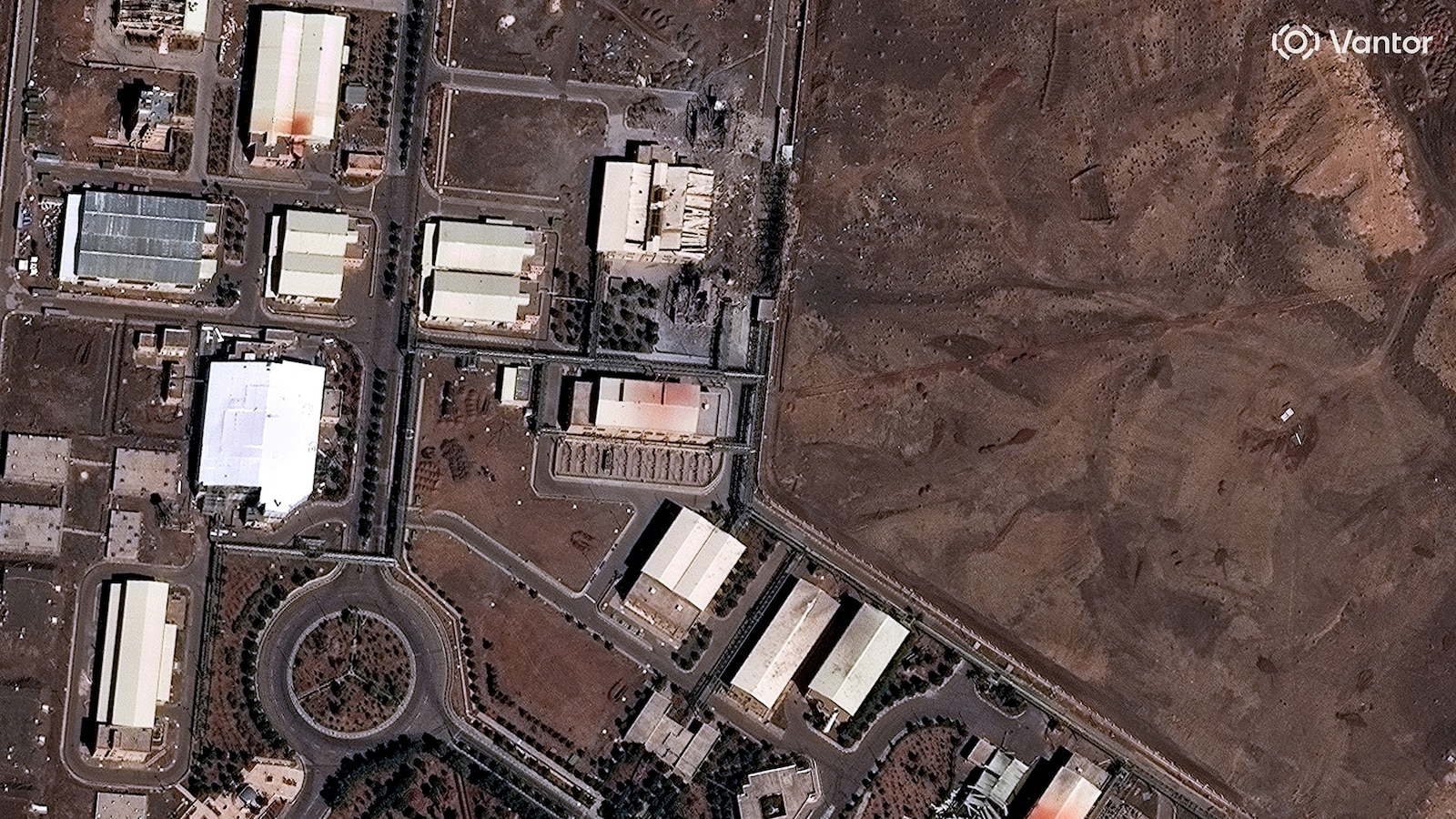

Devastating Impact: Satellite Images Reveal Extensive Damage to Iranian Military Infrastructure
Widespread Destruction Across Multiple Military Installations
Recent satellite imagery analysis has unveiled the staggering scale of destruction inflicted upon Iranian military facilities following coordinated U.S.-Israeli strikes. The comprehensive attack targeted numerous strategic installations throughout the country, with satellite company Vantor capturing detailed images that reveal the precision and intensity of the operation. The strikes, which the Israel Defense Forces described as a “broad strike on strategic defense systems of the Iranian regime,” have left visible scars across Iran’s military landscape, from naval ports in the south to missile bases scattered throughout the nation. What the imagery shows is not just random destruction, but carefully calculated strikes designed to cripple Iran’s military capabilities across multiple domains—naval, aerial, missile defense, and drone operations. The scope of the attack represents one of the most significant military operations against Iranian infrastructure in recent history, with damage verified across nearly a dozen separate locations.
Devastating Blow to the Konarak Military Complex
The Konarak military complex in southern Iran emerged as one of the hardest-hit targets, with satellite images from March 1st revealing catastrophic damage across three interconnected military bases. The naval base suffered particularly severe losses, with imagery showing a ship actively sinking in the port waters and nearby buildings either completely destroyed or heavily damaged. The adjacent drone base presents an even more devastating picture—buildings have been completely leveled, leaving nothing but rubble where operational facilities once stood. Storage bunkers positioned between the drone and naval bases were also obliterated in the strikes. The northern section of the complex, home to an air base, didn’t escape the assault either. Aircraft shelters, designed to protect valuable military aircraft from attack, were themselves damaged or destroyed through what appear to be precision-guided munitions. The comprehensive nature of the damage at Konarak demonstrates the attackers’ intimate knowledge of the facility’s layout and their determination to neutralize all three components of this strategic military hub in a single coordinated operation.
Strategic Strike on Natanz Nuclear Facility Raises Concerns
Perhaps the most internationally significant target was the Natanz nuclear facility, where satellite imagery captured on Monday revealed fresh damage to several buildings that serve as entrances to the underground fuel enrichment complex. This development prompted immediate attention from the International Atomic Energy Agency, which confirmed on Tuesday that they could verify “some recent damage” to the entrances of the nuclear fuel enrichment plant based on the new satellite evidence. However, the IAEA also provided some reassuring news, stating that “no radiological consequence [is] expected and no additional impact [was] detected at the FEP itself.” The agency noted that the fuel enrichment plant itself had already been “severely damaged in the June conflict,” suggesting this wasn’t the first time this facility had come under attack. The targeting of entrance structures rather than the enrichment facility itself appears to have been a calculated decision—possibly designed to restrict access and operations without risking a radiological incident that could have far-reaching environmental and political consequences. The strike nonetheless sends a clear message about the vulnerability of Iran’s nuclear infrastructure to precision attacks.
Systematic Targeting of Iran’s Missile Defense Network
Beyond the high-profile strikes on naval, drone, and nuclear facilities, satellite imagery has confirmed that nearly a dozen missile bases across Iran have been targeted and sustained damage in the coordinated U.S.-Israeli campaign. The Israel Defense Forces specifically highlighted their success in destroying “multiple strategic aerial defense systems, including an advanced SA-65 [air defense] system in the Kermanshah area of western Iran.” This particular system represents sophisticated Russian-designed technology that Iran had acquired to defend against exactly this type of aerial assault. By neutralizing these advanced air defense systems, the attacking forces not only achieved their immediate tactical objectives but also significantly degraded Iran’s ability to defend against future strikes. The systematic nature of these attacks—hitting bases distributed across the country from Kermanshah in the west to Shiraz in the south and Isfahan in central Iran—demonstrates extensive planning and intelligence gathering. Each strike location was carefully selected to maximize the degradation of Iran’s missile capabilities while presumably minimizing the risk to attacking aircraft and personnel.
Detailed Analysis Reveals Precision Targeting Strategy
Expert analysis by Sam Lair from the Open-Source Intelligence Team at the Center for Nonproliferation Studies has provided deeper insights into the nature and effects of these strikes. At a missile base located south of Shiraz, Monday’s satellite imagery revealed the pinpoint accuracy of the attacks: “one missile was damaged and leaking propellant. Several other launchers were destroyed, exploding and lighting a fire, which spread throughout the canyon.” This description illustrates how secondary effects—fires and explosions triggered by the initial strikes—amplified the damage beyond the immediate impact of the weapons used. At another facility north of Isfahan, imagery from Sunday showed “a big explosion from a launcher caught on the move, and a missile checkout building damaged.” This suggests that intelligence gathering had been so thorough that attackers knew when mobile launchers would be vulnerable and caught them during movement—perhaps their most exposed moment. Lair’s analysis revealed a clear tactical emphasis: “While nearly every Iranian missile base has been attacked by either the U.S. or the Israeli Air Force, the emphasis of the strikes so far has been on the trucks carrying and launching missiles.” This focus on mobile transporter-erector-launchers, rather than just fixed infrastructure, demonstrates an understanding that Iran’s missile threat comes primarily from these mobile platforms that can be relocated to avoid detection and destruction.
Long-term Implications and Strategic Assessment
The comprehensive nature of these strikes represents a significant recalibration of military dynamics in the Middle East. By targeting not just fixed installations but mobile launcher systems—the backbone of Iran’s missile deterrent—the U.S. and Israeli forces have struck at the heart of Iran’s military strategy. While Lair noted that “there has been some damage to supporting infrastructure, some buildings destroyed, and some tunnels attacked with bunker buster munitions,” the primary emphasis on destroying transporter-erector-launchers reveals a strategy designed to eliminate Iran’s capability to rapidly deploy and launch missiles from dispersed locations. The use of bunker-buster munitions against tunnel entrances, particularly at the Natanz facility, also demonstrates the attackers’ capability to reach even hardened, underground facilities that Iran had presumably built specifically to protect critical assets from aerial attack. The strikes leave Iran facing a substantial rebuilding challenge—not just replacing damaged buildings and equipment, but reconstituting an integrated defense network that has been systematically dismantled. The international community now watches closely to see how Iran will respond to this significant blow to its military infrastructure, and whether the destruction of these facilities will alter the strategic calculations in this volatile region.