



The Discovery of a Lifetime: Unearthing a New Dinosaur Species in the Sahara Desert
An Epic Expedition Into One of Earth’s Most Hostile Environments
In what reads like a thrilling adventure novel come to life, a team of dedicated paleontologists has made an extraordinary discovery in the unforgiving expanse of the Sahara Desert. Professor Paul Sereno from the University of Chicago, who led this remarkable expedition, didn’t mince words when describing the magnitude of their journey: “It was the expedition of a century, without exaggeration. It was an adventure and a half, never probably to be matched.” The 2022 expedition to Niger in West Africa resulted in the collection of an astounding 55 tons of specimens, among which were the fossils of a previously unknown dinosaur species. This new member of the Spinosaurus family has been christened Spinosaurus Mirabilis, with “mirabilis” being the Latin word for “astonishing”—a fitting name for such a spectacular find. The discovery, officially announced on a Thursday and subsequently published in the prestigious journal Science, represents not just a scientific breakthrough but also a testament to human perseverance and the enduring allure of paleontological exploration.
Meet the “Hell Heron”: A Prehistoric Fishing Specialist
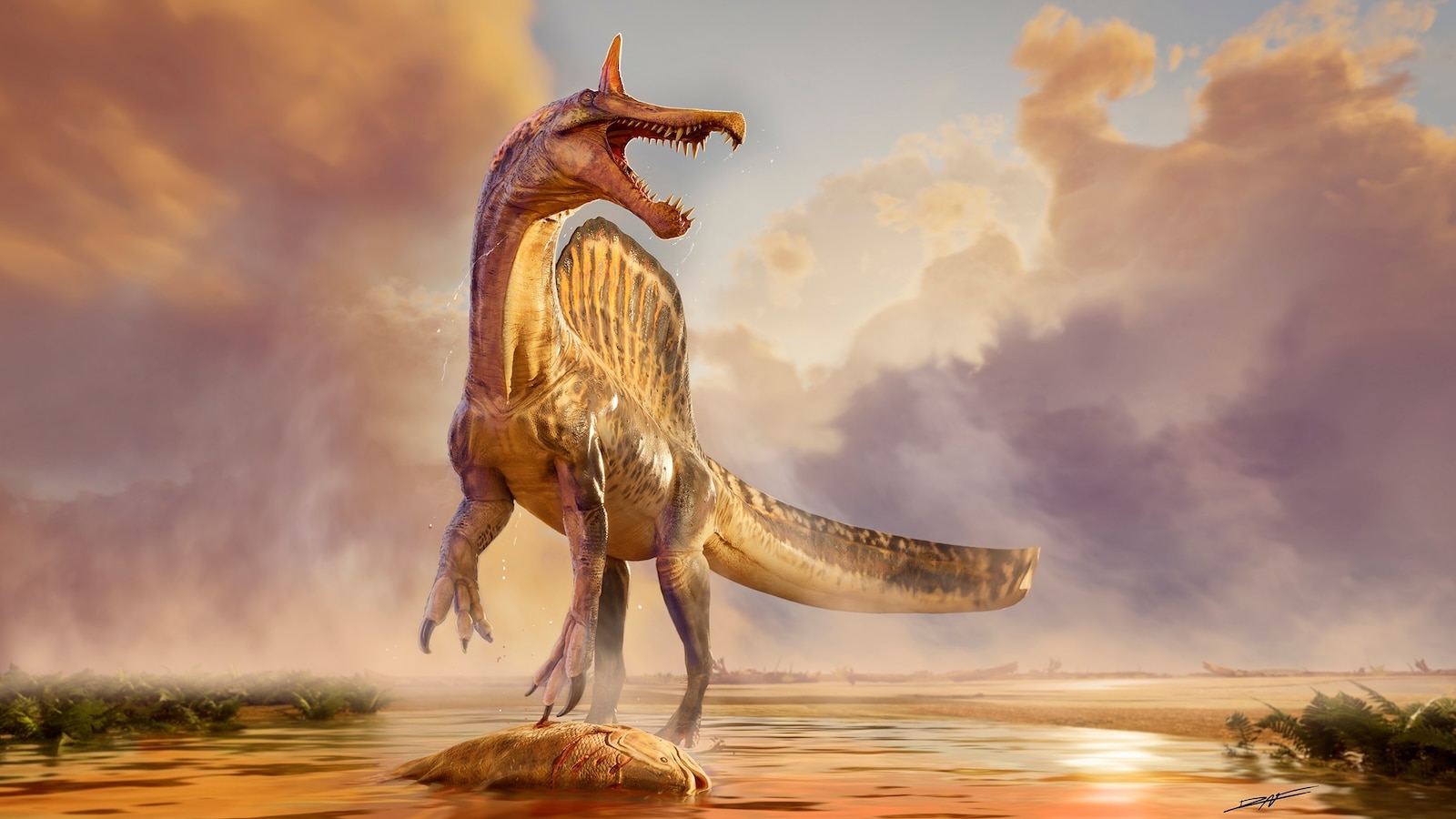
The newly discovered Spinosaurus Mirabilis was a formidable creature that roamed the Earth approximately 95 million years ago. According to Sereno, a National Geographic Explorer, this dinosaur was comparable in size to the famous Tyrannosaurus Rex, making it one of the larger predators of its time. What truly sets this species apart, however, are its distinctive features that paint a picture of a highly specialized hunter. The dinosaur possessed a large, scimitar-shaped crest atop its head that was likely covered in keratin—the same material that makes up our fingernails—and may have been brightly colored, possibly serving purposes ranging from temperature regulation to mate attraction or species recognition. Perhaps most fascinating is the creature’s dental arrangement: interlocking rows of teeth specifically designed for catching slippery fish, revealing a diet heavily dependent on aquatic prey. Sereno evocatively described the animal as a “hell heron,” envisioning it as a creature comfortable wading on sturdy legs into waters up to two meters deep, though likely spending most of its time stalking shallower areas where large fish would gather. This image of a massive predatory dinosaur behaving somewhat like a modern wading bird adds a compelling dimension to our understanding of prehistoric ecosystems.
A 70-Year-Old Clue Leads to Modern-Day Treasure Hunt
The story of this discovery begins not with cutting-edge technology, but with a single line in a dusty 1960s monograph. A French geologist had reported finding a dinosaur tooth at a small site in Niger, but the entry lacked photographs or substantial evidence to verify the claim. For decades, this tantalizing clue remained unexplored, the site forgotten and unvisited. For Sereno, however, that single line became an obsession—his personal “Shangri-La,” as he described it. The first attempt to reach the historic site came in 2018 when Sereno and his colleagues came tantalizingly close, getting within 50 miles of their goal before being forced to turn back due to the harsh desert conditions. “This part of the desert is daunting, and in between us and the site was a sand sea,” Sereno recalled. Undeterred, the team returned in 2019, this time equipped with drones and GPS technology to locate the original site. While they did make some discoveries, they didn’t find the larger fossils they had hoped for. Then, in a moment straight out of an adventure film, a local Tuareg man appeared at their camp with life-changing information: he knew where big bones could be found. What followed was a desperate race against their fuel supply, traveling a day and a half into the desert with just enough gas for a two-day round trip. “We were about ready to panic that we would not have enough gas to return,” Sereno remembered. But the gamble paid off spectacularly when their guide drove them right up to what Sereno described as “the biggest bone I’ve ever seen in my life.”
The Puzzle Pieces That Changed Everything
During that initial 2019 visit to the bone site, the team found a Spinosaurus tooth and what they suspected might be a Spinosaurus jaw, but time constraints forced them to rush back to camp. It was only upon returning to Sereno’s laboratory at the University of Chicago that the team could properly examine their finds and confirm they had indeed discovered a Spinosaurus jaw. However, they also found something else—something neither Sereno nor his collaborator Daniel Vidal, a postdoctoral researcher, could immediately identify. “I picked up a piece of the base of the crest, and it was such a weird piece of bone that neither Dan nor I could really put it on the skeleton somewhere,” Sereno explained. This mysterious bone fragment would prove to be the key to understanding that they had found something entirely new. The scientists knew they needed to return to what Sereno called “the most remote part of the Sahara” to learn more, but the COVID-19 pandemic and the need to secure funding for a larger expedition temporarily halted their plans. Finally, with the generous financial support of an anonymous donor, Sereno assembled an international team of 20 researchers for a 2022 return expedition. Given the remote and potentially dangerous location, the scientific team was accompanied by 64 armed guards traveling in four vehicles, some equipped with grenade launchers for security—a sobering reminder of the real-world challenges facing modern paleontologists working in unstable regions.
The Moment of Revelation and Overwhelming Discovery
The 2022 expedition delivered results beyond the team’s wildest expectations, and remarkably quickly. On the very first day back at the site, Daniel Vidal found another piece of the crest, this one with more of the skull attached. “We realized instantly that not only was it a Spinosaurus, but that it was a new species,” Sereno said. The emotional impact of this realization was profound. “People were literally crying,” Sereno recalled, describing the moment when the team understood the significance of what lay before them. The distinctive crest proved to be the clinching evidence. As Vidal explained, “Had it not been for the crest, it would have been debatable whether this was a new species or whether we were just seeing some variability. But the crest was just impossible to deny that we had something completely new.” Beyond the Spinosaurus Mirabilis itself, the team also discovered fossils of other animals at the site, providing a broader picture of the ancient ecosystem. The sheer volume of material collected—55 tons of specimens—represents years of future research and will undoubtedly yield additional insights into life during the Cretaceous period. The discovery stands as a reminder that despite centuries of paleontological work, our planet still holds secrets waiting to be unearthed by those willing to brave extreme conditions and follow even the faintest of clues.
Rewriting What We Know About Spinosaurus Ecology and Distribution
One of the most significant aspects of this discovery is what it reveals about Spinosaurus ecology and geographic distribution. The Spinosaurus family has long been associated with coastal habitats, and some researchers have even proposed that certain species were aquatic or semi-aquatic. However, Sereno firmly disputes this interpretation based on the new findings. “It’s not an aquatic animal. It is not a diver, it is not an adept ocean traveler,” he stated emphatically. The fact that these new remains were found hundreds of miles from the ocean provides further evidence against the aquatic hypothesis. Sereno points to the bird-like skeletal structure of Spinosaurus, which contained considerable air space inside the bones, and the relatively stiff bodies and tails that were better suited for side-to-side movement rather than the up-and-down motion required for swimming. This paints a picture of a terrestrial or wading predator rather than a swimming one. Furthermore, the discovery has important implications for understanding how these animals spread across ancient continents. Vidal noted that while Spinosaurus fossils were previously known from North Africa and Brazil, the vast gap between these locations left questions about their distribution. “This discovery really helps to see that their distribution might have been unbroken and probably tells a lot of how these animals migrated from one area to the other,” he explained. As Sereno cryptically added, “That’s the next chapter,” hinting at forthcoming research that may further illuminate the evolutionary history and migration patterns of these remarkable creatures. The story of Spinosaurus Mirabilis thus continues to unfold, promising more revelations about life in the age of dinosaurs.