
Trump Orders Naval Blockade of Strait of Hormuz Following Failed Iran Negotiations
Escalating Tensions After Diplomatic Breakdown
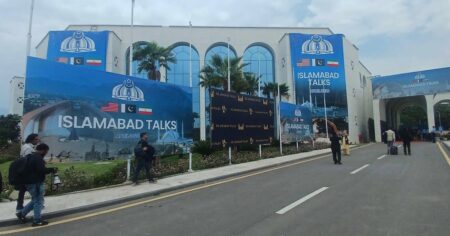
In a dramatic escalation of tensions in the Middle East, President Trump announced on Sunday morning that the United States Navy would immediately begin blockading the Strait of Hormuz, one of the world’s most critical maritime chokepoints. The announcement came through a post on Truth Social following the collapse of diplomatic negotiations between the U.S. and Iran held in Islamabad, Pakistan. Vice President JD Vance had led the American delegation in these face-to-face talks on Saturday, which ultimately ended without agreement despite a recently implemented two-week ceasefire that had offered a glimmer of hope for peaceful resolution. The president’s decision to pursue military action rather than continue diplomatic engagement marks a significant turning point in U.S.-Iran relations and threatens to disrupt global oil markets and international shipping routes that millions depend upon daily.
The failed negotiations centered primarily on Iran’s nuclear program, with Trump indicating that while progress had been made on several issues, the nuclear question remained the critical sticking point that prevented any comprehensive agreement. The president’s characterization of the talks as having “went well” while simultaneously announcing a military blockade highlighted the contradictory nature of the current situation—where both sides came close to agreement yet remained fundamentally at odds on the issues that matter most to their respective national security interests.
Iran’s Controversial “Toll Booth” System
At the heart of this crisis lies Iran’s recent implementation of what analysts have described as a de facto “toll booth” regime in the Strait of Hormuz. According to experts from Lloyd’s List Intelligence, Iran’s Islamic Revolutionary Guard Corps has begun requiring vessels to submit complete documentation, obtain special clearance codes, and accept IRGC-escorted passage through a single controlled corridor when transiting the strait. This system represents a significant departure from international maritime law and freedom of navigation principles that have governed these waters for decades. At least two vessels have already paid fees in Chinese yuan to guarantee safe passage through the strategically vital waterway, setting a troubling precedent that could fundamentally alter how international shipping operates in the region.
The strait itself represents one of the world’s most important oil transit chokepoints, with approximately one-fifth of the world’s petroleum passing through its narrow waters. Any disruption to shipping in this area has immediate global consequences, affecting oil prices, supply chains, and the economic security of nations around the world. Iran’s attempt to monetize control over this international waterway represents what President Trump has called an “Illegal Act of EXTORTION,” and his administration has made clear it will not tolerate this infringement on what the U.S. considers international waters subject to the principle of free navigation. The Iranian government has indicated it might seek to formalize and expand this toll system as part of any long-term peace agreement, a position that the Trump administration finds completely unacceptable.
The Military Response and Its Implications
President Trump’s directive to the Navy encompasses several aggressive actions beyond simply blockading the strait. He has ordered naval forces to “seek and interdict every vessel in International Waters that has paid a toll to Iran,” effectively targeting ships that have complied with Iranian demands. Additionally, the president announced that U.S. forces would begin “destroying the mines the Iranians laid in the Straits,” referring to naval mines that Iran has reportedly deployed in the waterway as part of its control strategy. The president’s warning that “Any Iranian who fires at us, or at peaceful vessels, will be BLOWN TO HELL!” leaves little doubt about the administration’s willingness to use overwhelming force if confronted by Iranian military action.
This military response raises numerous questions about international law, the rules of engagement, and the potential for miscalculation that could lead to wider conflict. A naval blockade is traditionally considered an act of war under international law, and implementing one in waters that border Iran’s territory creates enormous risks of confrontation. The president mentioned that “other countries will be involved” in the blockade effort, though he didn’t specify which allied nations would participate in this operation. The involvement of additional naval forces could provide legitimacy to the action but also increases the complexity of command and control and the potential for incidents that could spiral into broader conflict.
Nuclear Negotiations Remain at Impasse
Throughout his administration, President Trump has maintained that preventing Iran from obtaining nuclear weapons remains his top priority in the region. In his Sunday morning post, he emphasized that while negotiators had found common ground on many issues during the Islamabad talks, “the only point that really mattered, NUCLEAR, was not” agreed upon. This statement reveals the fundamental challenge facing diplomats: Iran appears willing to negotiate on various aspects of its regional behavior and even its maritime policies, but remains unwilling to accept the restrictions on its nuclear program that the United States deems essential for any lasting agreement.
The president’s comment that Iran wants “money and, more importantly, they want Nuclear” encapsulates his administration’s view of Iranian motivations. From this perspective, Iran’s toll collection scheme in the Strait of Hormuz serves dual purposes: generating revenue for a sanctions-weakened economy while creating leverage in nuclear negotiations. By refusing to allow Iran to “profit off this Illegal Act of EXTORTION,” Trump aims to remove one source of Iranian leverage while demonstrating American resolve. However, this approach carries significant risks, as it eliminates incentives for Iran to return to the negotiating table and may push Iranian leadership toward more confrontational positions rather than compromise.
International Consequences and Global Concerns
The implications of a U.S. naval blockade of the Strait of Hormuz extend far beyond the immediate U.S.-Iran relationship. Global oil markets will likely react with significant volatility, as traders price in the risk of supply disruptions from one of the world’s most critical petroleum transit routes. Countries heavily dependent on oil imports from the Persian Gulf—including major economies in Asia and Europe—face potential energy security challenges that could affect their economic growth and political stability. The international shipping industry confronts an unprecedented dilemma: comply with Iranian demands and risk U.S. interdiction, or refuse Iranian requirements and risk Iranian military action.
Allied nations find themselves in a difficult position, forced to choose between supporting American actions that many international legal experts consider violations of maritime law, or distancing themselves from Washington and potentially weakening the broader Western alliance structure. The president’s threat that “at an appropriate moment, we are fully ‘LOCKED AND LOADED,’ and our Military will finish up the little that is left of Iran!” suggests that the administration views military options as extending well beyond a naval blockade to potentially include strikes on Iranian territory. Such actions would almost certainly require congressional authorization under the War Powers Act, though presidents have historically claimed authority to act without congressional approval when they deem American interests immediately threatened.
The situation represents a classic security dilemma where actions taken by one side to increase its security inevitably decrease the security of the other, leading to escalatory cycles that become difficult to control. Iran’s implementation of toll collection reflected its desire to assert sovereignty and generate revenue while under economic pressure from sanctions. America’s military response, designed to protect freedom of navigation and prevent Iranian nuclear advancement, will likely lead Iran to further fortify its position in the strait and accelerate rather than abandon its nuclear program. Finding an off-ramp that allows both sides to step back from confrontation without losing face will require skilled diplomacy, international mediation, and a willingness to compromise that currently appears absent from both capitals. As naval forces move into position and rhetoric intensifies, the international community watches anxiously, hoping that cooler heads will prevail before miscalculation turns this crisis into a catastrophic conflict with global consequences.