
U.S. and Ecuador Launch Joint Military Operations Against Drug Trafficking Networks
Coordinated Strikes Target Narco-Terrorist Organizations
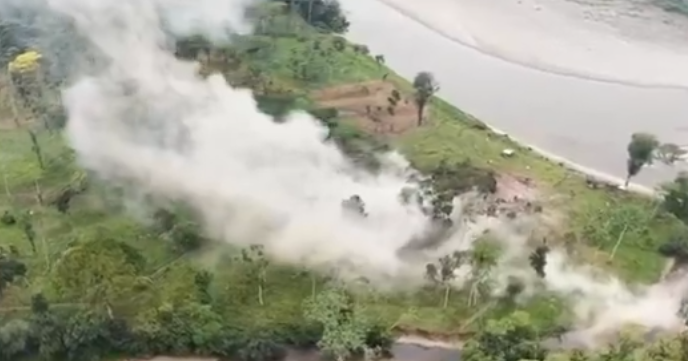
In a significant escalation of anti-drug efforts in South America, U.S. and Ecuadoran military forces have conducted coordinated military strikes within Ecuador’s borders, marking a notable expansion of American military involvement in the region’s fight against organized crime. According to an official statement from U.S. Southern Command (SOUTHCOM), these joint operations represent a new chapter in the ongoing battle against drug trafficking organizations that have transformed Ecuador from one of Latin America’s safest nations into one of its most dangerous in just a few short years. The announcement, made public through social media channels, included dramatic video footage showing multiple targets being destroyed in explosive strikes, though specific details about casualties were not immediately disclosed by military officials. This operation was carried out under the direction of Pentagon chief Pete Hegseth, with SOUTHCOM Commander General Francis Donovan overseeing the execution of what officials described as “lethal kinetic operations” against organizations that have been formally designated as terrorist groups by the United States government.
The Strategic Targets and Mission Objectives
The military strikes specifically targeted a training camp operated by a dissident faction of the FARC guerrilla group, located in Ecuador’s northeastern province of Sucumbios, which sits along the volatile border region with Colombia. Ecuador’s President Daniel Noboa, a 38-year-old right-wing leader who has positioned himself as a close ally of President Trump, revealed that the operation successfully destroyed the hideout of a significant cartel leader known as “Mono Tole,” who commands the Border Commandos (CDF). The president’s Instagram post, accompanied by striking video footage of a house exploding in a densely forested area, emphasized that the raid also eliminated a crucial training facility used by drug traffickers to prepare their operatives. This strategic location near the Colombian border is particularly significant, as it represents a critical corridor for drug smuggling operations that funnel narcotics from production centers in Colombia and Peru through Ecuador’s ports and out to international markets. The collaboration between U.S. and Ecuadoran forces demonstrates a unified approach to dismantling these networks at their operational bases, rather than simply intercepting their products in transit.
High-Level Cooperation and Political Alignment
The operation reflects the deepening security partnership between the United States and Ecuador under President Noboa’s administration, which began when he took office in 2023. Chief Pentagon spokesman Sean Parnell emphasized in his statement that these targeted actions were conducted at Ecuador’s request, highlighting the collaborative nature of the engagement and the shared objectives between the two nations in dismantling what officials term “narco-terrorist networks.” The Trump administration has made combating drug trafficking in the Western Hemisphere a priority, with Secretary Hegseth leading efforts to unite regional partners in a coordinated campaign to “detect, disrupt, and destroy” designated terrorist organizations that fuel violence and corruption throughout the Americas. President Noboa has emerged as one of Washington’s strongest regional allies in this fight, publicly declaring that criminal organizations had too long operated with impunity, crossing borders and moving drugs, weapons, and violence without facing meaningful consequences. Earlier in the week, Noboa held substantive discussions in Ecuador’s capital city of Quito with General Donovan and Mark Schafer, who heads U.S. Special Operations in Central and South America and the Caribbean, where they hammered out details regarding information sharing protocols and operational coordination at Ecuador’s airports and seaports—critical infrastructure that cartels have exploited for their smuggling operations.
The Scope of Ecuador’s Drug Trafficking Crisis
The scale of the drug trafficking problem flowing through Ecuador is staggering and helps explain why such aggressive military action has become necessary from the perspective of both governments. Approximately 70% of cocaine produced by Colombia and Peru—the world’s first and second-largest cocaine producers respectively—is shipped through neighboring Ecuador, making the country an absolutely critical transit point in the international drug trade. This geographical reality has transformed Ecuador into a battleground where competing criminal organizations wage brutal turf wars for control of smuggling routes and port access. The violence unleashed by these conflicts has been devastating for ordinary Ecuadorans, as their country has experienced a dramatic security collapse over just a few years, going from being recognized as one of Latin America’s safest nations to ranking among its most deadly. The cartels’ use of Ecuador’s infrastructure, combined with corruption and the challenge of controlling remote border regions, has created what officials describe as a national security crisis that threatens not just Ecuador’s stability but regional security throughout South America. The presence of dissident FARC factions—remnants of Colombia’s decades-long guerrilla conflict who have transformed into drug trafficking organizations—adds an additional layer of complexity, as these groups bring military-style organization and training to the criminal enterprises.
Broader Military Campaign and Recent Operations
The joint strikes announced this week are part of a broader, intensifying military campaign against drug trafficking organizations operating in and around Ecuador. Just last week, Ecuadoran forces successfully located and sank a “narco sub”—a semi-submersible vessel used by smugglers to transport drugs while evading detection—near the country’s northern border, demonstrating the varied tactics being employed in this crackdown. Ecuador’s Defense Ministry reported Wednesday that military operations had discovered a clandestine camp and another narco-vessel in the Cayapas-Mataje mangrove forest, a remote coastal area where smugglers had been preparing equipment for illicit activities away from government oversight. These mangrove forests, with their dense vegetation and maze-like waterways, have traditionally provided ideal concealment for criminal operations, making their discovery and disruption significant achievements for security forces. Beyond Ecuador’s borders, the U.S. military has been conducting its own complementary operations, including a strike on Sunday in the eastern Pacific Ocean that resulted in the deaths of six men aboard what officials described as a drug-smuggling vessel. General Donovan praised the collaborative efforts, calling the operation “a strategic success for all nations in the Western Hemisphere committed to disrupting and defeating narcoterrorism,” suggesting that similar coordinated actions may become more common as regional governments align their security strategies.
Looking Forward: Implications and Concerns
These military operations represent a significant policy development with far-reaching implications for U.S. engagement in Latin America and the evolution of drug war strategies. The willingness of the United States to conduct “lethal kinetic operations” inside a partner nation, even at that government’s request, marks an expansion of American military involvement in the region that some observers may view with concern, given the historical legacy of U.S. interventions in Latin America. Supporters of this approach argue that the threat posed by powerful, well-armed criminal organizations that effectively control territory and challenge state authority justifies aggressive military responses that go beyond traditional law enforcement methods. The designation of these groups as “terrorist organizations” rather than simply criminal enterprises reflects this shift in thinking and provides legal frameworks for military action that wouldn’t be available if they were treated purely as law enforcement matters. For President Noboa, these operations offer an opportunity to demonstrate decisive action against the violence plaguing his country, though he faces the challenge of ensuring that military strikes translate into lasting security improvements rather than simply scattering criminal networks to new locations. The success of this strategy will likely depend on whether the increased military pressure can be sustained over time and whether it’s accompanied by efforts to address the underlying conditions—including poverty, corruption, and limited economic opportunities—that make drug trafficking attractive to many in the region. As Ecuador continues to work closely with U.S. forces, the coming months will reveal whether this militarized approach can genuinely turn the tide against the cartels or whether it represents another chapter in the decades-long drug war that has yet to achieve its ultimate objectives.